Land drainage
Land drainage: water arriving on a property follows one of two basic paths: infiltration into the soil, or runoff across the surface toward the nearest low point. Every drainage problem is really about managing the balance between those two paths. Soil type, slope, and how saturated the ground already is all determine that balance.
Tight clay soil and already-saturated ground push more water into runoff. Sandy, well-drained soil and gentle slopes let more water soak in before it becomes a problem.
Once on the surface, water moves downhill by gravity toward the lowest point, so a house or yard in a natural low spot, or one receiving runoff from a larger area upslope, is more prone to trouble than a similar property on a well-drained slope. Before requesting work, describe where water enters, where it collects, whether the ground dries between storms and which nearby structures or access routes are affected.
| Water pathway | What affects it | Assessment or possible approach |
|---|---|---|
| Infiltration | Soil type, saturation level | Assess soil, loading, water source and whether infiltration is feasible |
| Surface runoff | Slope, concentrated flow paths | Swales, regrading, culverts |
| Subsurface flow | Water table, soil layering | Assess groundwater, interceptable flow and a suitable lawful outlet |
General framework for how surface and subsurface water movement determines the right drainage intervention.
Infiltration versus runoff
Infiltration is water soaking into the soil, where it either gets absorbed by plant roots, evaporates back out, or continues moving downward and laterally through the soil profile as subsurface flow. Runoff is water that doesn't infiltrate fast enough and instead moves across the surface, gathering volume and speed as it travels downhill.
The split between the two isn't fixed. It changes with soil saturation, so a storm on already-wet ground produces far more runoff than the same storm on dry soil, since the ground's infiltration capacity is already partly used up. This is why drainage problems often cluster during and after periods of sustained wet weather instead of a single storm.
Why gravity determines where problems show up
Surface water always moves toward the lowest available point, gathering volume as it travels, so a house sited in a natural low spot, or one that sits downhill from a larger drainage area, receives more water than its own footprint would suggest, concentrating runoff from land well beyond the property line.
This concentration effect is often the real explanation behind a wet yard or basement that seems disproportionate to local rainfall. It's not that more rain fell there, but that water from a wider surrounding area is being funneled toward that low point by the land's overall shape.
Match the work to the water pathway
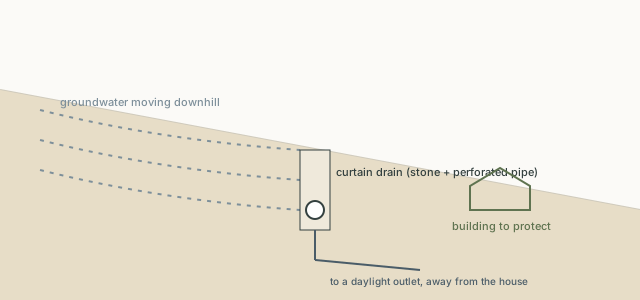
Regrading changes the surface slope. A swale carries surface runoff, while an interceptor drain needs groundwater that it can intercept and a suitable outlet. Identify the water source and where it can lawfully discharge before selecting either approach.
At a driveway crossing, inspect the inlet, pipe and outlet together. A larger pipe will not resolve an outlet blocked by sediment or a crossing that needs a different alignment.
Four conditions to check before choosing a drain
Soil texture, slope, watershed position and the seasonal water table determine where rain goes. Clay admits water more slowly than sand; a low point can collect runoff from land far outside the wet patch. A shallow water table leaves little storage in the soil.
Watch the property during rain and again after it dries. A downspout discharge, uphill seep and broad saturated hollow need different fixes. A drain needs a lawful outlet and cannot lower a regional water table merely by collecting water in already saturated ground.
Read soil, grade, runoff and groundwater together
Whether a property has naturally good or bad drainage comes down to four interacting factors. Soil composition matters first: sandy soil drains far faster than clay. Slope matters too: steeper grades move surface water away more quickly than flat ground.
Watershed position counts as well, since a natural collection point faces more water than its own footprint generates. And depth to the water table matters, since a shallow one leaves less capacity to absorb water before saturating. These factors interact.
A flat property on clay at the low point of a watershed combines most of the risks at once, while a sloped, sandy property positioned high in its local drainage area combines most of the advantages. Knowing which factor dominates on a specific property is what separates a fix that works from one that treats a symptom without addressing why water behaves the way it does there.
Soil composition determines how fast water can infiltrate. Sandy or gravelly soil accepts water quickly, while dense clay resists it, forcing more water to become surface runoff instead of soaking in. This is often the most visible factor, since a property's soil type is relatively easy to observe or test directly.
Lake-bed clay in the Champlain lowlands can hold water near the surface, while a dense layer beneath upland soil can perch it above the deeper groundwater. Soil mapping helps locate these possible constraints. It does not decide whether surface grading will work on a particular property: observe the wet layer, the contributing runoff and the proposed outlet before choosing a drainage method.
A property's position within its local watershed, whether it sits high on a slope, in the middle, or at a natural low point collecting runoff from a much larger surrounding area, often matters more than anything happening on the property itself, since a well-drained low point can still flood if it's receiving concentrated flow from far upslope.
Depth to the seasonal high water table sets a hard limit on how much water the soil can absorb before it saturates completely. A property with a shallow water table has less buffer capacity, meaning even modest rainfall can push conditions toward saturation faster than on a property with a deeper water table.
These four factors interact instead of operating independently: a flat, clay-soil property at a watershed low point with a shallow water table combines most drainage risk factors simultaneously, which explains why some properties seem to struggle no matter what surface-level fixes are attempted.
Conversely, a sloped, sandy property positioned high in its local drainage area with a deep water table has natural advantages that make drainage problems relatively unlikely even without any specific intervention. Recognizing where your property falls on this spectrum is the starting point for any effective drainage plan.
How land drainage works: service details and questions
How land drainage works
Water follows the slope, so drainage works by intercepting or redirecting that path
The four factors behind a property's natural drainage
Sandy soil drains fast; clay resists infiltration and increases runoff
A low point collects runoff from a much larger surrounding area
Depth to seasonal water table
A shallow table limits how much water soil can absorb before saturating
General framework for assessing what determines a site's inherent drainage behavior
Soil and slope: the two most immediate factors
Slope determines how quickly surface water that doesn't infiltrate moves away versus lingering. A property with even a modest, consistent grade away from structures sheds water far more effectively than a flat property, where water has nowhere obvious to go and simply pools
Which problem, which cause, which fix
Land drainage comes down to a handful of problems. Match the symptom to the cause and then to the page that covers the fix. Each row below points at a section of this site so you can go straight to the one that fits your yard
Vermont adds a reading of the ground: lake-bed clay, compact till and valley groundwater can constrain drainage differently. A mapped shallow-water-table category describes the survey area, not the depth observed on a particular parcel. Have the site evaluation identify the actual limiting layer, groundwater and discharge route before deciding that a surface drain or other correction will work.
Watershed position and water table: the less obvious factors
How these factors combine on a real property
Problem, likely cause, fix
Water pools on a flat lawn
Regrade or swale; see swales and regrading
Seepage from a slope above the yard
Perched water on till
Curtain drain; see curtain and interceptor drains
Yard stays wet all spring
High seasonal water table
Surface fixes will not fix it; see wet yard
Water overtops a driveway
Undersized culvert or plugged inlet
Resize or clean the culvert; see culverts and ditching
Stone apron or headwall; see headwalls and outlets
Vermont soil types as mapped by USDA NRCS; fixes as described on the linked pages of this site
USDA NRCS Web Soil Survey
What makes some properties naturally drain better than others?
Four interacting factors: soil composition, slope, position within the local watershed, and depth to the seasonal water table. A property strong in all four rarely has drainage problems
Can a property have good soil but still have drainage problems?
Yes. Good, well-draining soil helps. But a property sitting at a watershed low point can still receive more surface water than even good soil can absorb, especially during sustained wet weather
How do I find out if my property is at a watershed low point?
Observing where water flows during and after rain, looking at the broader landscape shape around your property, or having a professional assess your site's position within its local drainage area all help identify this
Does a shallow water table always mean bad drainage?
It's a significant contributing factor since it limits soil's absorption buffer, but it interacts with soil type and slope. A shallow water table on well-draining, sloped ground is less problematic than the same table under flat clay
Can I improve my property's natural drainage factors?
Slope can be adjusted through regrading. Some watershed-related runoff can be intercepted or redirected too. But soil composition and water table depth are largely fixed characteristics of a site that fixes have to work around
Why does my flat yard hold water longer than my sloped neighbor's?
Slope is one of the most direct factors in how quickly surface water moves away. Flat ground gives water nowhere obvious to go. It lingers and pools instead of draining off
Is clay soil always bad for drainage?
It infiltrates slowly, which pushes more water toward runoff, but clay soil combined with good slope and a favorable watershed position can still perform reasonably. It's rarely one factor alone that determines the outcome
How does upslope land use affect my property's drainage?
Development, clearing, or paving on land upslope from you can increase the runoff volume reaching your property, even if nothing about your own land or its natural factors has changed
Can a professional assess these four drainage factors for my property?
Yes. A drainage or excavation professional can evaluate soil, slope, watershed position and water table depth together to explain why your property behaves the way it does and what interventions would help
Does the season affect how these drainage factors play out?
Yes. The water table rises seasonally, particularly during Vermont's spring thaw, temporarily reducing soil's absorption buffer regardless of the property's underlying soil type or slope
Is it worth testing my soil before planning a drainage fix?
Yes. Knowing your specific soil's infiltration rate helps determine whether a fix should focus on managing surface runoff, improving infiltration, or intercepting subsurface flow, rather than guessing at a generic solution
Can new construction change how these factors affect my property?
Yes. Adding impervious surfaces like a driveway or roof area reduces infiltration and increases runoff volume on your own property, effectively worsening one of the four factors even if the underlying land hasn't changed
Land drainage: water pathways and lawful outlets
Does soil type affect how much drainage work my property needs?+
Yes, quite a bit. Tight clay soil infiltrates slowly and produces more runoff, while sandy, well-drained soil absorbs more water before it becomes a surface problem, which changes what kind of drainage intervention helps.
Can water from my neighbor's property cause drainage problems on mine?+
Yes. Surface water doesn't respect property lines. A low spot on your land can receive concentrated runoff from a much larger area upslope, including neighboring properties.
What's the first step in diagnosing a drainage problem?+
Start with the water itself. Understand whether the trouble is surface runoff or subsurface flow, and trace where it's coming from. This determines which category of fix, from regrading to a French drain, applies.
Does slope matter more than soil type for drainage?+
Both matter and interact. A steep slope on tight soil produces fast runoff, while a gentle slope on the same soil gives water more time to infiltrate. The combination determines actual behavior.
Can drainage problems get worse over time without any change to my property?+
Yes, this happens often. Changes on neighboring or upslope properties, like new construction or cleared land, can increase the runoff reaching your property even if nothing on your own land has changed.
Is standing water always a sign of a drainage problem?+
Not necessarily right after heavy rain, which can temporarily exceed any soil's infiltration capacity. But water that lingers for days after rain has stopped points to an underlying drainage issue worth addressing.
What's a swale and how does it help with drainage?+
A shallow, graded channel that redirects surface runoff along a controlled path instead of letting it pool or flow uncontrolled. It works directly on the runoff pathway instead of the soil itself.
Why do some Vermont properties have worse drainage than others nearby?+
Local variation in soil type, slope, and position relative to the broader watershed all differ even between nearby properties, so drainage solutions need to be specific to a site rather than generic.
Should I hire a professional to diagnose a drainage problem?+
For a problem affecting a structure's foundation or causing repeated significant flooding, yes. A professional can trace the actual water pathway instead of guessing, which avoids paying for a fix that addresses the wrong part of the system.