Well water testing
Well water testing for a Vermont private supply starts with the source, the intended use and the analyses recommended for that situation. Owners arrange the testing. Vermont Health recommends annual bacteria testing and the Homeowner Testing Package every five years; the package covers bacteria, inorganic chemicals and gross alpha, while PFAS, radon and other circumstance-specific analyses need separate selection.
Confirm the order with the laboratory. A new source, rental property, purchase, flood or suspected contamination can call for requirements or follow-up beyond that routine owner-occupied-home schedule. Follow the laboratory’s collection instructions.
The report should identify each result, units, reporting limit and the relevant Health recommendation, which may differ from a federal public-water benchmark. If Health advises against using the water, follow that advice while arranging confirmation, investigation or treatment; waiting for another sample does not make continued exposure acceptable. Keep the results and corrective-work records together.
| Test | Routine recommendation |
|---|---|
| Bacteria, Kit A | Every year |
| Inorganic chemicals, Kit C | Every five years |
| Gross alpha radiation, Kit RA | Every five years |
| Radon or PFAS | Separate tests selected for the concern |
Current Vermont Health schedule; additional tests depend on the source and circumstances.
What to test for and why it varies by type
Bacteria testing (total coliform and E. coli) is the baseline every well owner should do annually, since bacterial contamination can appear suddenly, after flooding, a damaged well cap, or changes in nearby land use, and poses an immediate health risk if present.
Vermont's bedrock naturally contains arsenic, uranium and radon in many areas, along with iron, manganese and hardness minerals. Hardness and iron commonly cause aesthetic problems; manganese above Vermont’s 0.300 mg/L advisory is a health concern. These geological contaminants change more slowly than bacteria but still warrant periodic re-testing, since levels can shift over years.
How often to test
Annual bacteria testing is the widely recommended minimum, ideally done in spring when snowmelt and runoff are more likely to reveal contamination that a summer test might miss. Vermont Health recommends the Homeowner Testing Package every five years. Order additional tests when the source, surrounding land use or a prior result calls for them.
Specific events should trigger testing outside the normal schedule: after any flooding near the well, after well repair or new construction nearby, if water quality noticeably changes in taste, odor or appearance, or before buying a property with an existing well.
What to do with a concerning result
Follow the contaminant-specific precautions immediately while arranging laboratory follow-up. Follow Health’s advice on using the water.
Arrange the recommended follow-up sample. Confirmation testing does not justify continued exposure while waiting.
The response depends on the contaminant. For detected bacteria, use safe replacement water or the recommended boiling precautions, investigate and repair entry pathways, disinfect and retest. Chemical contamination needs its own treatment; boiling does not remove dissolved arsenic or uranium.
Choosing the Vermont testing panel
Ask the laboratory for the Vermont recommended private-water panel, and identify whether the source is a drilled well, dug well or spring. Bacteria, arsenic, uranium and radon can be present without a useful warning from taste or appearance.
Property history can justify additional tests: agricultural use raises a nitrate question, while a former fuel or industrial site can call for tests selected for that contamination source. Iron, manganese and hardness testing helps investigate staining and scale. Have the lab or Health Department interpret health-related results before choosing treatment.
Choose the panel from both geology and land use
What to test for in Vermont . Vermont's specific geology and land use history make certain contaminants more relevant here than a generic national testing list would suggest: arsenic and uranium occur naturally in some Vermont bedrock and can leach into well water at levels of health concern. Radon gas can dissolve into water from the same bedrock sources.
Bacteria (coliform and E. coli) can enter any well regardless of geology through surface contamination or construction issues. Iron and hardness can affect taste, staining and plumbing; elevated manganese can also have health effects, so the laboratory value needs comparison with Vermont Health guidance. Beyond this core list, a property with a history of nearby agricultural use might warrant testing for nitrates, while one near a former industrial site or old gas station could reasonably test for volatile organic compounds.
But for most Vermont homeowners without a specific known risk factor, start with Vermont Health’s homeowner testing package for bacteria, inorganic chemicals and gross alpha, then add tests for specific concerns; radon and PFAS are separate tests.
Arsenic and uranium are both naturally occurring in certain Vermont bedrock formations, particularly in some areas of the state more than others, and can leach into groundwater at levels the state considers a health concern. Neither has any taste, odor or color. Only a test tells you.
Radon gas, also from bedrock sources, can dissolve into well water and later be released into indoor air during showering or other water use, adding an inhalation exposure pathway distinct from simply drinking the water, so a separate radon-water test may be appropriate; it is not part of the standard homeowner package.
Bacteria contamination , total coliform and E. coli specifically, isn't tied to Vermont's geology the way arsenic and radon are. It can enter any well through surface water infiltration, a damaged or improperly sealed well cap, or nearby septic or agricultural runoff, so it needs annual testing regardless of location.
Iron and hardness can cause staining, odd taste and scale. Manganese needs separate attention because elevated concentrations may harm the nervous system. Treat the measured concentration and the current Vermont Health recommendation as the decision point; staining alone cannot establish whether a health advisory is exceeded.
A property with nearby agricultural land, particularly with a history of fertilizer or manure application, is reasonable to test for nitrates, since agricultural runoff is a known nitrate source that can affect nearby wells, especially shallower ones.
A property near a former gas station, industrial site, or other known contamination source could reasonably warrant testing for volatile organic compounds or other site-specific contaminants. This is a case where knowing your property's history and surroundings should inform a testing panel beyond the standard list.
Arsenic, uranium and radon from natural bedrock, bacteria from surface or construction issues, and iron, manganese and hardness need interpretation alongside the rest of Vermont Health’s homeowner package; manganese is not solely an aesthetic concern.
Order and interpret a separate PFAS analysis
This means finding out whether PFAS is a relevant concern for your specific well falls on the owner: checking whether your property sits within a documented state investigation area, and if you are uncertain or nearby, testing proactively through a certified lab instead of waiting for a state program to reach your address.
Because PFAS is a family of related chemical compounds rather than one single substance, a comprehensive PFAS panel from a certified lab, instead of a single-compound screening test, gives the most reliable basis for deciding whether treatment is warranted and what kind.
Check Vermont DEC's current PFAS program page for the up-to-date list of identified investigation and testing areas, since these can expand as new contamination is documented.
PFAS refers to per- and polyfluoroalkyl substances, a family of persistent 'forever chemicals' historically used in firefighting foam and various industrial applications, so contamination often comes from industrial or firefighting-training sites.
No. PFAS contamination has no taste, odor or visible sign, so only testing, not sensory judgment, tells you whether it's present.
Activated carbon filtration and reverse osmosis are treatment approaches to compare against the actual compounds and concentrations found; ask for documented performance, maintenance requirements and follow-up testing.
Cost varies by lab and how comprehensive a panel you order. A certified lab offering a full PFAS compound panel is more informative than a narrow single-compound screen, and pricing should be confirmed directly with the lab.
Not always. Confirm specifically that PFAS is included, since the recommended Vermont Homeowner Testing Package does not include PFAS analysis unless an additional test is selected.
Vermont DEC's drinking water and groundwater protection program is the state resource for current PFAS testing program areas and guidance. A certified private lab can test any well regardless of location.
What the Bennington retesting established about the sampled wells
PFAS, a family of persistent chemicals historically used in firefighting foam and some industrial processes, is a confirmed contamination concern in specific parts of Vermont, including the Bennington region. Bennington College’s March 17, 2025 research analyzed PFOA in 4,797 groundwater samples from 698 unique wells taken between 2016 and 2024. The dates describe the study dataset; they do not mean testing continued through 2026 in that analysis.
The researchers reported 239 wells with increasing PFOA levels and 84 with decreasing levels. Among those 323 wells classified in the summary as increasing or decreasing, 239 divided by 323 is about 74%, which is approximately three quarters.
That is not a claim that three quarters of every Vermont well are worsening, nor a result for an untested house. The study supports continued property-specific testing rather than assuming the contamination is only historical.
DEC’s PFOA contamination response provides community information for Bennington, North Bennington, Shaftsbury and Pownal, including maps, testing and bottled-water information. Other sites are handled separately.
Check the current program area before assuming your property is or is not included, and ask whether its particular well qualifies for an offered sampling or interim-water arrangement. A town name alone does not establish eligibility.
Unlike routine bacteria testing, a separate PFAS analysis needs to be selected with the laboratory unless it is already part of the property’s investigation or permit requirements. The state’s response has included targeted testing near known or suspected sources. Finding out whether PFAS is a concern for a specific well therefore includes checking the current investigation area and any requirements attached to that supply, rather than waiting for a general testing program to reach the address.
A confirmed PFAS result needs comparison with Vermont Health’s current guidance. Activated carbon or reverse osmosis are treatment approaches to evaluate, with selection matched to the specific compounds and levels the test identifies.
Whole-home and single-tap treatment have different coverage and maintenance duties. Ask the provider to state what water will be treated, which compounds the equipment is documented to remove and how follow-up testing and filter replacement will be handled.
Ordering a PFAS panel outside a response program
PFAS refers to per- and polyfluoroalkyl substances, a family of persistent chemicals historically used in firefighting foam and various industrial applications. Contamination can be associated with industrial or firefighting-training sites.
PFAS does not announce itself through taste, odor or appearance: only testing tells you whether it is present. Bennington County is a documented concern area, but an address elsewhere in Vermont is not proof that its well is unaffected.
Is PFAS covered by a standard comprehensive well water panel? Not always. Confirm specifically that PFAS is included, since some comprehensive panels focus on bacteria and geological contaminants without PFAS unless it is separately requested or added.
Cost varies by lab and how comprehensive a panel you order. Ask a certified laboratory which PFAS compounds and reporting limits its analysis covers, what containers and sampling procedure it supplies, and what the completed analysis will cost.
How do I know if my property is in a PFAS concern area? Check Vermont DEC’s current PFAS program page for the up-to-date list of identified investigation and testing areas, since these can expand as new contamination is documented.
Free testing has been offered in specific identified concern areas; availability depends on whether the property falls within a current program and meets its conditions. Outside a response program, a homeowner can arrange testing through an appropriate laboratory instead of waiting for a state investigation to reach the address.
PFAS concern alongside routine private-well testing
If your property is not near a documented industrial site, firefighting training area, or other suspected PFAS source, and is not in a current state investigation area, routine testing still includes bacteria and the geological contaminants recommended by Vermont Health. Proactive PFAS testing is also an option if you have any reason for concern. Keep the ordinary testing schedule while discussing a separate PFAS panel with the laboratory; a routine result does not cover compounds that were not analyzed.
DEC’s PFOA response covers Bennington, North Bennington, Shaftsbury and Pownal, with bottled water and well testing offered in affected neighborhoods under the program’s conditions. Other sites are handled one at a time.
Check Vermont DEC’s current PFAS program page for the up-to-date list of active testing areas before assuming your property is or is not included. These offers depend on the property and investigation; they are not statewide entitlements to a free test.
Match the PFAS analysis to the treatment decision
Because PFAS is a family of related chemical compounds rather than one single substance, ask which compounds a laboratory panel will report instead of relying on the name of a single-compound screening test. A comprehensive PFAS panel from a certified lab gives more compound-specific results for comparing treatment options, but the detection limits and sampling procedure still matter. Give the treatment provider the laboratory report with compound names, units and reporting limits, rather than a verbal statement that the water passed a PFAS test.
Why an older PFAS report may use a different benchmark
Vermont's 2020 public-water compliance report described a drinking water standard of 20 parts per trillion for the combined total of five PFAS: PFOA, PFOS, PFHxS, PFHpA and PFNA. Current Vermont Health guidance is stricter for two of them, with individual limits of 4 parts per trillion each for PFOA and PFOS. That historical comparison helps explain older laboratory and treatment paperwork; it is not the current decision rule for a private-well result.
Vermont Health's guidance, updated January 15, 2026, now lists the six-PFAS framework, including individual limits and the grouped hazard index. Compare an old report with that current guidance instead of treating a former five-compound pass as assurance that the water meets today's recommendations.
Iron, manganese and hardness: service details and questions
Iron, manganese and water hardness are among the most common well water issues in Vermont, all originating from minerals naturally present in the state's bedrock and soil, and while none poses a direct health risk at typical levels, each causes real, noticeable problems: iron causes reddish-brown staining on fixtures and laundry, along with a metallic taste. Manganese produces similar but darker, black-to-brown staining and can affect taste too.
And hardness, dissolved calcium and magnesium, causes scale buildup in pipes and appliances, reduces soap effectiveness, and can shorten water heater lifespan over time. Because these three often occur together in varying combinations, a test that identifies the specific level of each is essential before choosing treatment, since the right system differs meaningfully depending on which mineral, and how much, is present
A softener addresses hardness specifically but does little for iron or manganese, while iron and manganese filtration is a separate category. Matching treatment to actual results avoids paying for the wrong solution
Iron, manganese and hardness: symptoms and treatment
A water softener uses an ion exchange process specifically designed to address hardness minerals, but it does little to nothing for iron or manganese, which require different treatment approaches. Often oxidation and filtration systems designed specifically for those minerals
Iron, manganese and hardness: levels, effects and treatment
Orange stains, metallic taste
Oxidizing filter, or water softener at low levels
Black staining; health concern at high levels, especially for infants
Oxidizing or greensand filter, sized to the result
Over 120 mg/L as CaCO3
Scale in pipes and heaters, poor lathering
EPA secondary drinking water standards; USGS hardness scale; Vermont Department of Health test kit prices. Treatment choices depend on the full test result
Vermont Department of Health, how to test your drinking water
; EPA secondary drinking water standards
No. Neither poses a direct health risk at typical levels found in well water. They're primarily aesthetic and functional issues causing staining and taste problems instead of safety concerns
What causes hard water in Vermont wells?
Dissolved calcium and magnesium minerals, naturally present in the state's bedrock and soil, cause water hardness. Levels vary considerably by location depending on local geology
Does a water softener remove iron and manganese too?
No. A standard water softener is designed specifically for hardness and does little for iron or manganese, which require separate oxidation and filtration treatment systems
How do I know if I have iron, manganese or hardness problems?
A water test identifies the specific levels of each present in your well, which is essential before choosing treatment, since the three often occur together in varying combinations
What to test for in Vermont: service details and questions
Vermont's specific geology and land use history make certain contaminants more relevant here than a generic national testing list would suggest: arsenic and uranium occur naturally in some Vermont bedrock and can leach into well water at levels of health concern. Radon gas can dissolve into water from the same bedrock sources. Bacteria (coliform and E. coli) can enter any well regardless of geology through surface contamination or construction issues.
And iron, manganese and hardness are widespread nuisance minerals affecting taste, staining and plumbing instead of posing direct health risks. Beyond this core list, a property with a history of nearby agricultural use might warrant testing for nitrates, while one near a former industrial site or old gas station could reasonably test for volatile organic compounds
But for most Vermont homeowners without a specific known risk factor, the core panel of bacteria, arsenic, uranium and radon, plus iron, manganese and hardness, covers what's most likely to matter
Vermont well contaminants by relevance
Natural bedrock, dissolves into water
Bacteria (coliform, E. coli)
Surface contamination, well condition
Every well, any geology
Wells with taste, staining or scale issues
Industrial or fuel contamination
Properties near known contamination sources
General guidance reflecting Vermont's known geological and land-use contaminant risks for private wells
The Vermont-specific geological contaminants
Radon gas, also from bedrock sources, can dissolve into well water and later be released into indoor air during showering or other water use, adding an inhalation exposure pathway distinct from simply drinking the water, which is part of why it's tested alongside arsenic and uranium
Contaminants that can affect any well
Iron, manganese and hardness are widespread nuisance issues across Vermont that don't pose direct health risks at typical levels but cause staining, odd taste, and plumbing scale buildup. Worth testing for if you notice these symptoms, even though they're a quality-of-life instead of safety concern
When to test beyond the core list
What contaminants are most relevant to Vermont well water?
Arsenic, uranium and radon from natural bedrock, bacteria from surface or construction issues, and iron, manganese and hardness as widespread nuisance minerals form the core Vermont-relevant testing panel
Why is arsenic a concern in Vermont well water specifically?
Vermont bedrock in certain areas naturally contains arsenic that can leach into groundwater at levels of health concern, with no taste or odor to warn you. Only a test tells you
Do I need to test for radon in my well water?
It's worth including, since radon gas from the same bedrock sources as arsenic and uranium can dissolve into well water and later release into indoor air during water use
Should I test for nitrates in my Vermont well?
It's worth adding if your property is near agricultural land with a history of fertilizer or manure application, since runoff is a known nitrate source affecting nearby wells
Is bacteria testing different from geological contaminant testing?
Yes. Bacteria can enter any well through surface contamination or a damaged well cap regardless of geology, so it needs annual re-testing instead of a one-time check
Do I need to test for iron and manganese if my water tastes fine?
Not urgently. These are nuisance minerals affecting taste, staining and plumbing rather than posing direct health risks. Testing is more relevant if you're already noticing symptoms
What contaminants should I test for near an old gas station?
Volatile organic compounds are the relevant concern for a property near a former fuel or industrial site, which is a case where site history should expand your testing beyond the standard panel
Is one test enough to know my well is safe long-term?
No. Bacteria needs annual re-testing since it can appear suddenly, and geological contaminants should be re-checked every few years even though they change more slowly
Does every Vermont well have arsenic or uranium?
No. Levels vary significantly by specific location and bedrock formation, which is exactly why testing your specific well is necessary instead of assuming based on general regional risk
What's the health concern with drinking water that has high arsenic?
Long-term exposure to elevated arsenic levels is associated with increased health risks, so the state sets a recommended action level and why testing and treatment matter for affected wells
Can I skip testing for contaminants that aren't common where I live?
It's reasonable to prioritize the core Vermont panel first. But a comprehensive test at least once still gives you a fuller baseline picture instead of assuming your specific well matches regional averages
How do I decide which contaminants to prioritize testing for?
Start with the core Vermont panel, bacteria, arsenic, uranium, radon, then add site-specific tests like nitrates or VOCs if your property's history or surroundings suggest a particular added risk
PFAS in Vermont well water: service details and questions
PFAS, a family of persistent 'forever chemicals' historically used in firefighting foam and some industrial processes, is a confirmed, active contamination concern in specific parts of Vermont, including the Bennington region. Bennington College’s analysis of private-well samples between 2016 and 2024 identified rising PFOA in 239 wells and declining levels in 84; about three quarters of those 323 classified wells were increasing. This is not a result for every well rechecked or for an untested address.
The state offers well testing in identified concern areas, including Bennington and Shaftsbury, under the investigation’s conditions. Unlike bacteria or the geological contaminants covered elsewhere on this site, PFAS testing needs separate selection with the laboratory unless your property falls inside a state-identified investigation or another applicable requirement.
That makes knowing whether you are near a documented concern area, and testing proactively if you are unsure, a practical step. PFAS does not announce itself through taste, odor or appearance the way some contamination does.
PFAS in Vermont well water: what's confirmed
Most documented concern area
Bennington-region analysis: 2016–2024 samples; increasing PFOA in 239 wells and decreasing levels in 84
Pownal and other locations DEC has identified: check DEC's current program page
Statewide testing mandate for private wells
None: testing is homeowner-initiated outside state investigation areas
Common treatment if confirmed
Activated carbon or reverse osmosis, matched to the specific compounds and levels found
Bennington College published the analysis in March 2025. Confirm current program areas with Vermont DEC; study results do not establish contamination or testing eligibility for a specific property
Where PFAS contamination is confirmed in Vermont
Bennington College’s March 2025 analysis of samples from 2016 through 2024 identified increasing PFOA in 239 wells and decreasing levels in 84. The result concerns that sampled region and classified groups, not every well or a dataset ending in 2026.
DEC's PFOA response covers Bennington, North Bennington, Shaftsbury and Pownal, with bottled water and well testing offered in the affected neighborhoods. Other sites are handled one at a time. Check the Vermont DEC's current PFAS program page for the up-to-date list of active testing areas before assuming your property is or isn't included
Vermont's standard, the federal standard and the state's response
Vermont’s historical public-water standard was 20 parts per trillion for the sum of five PFAS. Current Vermont Health guidance lists individual limits of 4 ppt each for PFOA and PFOS, other individual limits and a grouped hazard index. Compare a private-well result with the current Health guidance and follow its advice; the fact that public-water rules regulate a different supply category is not advice to continue using contaminated water.
The state's PFOA contamination response covers Bennington, North Bennington, Shaftsbury and Pownal, with well testing and bottled water offered where contamination is found under the program’s conditions. The current investigation boundary and the property’s eligibility still need checking.
The Bennington College analysis of state samples from 2016 through 2024 identified 239 wells with rising PFOA and 84 with declining levels; those results do not supply a concentration for an untested address. Outside those areas a homeowner-ordered lab panel is a way to know the actual compounds and concentrations rather than inferring them from a town name.
Why there's no statewide testing mandate
Unlike bacteria testing, which is a widely recommended annual practice for every well owner, PFAS testing in Vermont is not required by state mandate for private wells outside identified investigation areas. The state's approach has been targeted testing near known or suspected sources instead of a universal requirement
What a PFAS result means for treatment
A confirmed PFAS result above the state's guidance level calls for point-of-use treatment. Activated carbon or reverse osmosis systems are the two approaches most commonly effective against PFAS compounds, though system selection should match the specific PFAS compounds and levels your test identifies
Vermont DEC, PFOA contamination response
; Vermont DEC, PFAS in drinking water
; VTDigger, new EPA rule and Vermont's water systems
Is PFAS a real problem in Vermont well water?
Yes. Bennington County has documented PFAS contamination in private wells, confirmed through analysis of state retesting between 2016 and 2024, and the state's response also covers North Bennington, Shaftsbury and Pownal. Bennington College’s March 2025 report identified increasing PFOA in 239 wells, alongside 84 with declining levels. That supports continued testing without asserting that every private well is worsening or that a particular property qualifies for a state sampling program.
Does Vermont require testing my well for PFAS?
No. There's no statewide mandate for private well owners to test for PFAS outside of state-identified investigation areas, so testing is the homeowner's own initiative
Is free PFAS well testing available in Vermont?
Yes, in specific identified concern areas. The state has run free testing programs in Bennington and Shaftsbury, though availability depends on whether your property falls within a current program area
What does PFAS stand for and where does it come from?
Can I taste or smell PFAS in my water?
What treatment removes PFAS from well water?
Activated carbon filtration and reverse osmosis systems are the two approaches most commonly effective, with the right choice depending on which specific PFAS compounds and levels your test identifies
Is PFAS contamination getting worse in Bennington County?
Bennington College identified 239 wells with increasing PFOA and 84 with decreasing levels in its 2016–2024 analysis. Dividing 239 by those 323 classified wells gives about 74%. This does not mean that three quarters of every Vermont well has worsening PFAS.
How much does PFAS well water testing cost?
Should I test for PFAS if I don't live in Bennington County?
If your property isn't near a documented industrial site, firefighting training area, or other suspected PFAS source, and isn't in a current state investigation area, the priority for routine testing remains bacteria and the geological contaminants covered elsewhere on this site. But proactive PFAS testing is still a reasonable choice if you have any reason for concern
Not always. Confirm specifically that PFAS is included, since some 'comprehensive' panels focus on bacteria and geological contaminants without PFAS unless it's separately requested or added
Who do I contact about PFAS testing in Vermont?
What to test for in Vermont
What to test for in Vermont well water should follow the Health Department’s current testing schedule, the source type and any specific contamination event. Do not select a panel from taste or clarity alone. Obtain the laboratory’s bottles and instructions before collecting the sample; different analyses can require different handling.
Keep raw-water and post-treatment samples clearly identified so the result answers the intended question. A bacteria result does not evaluate every chemical, and a hardness measurement does not establish that the water is safe. Ask the laboratory or Drinking Water Program about the recommended inorganic and radiological testing and any added site-specific analyses.
Flooding, repairs or a suspected nearby release can require additional action beyond routine sampling. Keep the numerical results and their units when seeking treatment advice.
Vermont: what to test before choosing a water kit
Vermont Health recommends regular bacteria, inorganic-chemical and gross-alpha testing for private sources. Use its current schedule to choose the actual kit and interval.
Manganese can be a health concern as well as a staining issue; discuss the measured concentration and the Department’s guidance before choosing treatment. Appearance cannot exclude a health-related contaminant.
Make the sample location part of the request
Tell the laboratory whether the sample will be taken before or after a treatment unit. A result from softened or filtered water answers a different question from a source sample.
If the concern involves fuel, pesticides or another possible release, describe that history and ask which additional analysis is appropriate. Do not assume the standard kit tests for every possible substance.
Arsenic, uranium and radon
Arsenic, uranium and radon: arsenic, uranium and radon all occur naturally in certain Vermont bedrock and can leach or dissolve into groundwater at levels of genuine health concern, with the specific risk varying considerably by location depending on local geology, which is exactly why testing your specific well matters more than any regional statistic. Arsenic exposure over time is linked to increased health risks including certain cancers, and Vermont has documented areas above the recommended action threshold. Uranium, similarly geological in origin, is associated with kidney effects at elevated long-term exposure.
Radon dissolved in well water poses two distinct exposure pathways: direct ingestion, and inhalation when it's released into indoor air during showers or other water use, the latter considered the more significant pathway. None of these three contaminants have any taste, odor or visible sign at concerning levels, so only laboratory testing, not any sensory check, can tell you if your well is affected.
How each contaminant gets into well water
Arsenic and uranium are present in trace amounts in many types of bedrock, and under certain geochemical conditions, related to groundwater chemistry, rock type, and other local factors, they can leach out into groundwater at levels well above what's naturally present in the rock itself.
Radon is a radioactive gas produced by the natural decay of uranium in rock and soil. It readily dissolves into groundwater passing through radon-bearing bedrock, so radon-contaminated water so often correlates with, though doesn't always match exactly, areas with elevated uranium.
The levels the standards set
Distinguish public-water standards from private-water health advice. Vermont Health advises stopping consumption above 0.010 mg/L arsenic and considering treatment between 0.001 and 0.010 mg/L. Its uranium treatment threshold is above 0.020 mg/L; citing only the federal 0.030 mg/L value misses that recommendation.
Gross alpha radiation is limited to 15 picocuries per liter, and the Health Department tells owners that a result under 5 pCi/L is not considered a health risk. These naturally occurring elements come from the bedrock, so a well drilled into the same rock as a neighbor's can test very differently.
The state's geological survey has documented elevated radioactivity in Champlain Valley bedrock wells, with Milton and Colchester named among the areas where domestic wells often read high. The Health Department's Kit C at $100 covers arsenic and uranium, and Kit RA at $45 covers gross alpha; the department recommends the full package every five years. There is no enforceable federal limit for radon in a private well's water, so test the house air first.
What the actual health risks are
Long-term arsenic exposure through drinking water is associated with increased risk of certain cancers and other health effects, so public health guidance treats even moderate elevation above the recommended action level as worth addressing instead of ignoring.
Uranium exposure at elevated levels over time is primarily associated with kidney effects, distinct from arsenic's cancer risk profile. Radon's main water-related health concern is considered to be inhalation exposure from water use, showering, running a dishwasher, rather than ingestion alone, since it releases into indoor air during these activities.
What treatment looks like for each
Treatment depends on the contaminant and water chemistry. Vermont Health lists reverse osmosis at a drinking-water faucet or whole-house equipment as options, along with contaminant-specific media. Uranium and radium require different exchange processes; a conventional softener is not a universal radioactive-contaminant treatment.
Radon in water is addressed differently, with aeration systems that release the dissolved gas before it enters the home's plumbing, or in some cases combined with treatment for the separate concern of radon in soil gas entering the house directly, which is a distinct pathway from the water-based one.
How common is arsenic in Vermont well water?
It varies significantly by location within the state depending on local bedrock geology. Some areas have documented levels above the recommended action threshold, so testing your specific well matters.
Can I taste or smell arsenic, uranium or radon in my water?
No. None of these three contaminants have any taste, odor or visible sign at concerning levels, which is exactly why laboratory testing is the only reliable way to know.
How is arsenic removed from well water?
Options include appropriately certified reverse osmosis and arsenic-specific filtration selected for the water chemistry. A point-of-use drinking-water system or whole-house treatment can be appropriate. Verify removal with a follow-up test.
How is radon removed from well water?
With an aeration system that releases the dissolved gas before it enters the home's plumbing, addressing the water-based radon source specifically.
Does boiling water remove arsenic, uranium or radon?
No. Boiling does not remove these contaminants and can concentrate some of them as water evaporates, so it is not an appropriate treatment method for any of the three.
How often should I retest for arsenic, uranium and radon?
Use the Homeowner Testing Package every five years for inorganic chemicals and gross alpha radiation. Radon is a separate test; discuss it alongside indoor-air testing and the actual results.
Does a water softener remove arsenic, uranium or radon?
It won't. A softener is built for hardness minerals only and has no effect on these three. Each needs its own treatment system, matched to what your specific testing shows.
How much does treatment for arsenic, uranium or radon cost?
It depends on the specific system required and how elevated the levels are. A water treatment professional can quote a real number once they see your actual lab results.
Bacteria and coliform
A positive total coliform result means bacteria were detected. Vermont Health says the water is unsafe to drink pending appropriate follow-up. A signal that surface contamination has found a way into the well, even if the specific species detected isn't dangerous.
A positive E. coli result is more serious, since it specifically indicates fecal contamination from human or animal waste and carries a real risk of illness if consumed, calling for immediate action: avoid drinking or cooking with the water until it's treated and retested clear. Both results point to the same underlying issue.
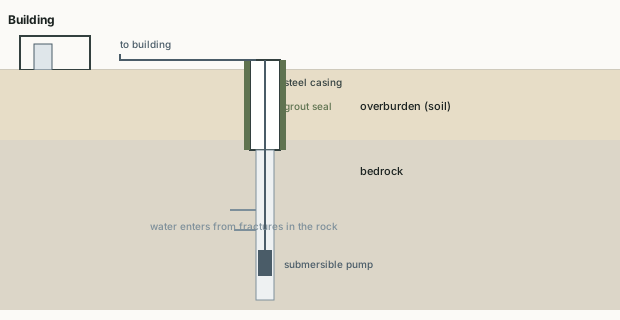
Some pathway is letting contamination into a well that should be sealed from it, commonly a damaged well cap, a crack in the casing, or nearby flooding overwhelming normal protections. The standard fix is shock chlorination, a strong chlorine solution disinfecting the well and plumbing, followed by flushing and a retest, but fixing whatever let contamination in matters just as much as the disinfection itself, or the problem will likely recur.
Coliform versus E. coli: why the distinction matters
Total coliform is a broad category of bacteria commonly found in soil, vegetation and the environment. Most types are not harmful to humans, but their presence in well water signals that something is allowing outside material into a well that should be protected from it.
E. coli is a specific type of coliform bacteria found in the intestines of humans and animals, so its presence specifically indicates fecal contamination, a much more direct and serious health concern, since it suggests actual sewage or animal waste has reached the water supply.
How contamination gets in
A damaged, cracked, or improperly sealed well cap is one of the most common entry points, since it's meant to seal the top of the well from surface water and debris. Even a small gap or crack can let contaminated surface water seep in during rain or snowmelt.
A cracked or deteriorated well casing below ground can allow shallow groundwater, potentially contaminated by nearby septic systems, agricultural runoff or other sources, to enter the well at a depth where it should be protected by the casing's seal.
The shock chlorination and retest process
Shock chlorination involves introducing a strong chlorine solution into the well and circulating it through the entire plumbing system, letting it sit for a set period to disinfect, then flushing completely until the chlorine smell and taste are gone from all fixtures.
Vermont Health recommends retesting two to three days after the chlorine smell is gone. Until follow-up results show no bacterial contamination, follow its safe-water precautions. A clear result after treatment is good news, but if contamination recurs, it points to an ongoing entry pathway, like a still-damaged well cap, that needs to be physically fixed instead of just repeatedly chlorinated away.
How does bacteria get into a well in the first place?
Most commonly through a damaged or improperly sealed well cap, a cracked well casing, or nearby flooding overwhelming normal protections that keep surface water separate from the well.
Can I do shock chlorination myself?
It's a task a capable homeowner can sometimes do with proper guidance, though many choose to hire a professional, especially if the source of contamination isn't obvious and needs investigation too.
How long after shock chlorination can I drink the water again?
Follow Health’s flushing, sampling and retest instructions and maintain its precautions until the required follow-up results are satisfactory. Smell or taste alone cannot establish drinking-water safety. Don't rely on smell alone as confirmation of safety.
Will bacteria come back after shock chlorination?
It can, if the underlying entry point, like a damaged well cap or cracked casing, isn't also fixed. Disinfection alone addresses the symptom, not necessarily the ongoing cause.
Is boiling water enough to deal with a positive coliform result?
Vermont Health recommends boiling for one minute water used for drinking, cooking, brushing teeth, ice or formula while bacterial contamination persists, or using a known safe source. Boiling does not fix the well or remove chemical contamination.
How often should I test for bacteria if I've had a positive result before?
More frequently than the standard annual test, at least initially after treatment, to confirm the fix held. Your water treatment professional can recommend a specific follow-up schedule.
Can flooding cause bacteria contamination in my well?
Yes. Flooding can overwhelm a well's normal protections, particularly if the well cap isn't watertight or floodwater rises above it, introducing surface contamination directly.
Does a new well need a bacteria test before use?
Yes. Testing a newly drilled well before regular use is standard practice, since construction itself can introduce contamination that needs to be confirmed clear before the well is relied on.
Can pets or wildlife cause bacteria contamination in a well?
Yes, indirectly. Animal waste near the well can be a source of the fecal contamination that shows up as E. coli, particularly if a damaged well cap allows surface runoff to reach the well.
Iron, manganese and hardness
Iron, manganese and hardness in well water need a laboratory result before treatment is selected. Iron commonly causes reddish staining and metallic taste; manganese can produce dark stains, while calcium and magnesium hardness leave scale and reduce soap performance. Their health significance differs: Vermont Health recommends treatment above 0.300 mg/L manganese, so a dark stain should not be dismissed as only cosmetic.
Iron’s 0.3 mg/L and manganese’s 0.05 mg/L EPA secondary standards describe aesthetic effects, not the same health threshold. A softener addresses hardness and can remove some iron or manganese within its rated conditions. Oxidation and filtration may be needed for other concentrations or forms.
Give the treatment provider the complete chemistry report, including pH and competing contaminants, then verify performance with treated-water testing. Treating a visible mineral problem does not establish that the well is free of bacteria, arsenic or other contaminants.
What each mineral does to your water and home
Iron in well water is easy to spot once you know what to look for: reddish-brown staining on sinks, tubs, toilets and laundry, sometimes a metallic taste, and in higher concentrations, visibly discolored water straight from the tap, especially after the well hasn't been used for a while.
Manganese causes a similar staining pattern but darker, black to brown instead of reddish, and like iron can affect taste. It's often found alongside iron in the same wells since both minerals share similar geological origins in Vermont's bedrock and soil.
The levels that matter
The EPA's secondary standards, which are aesthetic rather than health limits, are 0.3 mg/L for iron and 0.05 mg/L for manganese. Iron above that stains fixtures and tastes metallic. Manganese above it leaves black staining, and long-term exposure at high levels is a health concern, particularly for infants, so a result well above 0.05 mg/L is worth a treatment plan and not just tolerance.
Hardness is reported in mg/L as calcium carbonate. The USGS scale calls water soft under 60, moderately hard from 61 to 120, hard from 121 to 180 and very hard above 180. The Health Department's inorganic chemicals kit, Kit C at $100, reports iron, manganese and hardness together, and the department recommends running the full homeowner package every five years.
Why hardness is a different kind of problem
Hardness comes from dissolved calcium and magnesium instead of iron or manganese, and its effects are more about function than appearance. Scale buildup inside pipes and water heaters reduces efficiency and can shorten appliance lifespan, while soap and detergent don't lather or work as effectively in hard water.
Vermont's water hardness varies considerably by location depending on local geology, with some areas having notably harder water than others. Testing tells you where your specific well falls rather than assuming based on general regional patterns.
Matching treatment to what your test shows
A water softener uses an ion exchange process specifically designed to address hardness minerals, and can also remove some forms and concentrations of iron or manganese. Its suitability depends on the full chemistry and equipment limits; oxidation and filtration may be needed instead. Often oxidation and filtration systems designed specifically for those minerals.
Iron, manganese and hardness commonly occur together in varying combinations across Vermont wells, so testing for the specific levels of each before choosing a treatment system avoids installing an expensive softener that solves your hardness problem while leaving staining from iron or manganese completely unaddressed.
Why is my well water leaving reddish-brown stains?
This is a classic sign of iron in your well water, which is common across Vermont due to naturally occurring iron minerals in the bedrock and soil. A water test confirms the level present.
Is iron or manganese in well water dangerous to drink?
Read the measured concentration. Vermont Health recommends treatment when manganese exceeds 0.300 mg/L because of nervous-system effects.
Iron and hardness commonly cause taste, staining and scale. Their appearance does not establish whether other contaminants are present.
What's the difference between iron and manganese staining?
Iron causes reddish-brown staining, while manganese causes darker, black-to-brown staining. Both can occur together since they share similar geological origins in Vermont bedrock.
Can hard water damage my appliances?
Yes. Scale buildup from hardness minerals reduces efficiency and can shorten the lifespan of water heaters and other plumbing fixtures over time if left untreated.
How much does iron and manganese treatment cost?
Cost varies with the specific system needed and the mineral levels found in your test results. A water treatment professional can quote based on what your well shows.
Can I use a whole-house filter for iron instead of a specific system?
A basic sediment filter alone isn't sufficient for dissolved iron, which needs an oxidation step before filtration. A system designed specifically for iron removal is the more reliable approach.
Does hardness affect how well my soap and detergent work?
Yes. Hard water reduces how effectively soap and detergent lather and clean, which is one of the more noticeable everyday effects of hardness beyond the scale buildup in pipes.
Is it normal for iron levels to vary in the same well over time?
Some fluctuation can occur, particularly related to seasonal groundwater changes, which is one reason periodic re-testing helps confirm your treatment system remains appropriately sized for current conditions.
Can I have iron, manganese and hardness problems all at the same time?
Yes. These three commonly occur together in varying combinations in Vermont wells, which is exactly why a comprehensive test identifying each specific level matters before choosing treatment.
PFAS in Vermont well water
PFAS in Vermont well water require a separate laboratory test. They are not automatically included in the Health Department’s Homeowner Testing Package. Start by checking whether the property lies near an investigated contamination source, then ask DEC or a certified drinking-water laboratory about appropriate sampling.
Clear appearance and normal taste cannot establish whether PFAS are present. Vermont Health’s current guidance lists public-water limits of 4 parts per trillion each for PFOA and PFOS and additional limits for other regulated PFAS. It advises private-water users to stop swallowing water above those listed limits and use a known safe source or effective treatment.
Do not rely on the older combined-five-PFAS figure as the only benchmark. Ask Health to interpret the complete report, including individual compounds, units and detection limits, before selecting treatment. A test result below one compound’s limit does not answer every question about the mixture or other contaminants.
Order a separate PFAS analysis
Tell the lab that the sample is from a private well or spring and ask which PFAS compounds it reports. Follow the laboratory’s collection instructions.
Confirm that PFAS analysis was ordered. A routine bacteria or inorganic-chemicals sample is not an equivalent test.
DEC may test during investigations near suspected groundwater contamination. Program eligibility depends on the site. Ask about your address rather than assuming every property in a town receives free testing.
Read the current benchmark and the complete report
Vermont Health’s current table gives individual public-water MCLs for PFOA, PFOS, PFNA, PFHxS and HFPO-DA, plus a cumulative hazard-index provision for specified mixtures. The page applies precautionary advice to private-water results using those values.
If a listed limit is exceeded, follow Health’s instructions for water you might swallow while arranging treatment or an alternate safe source. Health also says some PFAS can have effects below MCLs, so detected lower values warrant a discussion rather than an assurance of no risk.
Verify treatment against the actual compounds
Ask the treatment provider for documented performance for the compounds and concentrations found, the service capacity, replacement schedule and follow-up sampling plan. A filter sold for taste or sediment is not automatically a PFAS treatment system.
Keep both raw-water and treated-water reports. Retest as directed to verify removal and identify when media or membranes need service. Discuss health concerns with your clinician and water-result questions with the Health Department.
Is PFAS in the routine homeowner package?
No. Vermont Health lists PFAS among separate concerns outside its recommended Homeowner Testing Package. Ask the lab for the appropriate additional analysis.
Is 20 ppt combined still the only number to use?
No. Current Vermont Health guidance lists individual and mixture benchmarks, including 4 ppt each for PFOA and PFOS. Use the complete current table with your lab results.
Are ng/L and ppt comparable?
For these water results, one nanogram per liter is one part per trillion. Check the units and reporting limits before comparing values.
Can I get a free test?
DEC may provide testing during a site investigation. Confirm whether your address qualifies; free statewide testing is not promised.
Can I tell by taste or smell?
No. Laboratory analysis is needed. Normal taste does not establish the absence of PFAS or other contaminants.
Who interprets a detected result?
Send the complete report to Vermont Health for water-use and treatment guidance, and contact DEC about nearby investigations. Discuss personal health concerns with your clinician.
Does a result marked not detected mean a concentration of zero?
Read the laboratory’s reporting limit and the list of substances analyzed with the result. A report describes what that method could measure for the submitted sample.
It should not be treated as proof that every PFAS is absent. Send the complete laboratory report, including its units and limits, to Vermont Health when asking how the result compares with current water-use guidance.
Should I sample before or after the filter?
Tell the laboratory and treatment professional which question the sample needs to answer: source-water condition or treatment performance. Identify each sampling point on the report and retain both raw and treated results when checking removal. A low reading after equipment cannot establish the untreated well’s concentration, and a source sample alone cannot verify that the installed filter is performing.
What should a treatment quotation document for PFAS?
Ask for the specific compounds and concentrations used in selecting equipment, documented performance, the proposed sampling points and the service or replacement schedule. Match that information to the complete lab report and Health advice.
A filter advertised for sediment or taste may have a different purpose. Brand recognition and clear-looking water do not establish PFAS removal.
| Concern | Clarify before sampling | Preserve in the record |
|---|---|---|
| Routine source screening | Current Vermont kit and interval | Date, location and units |
| Treatment performance | Raw versus treated sample point | Treatment settings at collection |
| Specific contamination event | Additional analysis and immediate advice | Event details and sample instructions |
Vermont Health’s testing instructions distinguish the kit, sample location and reason for testing.
| Measure | Follow-up |
|---|---|
| Arsenic, above 0.010 mg/L | Stop drinking; use safe water or treatment |
| Arsenic, 0.001–0.010 mg/L | Consider treatment |
| Uranium, above 0.020 mg/L | Treatment recommended |
| Unadjusted gross alpha, above 5 pCi/L | Use uranium results for further calculation or testing |
| Radon | Separate water and indoor-air evaluation |
Contaminant-specific Health guidance; values and units are distinct from federal public-water MCLs.
| Item | Explanation |
|---|---|
| Follow the drinking-water precautions | Use the Health guidance for the reported organism and circumstances; do not assume total coliform proves fecal contamination. |
| Investigate source condition | Have accessible wellhead, casing and possible entry routes assessed without unsafe electrical or tank work. |
| Plan any disinfection | Use the procedure for the actual well and plumbing, including treatment equipment that may need special handling. |
| Flush under the specified procedure | Smell or taste alone does not establish that water is ready for sampling or safe to drink. |
| Retest at the specified time | Use the lab’s collection instructions and Health’s retest schedule; retain the result and continue routine testing. |
| Resolve recurring contamination | Have the source and treatment options assessed if contamination returns. |
Vermont Health coliform-bacteria and drinking-water disinfection guidance; test circumstances and source condition matter.
| Mineral | Symptom | Typical treatment |
|---|---|---|
| Iron | Reddish-brown staining, metallic taste | Oxidation and filtration systems |
| Manganese | Black-to-brown staining, taste effects | Oxidation and filtration systems |
| Hardness (calcium, magnesium) | Scale buildup, poor soap lathering | Water softener (ion exchange) |
General guidance on common Vermont well water mineral issues and standard treatment approaches.
| Result or concern | Interpretation and follow-up |
|---|---|
| Manganese 0.05 mg/L | Aesthetic benchmark, not the health-advisory level |
| Manganese above 0.300 mg/L | Follow Vermont Health’s safe-water and treatment advice, particularly for infants |
| Iron staining or hardness | Evaluate measured levels and the complete water chemistry; appearance alone does not select treatment |
Vermont Health manganese advice distinguishes 0.05 mg/L aesthetic effects from the 0.300 mg/L health advisory. Treatment follows the complete laboratory results.
| Compound or mixture | Listed MCL |
|---|---|
| PFOA | 4 ppt |
| PFOS | 4 ppt |
| PFNA | 10 ppt |
| PFHxS | 10 ppt |
| HFPO-DA (GenX) | 10 ppt |
| Two or more of PFHxS, PFNA, HFPO-DA and PFBS | Cumulative hazard index 1 |
Vermont Health PFAS guidance checked 2026-10-18. These are distinct limits, not a total-five-PFAS calculation.
Well water testing: sampling panels and result interpretation
Where can I get my well water tested in Vermont?+
There are two main options. The Vermont Department of Health's laboratory offers testing services, and several private certified labs across the state also perform well water analysis for homeowners.
What happens if my well water tests positive for bacteria?+
It means shock chlorination to disinfect the well, followed by a retest to confirm the treatment worked, along with investigating what allowed contamination to occur in the first place.
Is arsenic common in Vermont well water?+
Yes. Arsenic occurs naturally in some Vermont bedrock and is found at varying levels across the state, so a comprehensive test panel including arsenic is recommended for every well.
Do I need to test my well water if it looks and tastes fine?+
Yes, appearance tells you nothing. Many serious contaminants, including bacteria, arsenic and uranium, have no taste, odor or visible sign. Appearance alone tells you nothing reliable about safety.
Should I test my well before buying a house in Vermont?+
Strongly recommended. A comprehensive test before purchase reveals the property's actual water quality and gives you information to negotiate treatment costs if problems are found.
How long does it take to get well water test results?+
Bacteria results are often available within a few days. A comprehensive panel covering more contaminants can take one to two weeks depending on the lab and specific tests ordered.
Does Vermont require well water testing?+
Requirements depend on use. New groundwater sources have testing rules, landlords must provide water free from harmful contaminants, and existing owner-occupied supplies follow Health’s routine recommendations. Sellers must provide the state home-buyer testing guide.
Can I test my own well water with a home kit?+
Only in a rough way. Home kits can give a rough indication for some parameters, but a certified lab test is far more reliable and is what's needed to make real decisions about treatment or health concerns.
What's the difference between a basic and comprehensive well water test?+
Confirm the exact analytes. Ask the laboratory for the package that matches the Health Department recommendation and identify any separate analyses needed for the property.
Follow its sample collection instructions. Radon, PFAS and some other concerns need separately selected tests.