Well pumps and pressure
Well pumps and pressure equipment work together: a submersible pump pushes water from below the well’s water level to the house, where a pressure tank supports delivery between pump starts. The tank contains a rubber bladder separating water from a cushion of compressed air. As water is drawn, pressure drops until it hits a low set point, at which the pump switches on, refills the tank, and shuts off again at a high set point.
A healthy system cycles this way only occasionally, not with every use. Most 'pump problems' are something upstream of it: a waterlogged tank that has lost its air cushion, a failing pressure switch, or a simple power issue, all cheaper and easier fixes than replacing a pump. Understanding this basic cycle is what lets a homeowner tell a real pump problem from one of these more common issues.
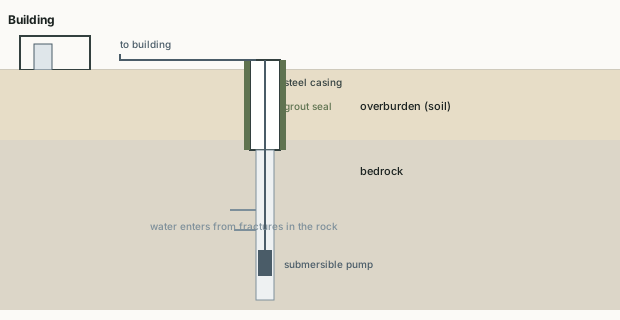
Follow the delivery path from borehole to fixtures
A submersible pump delivers water through a pipe from the well to the building. The installed depth, available supply, pump rating and control arrangement affect how that equipment operates. This design is standard for drilled wells in Vermont since it is reliable and, being underwater, protected from freezing.
The pressure tank stores a reserve of pressurized water so the pump doesn't need to run continuously. It turns on to refill the tank at a low pressure setpoint and off again once the tank reaches its high setpoint, with the tank's air cushion providing pressure to the house in between those cycles.
| Check | What it involves |
|---|---|
| Record safe observations | Note affected fixtures, an accessible gauge reading and whether equipment appears to be running. |
| Avoid exposed electrical work | Do not open wet/damaged controls, repeatedly reset breakers or bypass protection. |
| Describe cycling and recent changes | Leaks, water availability, tank condition and controls can produce overlapping symptoms. |
| Have the model-specific checks performed | A qualified technician assesses electrical supply, controls, tank, pump and piping. |
| Keep delivery and quality separate | Restored pressure does not establish drinking-water safety after flooding, contamination or opened equipment. |
Goulds troubleshooting, Amtrol tank instructions and Vermont Health private-water guidance.
What each part costs to replace
A pressure complaint does not identify the failed component. Angi’s August 31, 2026 national well-pump replacement survey reports $1,897 on average and a $973–$2,822 typical range; its separate pressure-tank guide reports a $500 average and $300–$700 typical range.
These are national benchmarks, not Vermont quotes or a depth-based pricing formula. Ask the technician to document the fault and specify the exact equipment, access, electrical work and return-to-service checks.
Because the cheap parts fail first, the order of checking matters: the switch and the tank's air charge before the pump. The linked pages walk through the pre-charge rule, the cost table for a pump replacement and the noises that point at each part.
What a normal cycle looks like
In a healthy system, the pump runs for a set period to refill the tank, then rests for a stretch while the household draws from the tank's reserve, cycling only occasionally instead of every time a faucet is opened. A pump that cycles on and off rapidly and frequently is a strong sign something is wrong upstream.
The gap between pump cycles depends on tank size and household demand. A larger pressure tank means fewer, longer rests between pump cycles, which is easier on the pump's working life than a smaller tank that cycles more frequently.
Why most 'pump problems' aren't the pump
A waterlogged pressure tank, one that has lost its air cushion, often because the bladder has failed, causes the pump to short-cycle rapidly, which looks like a pump problem but is a tank issue, and a far cheaper fix than pump replacement.
A failing pressure switch, which senses tank pressure and tells the pump when to start and stop, can cause similar symptoms, as can a simple tripped breaker or power issue. Ruling these out before assuming pump failure saves real money, since a pump itself is the most expensive component to replace.
Why a tank loses its useful water reserve
Well pressure tanks . Well pressure tanks: a well pressure tank stores a reserve of pressurized water using a rubber bladder that separates the water from a cushion of compressed air, letting the pump rest between refills instead of running every time a faucet is opened, and providing more consistent pressure throughout the house.
Over time, the bladder can develop a small leak or fail outright, letting the air cushion escape and water fill the space it occupied. A condition called waterlogging, a possible tank failure, produces a distinctive symptom: the pump short-cycles, turning on and off rapidly instead of running for a set period and resting.
A tank's air charge can sometimes be recharged if the bladder is still intact but has simply lost pressure, a service whose suitability depends on the tank condition and manufacturer’s instructions. But a torn or ruptured bladder means the tank needs replacement, since recharging a torn bladder doesn't hold. A pressure tank lasts many years, but rapid, frequent cycling is the clearest sign it's time to have it checked.
Inside the tank, a rubber bladder or diaphragm physically separates water from a pocket of air that has been pre-charged to a specific pressure. As the pump fills the water side, it compresses that air cushion further, and the compressed air is what pushes water out to the house as faucets draw from it.
This design means the pump doesn't need to run continuously to maintain pressure. The tank's stored reserve handles typical household draws, and the pump only kicks in periodically to refill the tank once pressure drops to its low setpoint.
A bladder that develops even a small leak lets air escape over time, and once enough air is lost, water fills more of the tank than it should, leaving little air cushion to buffer pressure. The tank is now 'waterlogged.' This causes the pump to run each time water is used, cycling rapidly and briefly instead of the normal longer run-and-rest pattern.
Rapid short-cycling is hard on the pump's working life, since starting and stopping frequently causes more wear than infrequent, longer runs, so a waterlogged tank left unaddressed can shorten the life of an otherwise healthy pump.
If the bladder itself is intact but has simply lost its air charge over time, a slow, normal seepage, a professional can recharge it by adding air back to the correct pressure, a service whose suitability, price and result depend on the tank and the measured fault.
If the bladder has torn or ruptured, recharging won't hold, since the air will simply escape again through the same failure point. At that stage, replacing the tank is the only real fix, and the replacement scope should identify the tank, fittings, controls and access work separately.
What a pump replacement includes
A pump that runs without building adequate pressure needs checks of its delivery, the water level, piping and controls. Confirming that the tank and switch work does not by itself exclude a leaking line or inadequate supply.
Persistent grinding noise needs investigation of the pump and associated equipment. Describe where the noise occurs and whether it changes during a draw, because sound alone does not establish an internal bearing failure or a replacement price.
Use the well completion report to establish the actual depth before comparing an estimate. Plan for the drop pipe and wire to be replaced with the pump when they are old, and for the rig or hoist to need clear access. A cold-weather pull is possible, but frozen ground and deep snow around the casing add time.
A submersible pump sits down in the well casing attached to a length of pipe and wiring, so replacement requires pulling the entire assembly out, using a specialized truck-mounted well service rig that can handle the depth and weight involved. This job needs a professional well contractor instead of a general plumber.
Once pulled, the old pump is disconnected and the new one attached to fresh pipe and wiring as needed, then lowered back into the well and reconnected to the house's pressure system, with the completion time depending on the depth, access, condition of the retrieved components and required testing.
Replacement cost depends on well depth , a deeper well requires more pipe, wire and pull time, along with the pump's size and horsepower rating, matched to the household's water demand and the well's characteristics. Get a quote specific to your well rather than relying on a generic estimate.
Look for pressure that never builds despite a healthy tank and switch, persistent grinding noise, or a pump that has simply stopped running with power and the switch both confirmed good.
Cost varies with well depth, pump size and access, so a total without those details cannot be compared reliably. A well contractor can quote precisely for your specific well's characteristics.
Ask for a schedule covering retrieval, installation, reconnection and water-quality work; a fixed same-day promise cannot cover every depth or access condition.
Separate an electrical loss from a delivery problem
No water from the tap . A sudden, total loss of water from every tap has several possible causes: a tripped breaker for the pump circuit, a failed pressure switch that isn't telling the pump to run, a pump that has lost prime or failed, or, on rare occasions, a well that has run dry.
Observe whether the pump circuit shows a trip indication without opening covers or touching wiring; a tripped breaker calls for identifying the fault rather than repeated resets. If the breaker is fine, listen at the tank or well cap for the pump attempting to run.
Hearing it cycle with no water reaching the house points toward the piping, while total silence points toward the switch, wiring, or the pump itself. Loss of supply can also involve the operating water level. Report preceding sputtering or air in the water, but their absence does not exclude a supply problem.
The well pump circuit is a dedicated breaker in most homes, and it can trip from a power surge, a momentary short, or simply age, producing a symptom indistinguishable from a failed pump. Record the breaker indication and recent power interruptions for the technician; they are observations rather than proof that the pump itself is sound.
A breaker that has tripped repeatedly needs fault diagnosis. It suggests an actual electrical fault in the pump, wiring, or pressure switch, and calls for a professional rather than repeated resets.
With the breaker confirmed fine, open a faucet and listen near the pressure tank or well cap for the pump attempting to run. Silence suggests the pressure switch isn't triggering it, a wiring problem exists, or the pump itself has failed . All of which need a professional to diagnose safely.
If you can hear the pump running but no water reaches the faucet, possible causes include lost prime on a jet-pump arrangement, a piping or check-valve problem, insufficient water at the intake or a blockage between the pump and the house.
A well with low yield relative to demand can lose delivery as the water level falls. Possible preceding observations include sputtering faucets, air in the water, or a noticeable drop in pressure before total loss.
If those warning signs preceded the total loss, or if the property has a documented history of low yield, a well running dry becomes a more likely explanation and changes the fix from an electrical or pump repair to a conversation about well yield, storage, or in rare cases redrilling deeper.
Check the breaker first. A tripped breaker produces exactly the same symptom as a failed pump but that indication needs fault diagnosis. If that's fine, listen for the pump running at the pressure tank.
Can I replace a well pump myself?
It's not a typical DIY job. Pulling a submersible pump requires specialized equipment able to handle well depth and weight, so this work is done by a professional well contractor.
What equipment is used to pull a well pump?
A specialized truck-mounted well service rig designed to handle the pipe, wiring and pump weight at whatever depth your well requires. This is standard equipment for a well contractor.
Does a deeper well cost more to replace the pump in?
Yes. A deeper well requires more pipe, wire and pull time, which increases the cost compared to a shallower well of the same pump size and type.
Can I upgrade to a bigger pump when replacing mine?
Only after checking well yield, operating depth, demand, piping and the rest of the delivery system. A well contractor can recommend the right size for your current needs.
What size well pump do I need?
Sizing depends on well depth, yield, and household water demand. A well contractor evaluates these factors together to recommend the right horsepower and capacity for your specific situation.
Is it worth repairing an old well pump instead of replacing it?
For a pump nearing or past its typical service life showing genuine failure, compare the diagnosed repair with replacement, including retrieval and related components, though a contractor's assessment of your specific pump's condition is the best guide.
Can I use the same pressure tank with a new well pump?
Often yes, if the existing tank is in good condition and appropriately sized, though it's worth having a contractor evaluate the tank's condition at the same time, since the tank must suit the replacement pump and intended control arrangement.
What does it mean if I can hear the pump running but no water comes out?
Running without delivery needs checks of water level, the pump and piping as well as the controls. A jet pump can lose prime; a blockage, check valve or leaking pipe can also affect delivery, but sound alone does not exclude pump failure.
Can a power outage cause no water from the tap?
Yes. Without power, the pump can't run. The pressure tank may supply a limited reserve; after restoration, observe whether the system returns to normal and report any continuing fault.
How do I know if my well has run dry?
Possible signs include sputtering faucets, air in the water, or a noticeable pressure drop. Their absence does not exclude insufficient water at the intake; a provider needs the operating level and recovery findings.
Can cold weather cause a sudden loss of water from a well?
Yes, if exposed or shallow pipes freeze between the pump and the house, blocking flow even though the pump itself works fine. This is a different problem from pump or well failure.
Should I call a well contractor or an electrician for no water?
A well contractor is the right first call. They can diagnose the pressure switch, pump and electrical connections specific to the well system, rather than general household wiring.
Can low water pressure everywhere in the house mean the same thing as no water at all?
It can be an earlier stage of the same underlying causes, a struggling pump, a weak switch, or declining well yield, worth investigating before it progresses to a total loss.
Does a dry well mean I need a new well?
Not necessarily. Options can include adding storage capacity, adjusting the pump setup, or in some cases deepening the existing well, all of which a well contractor can evaluate before assuming a full new well is needed.
Can I reset my own pressure switch?
Resetting a pressure switch is best left to a professional. It involves electrical components at the well system, and misdiagnosis can leave the underlying problem unresolved or create a new issue.
Why does my water come back on its own sometimes?
Intermittent return can involve controls, pump protection, piping or recovery of the well’s water level. Record the sequence and demand at the time so the provider can distinguish those possibilities before replacing equipment.
Well pressure tanks: service details and questions
Well pressure tanks: a well pressure tank stores a reserve of pressurized water using a rubber bladder that separates the water from a cushion of compressed air, letting the pump rest between refills instead of running every time a faucet is opened, and providing more consistent pressure throughout the house. Over time, the bladder can develop a small leak or fail outright, letting the air cushion escape and water fill the space it occupied. A condition called waterlogging, the most common tank failure, produces a distinctive symptom: the pump short-cycles, turning on and off rapidly instead of running for a set period and resting
A tank's air charge can sometimes be recharged if the bladder is still intact but has simply lost pressure, a quick, inexpensive fix. But a torn or ruptured bladder means the tank needs replacement, since recharging a torn bladder doesn't hold. A pressure tank lasts many years, but rapid, frequent cycling is the clearest sign it's time to have it checked
The air cushion in the tank is what keeps the pump from running on every use
Pressure tank symptoms and fixes
Pump cycles rapidly and often
Waterlogged tank, low air charge
Recharge if bladder intact
Waterlogged tank or failing switch
Check tank air charge, then switch
Tank feels heavy, sounds full of water
Standard diagnostic guidance for well pressure tank problems
How the tank stores pressure
The pre-charge rule, typical settings and what a tank costs
A bladder tank's air charge is set with the pump off and the tank drained of water. The rule that most installers follow is to set the pre-charge 2 psi below the pump's cut-in pressure
A switch set to 30 and 50 psi takes a 28 psi charge, and a 40 and 60 switch takes 38. Check it with a tire gauge at the valve on top of the tank, and add air if it is low
HomeGuide’s July 2025 national guide lists pressure-tank replacement at $800 to $1,500 for labor and materials. That installed range is different from an equipment-only price.
Ask the quote to separate the tank, access, fittings and any control replacement. If the bladder has failed, adding air does not repair the rupture; a contractor should identify the tank condition before recommending recharge or replacement.
What waterlogging looks like and why it happens
If the bladder has torn or ruptured, recharging won't hold, since the air will simply escape again through the same failure point. At that stage, replacing the tank is the only real fix, and it's a relatively straightforward, moderately priced job for a well contractor
Pressure tank settings and costs
Pre-charge for a 30/50 psi switch
28 psi, measured with the tank drained
Pre-charge for a 40/60 psi switch
38 psi, measured with the tank drained
Tank replaced, with labor
Sign a bladder has failed
Water at the air valve, or a tank that feels full and heavy
Common installer practice (pre-charge 2 psi below cut-in) and 2026 cost guides from Angi and HomeGuide. Estimates only
Angi, well tank replacement cost
; HomeGuide, replacing a well pressure tank
What is a well pressure tank for?
It stores a reserve of pressurized water using a compressed air cushion, letting the pump rest between refills instead of running every time a faucet is opened, and providing more consistent household pressure
How do I know if my pressure tank has failed?
The clearest sign is the pump cycling on and off rapidly and frequently instead of running for a set period and resting. This short-cycling means the tank has lost its air cushion
Can a pressure tank be recharged instead of replaced?
Yes, if the bladder is intact but has simply lost air pressure over time. A professional can recharge it quickly and inexpensively. A torn or ruptured bladder needs replacement instead
How long do well pressure tanks last?
Many years under normal conditions, though a slow bladder leak can develop gradually. Periodic checking of the air charge helps catch a failing tank before it causes rapid pump cycling
What does a waterlogged pressure tank mean?
It means the tank has lost enough of its air cushion that water has filled the space it occupied, leaving little buffer to maintain pressure. This causes the pump to short-cycle
How much does it cost to replace a well pressure tank?
It's a relatively straightforward, moderately priced job for a well contractor, far less expensive than pump replacement. Get a quote from a local contractor for your specific tank size
Does a bigger pressure tank mean better performance?
Yes for pump longevity. A larger tank means fewer, longer rests between pump cycles, which is easier on the pump's working life than a smaller tank that cycles more frequently
Can I check my own pressure tank's air charge?
With the right gauge and some basic know-how, a homeowner can check tank pressure with the system depressurized, though many prefer to have a professional handle it as part of routine service
Is short-cycling bad for my well pump?
Yes. Frequent starting and stopping causes more wear than infrequent, longer runs, so a waterlogged tank left unaddressed can shorten the life of an otherwise healthy pump
What size pressure tank do I need?
Sizing depends on household water demand and the pump's capacity. A well contractor can recommend the right size based on your specific fixtures and household size
Can a failing pressure tank cause low water pressure throughout the house?
Yes. A waterlogged or failing tank can produce both rapid cycling and weaker, less consistent pressure throughout the house, since it's no longer buffering pressure the way it was designed to
Should I replace my pressure tank at the same time as my pump?
Both parts are worth evaluating together. An old tank nearing the end of its life may fail soon after a new pump is installed. A contractor can advise whether replacing both together makes sense for your system's age
Replacing a well pump: service details and questions
A well pump needs replacement, instead of a cheaper fix to the tank or switch, when it shows clear signs of failure: it runs constantly without building pressure, makes grinding noises consistent with worn bearings, has stopped running despite confirmed power and a good pressure switch, or has reached an age where a professional judges it more cost-effective to replace than keep repairing. Replacing a submersible pump means pulling the entire pump and its attached pipe up out of the well casing, which can require a specialized lifting rig according to depth, pipe and access, then installing new pump, pipe and wiring before lowering it back down and reconnecting the system.
Cost varies with well depth, pump size and access, landing in a moderate-to-significant range a well contractor can quote precisely. A quality submersible pump, correctly installed, commonly lasts 10 to 15 years in HomeGuide’s national service-life guide, so replacement is an expense to plan for after condition assessment instead of a recurring cost
The pump sits down the well on its pipe, so replacing it means pulling the whole assembly
Signs a well pump needs replacement, not repair
Runs constantly, no pressure builds
Even with a confirmed healthy tank and switch
Persistent, worsening grinding noise
Points to worn internal bearings, not economically repairable
Pump has simply stopped, power and switch confirmed good
Points to internal failure rather than an upstream issue
Age and repair history
A well contractor can judge when repair no longer makes sense
Standard indicators distinguishing genuine pump failure from a cheaper tank or switch fix
The signs that mean the pump has failed
A pump that runs continuously without ever building adequate pressure, despite a healthy pressure tank and switch, is showing genuine failure. It's no longer able to move water efficiently, whatever the cause inside the unit itself
Persistent grinding noise while running, especially if it develops gradually and worsens over time, points to worn internal components like bearings, which cannot be economically repaired in place and signal the pump is nearing the end of its service life
What a pump replacement costs, by depth
HomeGuide’s August 2025 national guide puts installed submersible well pumps at $1,000 to $2,500, with its overall replacement table showing a $1,800 national average. Plumbing labor is listed at $250 to $800 and can exceed $1,000 on difficult installations. Depth changes the required pipe, wire, lifting and pump specification; ask for those actual quantities and access costs instead of multiplying depth by an assumed price increment.
Vermont wells are deep on average, so the higher rows of the table apply more often here than the national figures suggest. Plan for the drop pipe and wire to be replaced with the pump when they are old, and for the rig or hoist to need clear access. A cold-weather pull is possible, but frozen ground and deep snow around the casing add time
How the physical replacement works
Once pulled, the old pump is disconnected and the new one attached to fresh pipe and wiring as needed, then lowered back into the well and reconnected to the house's pressure system, with the whole visit completed in a single day for a straightforward job
What to expect on cost and lifespan
A correctly sized, quality pump installed correctly commonly lasts 10 to 15 years in HomeGuide’s national service-life guide, but actual replacement follows condition, use and water quality instead of a promised lifetime. It is a significant but infrequent expense instead of an ongoing maintenance line item
Published well pump replacement costs, 2026
HomeGuide: $1,000 to $2,500 installed submersible pump; $1,800 overall replacement average
Pump, materials and labor for the actual well depth
Added pipe, wire and lifting requirements with increased depth
HomeGuide’s August 2025 national well-pump guide. Estimates only; pump specification, depth and access determine the actual quote
DrillerDB, well pump replacement cost
; Angi, well pump replacement cost
How do I know if my well pump needs to be replaced?
How much does it cost to replace a well pump in Vermont?
Cost varies with well depth, pump size and access, landing in a moderate-to-significant range. A well contractor can quote precisely for your specific well's characteristics
How long does it take to replace a well pump?
A straightforward job is completed in a single day, from pulling the old pump out of the casing to installing and reconnecting the new one
How long do new well pumps last?
A quality submersible pump, correctly installed, commonly lasts 10 to 15 years in HomeGuide’s national service-life guide, making replacement an expense to plan for after condition assessment for most homeowners instead of a recurring cost
Yes, if your household's water demand or fixture count has increased since the original pump was sized. A well contractor can recommend the right size for your current needs
For a pump nearing or past its typical service life showing genuine failure, replacement is more cost-effective than repair, though a contractor's assessment of your specific pump's condition is the best guide
Does well pump replacement require a permit in Vermont?
No separate permit is needed just for pump replacement, since it doesn't change the well's structure, though check with your local requirements if you're unsure for your specific situation
Often yes, if the existing tank is in good condition and appropriately sized, though it's worth having a contractor evaluate the tank's condition at the same time, since an aging tank may benefit from replacement too
Well pump short-cycling and noise: service details and questions
Short-cycling, a well pump turning on and off rapidly instead of running for a stretch and resting, is most often caused by a waterlogged pressure tank that has lost its air cushion, though a failing pressure switch or a system leak can produce the same symptom. Unusual noise is a separate but related clue: a humming sound with no water movement suggests the pump is trying to run but something is preventing it, often a seized motor or an electrical issue. A grinding or rattling noise while running can indicate worn bearings or debris in the pump.
And water hammer, a banging sound when a valve closes, is a plumbing issue instead of a pump problem, caused by the sudden stop of moving water. Because short-cycling accelerates wear on the pump, addressing the underlying cause, the pressure tank, promptly is both cheaper and protects the pump from premature failure
Short cycling is the pump starting and stopping too often, and the tank is the first place to look
Well system noises and what they mean
Waterlogged pressure tank or failing switch
Humming, no water movement
Seized motor, capacitor or electrical issue
Grinding or rattling while running
Worn bearings or debris in the pump
Banging or knocking when a valve closes
Water hammer: a plumbing issue, not the pump
A waterlogged pressure tank is one possible cause, alongside control faults, leakage and supply problems. Once the tank's air cushion is gone, it can no longer buffer pressure, so the pump has to run almost continuously in short bursts to keep up with even modest household demand
Short-cycling needs checks of the tank, controls, leakage and water delivery. A qualified provider can assess a low air charge and whether the tank is intact; the service charge and required repair depend on that finding.
A humming noise with no water moving suggests the pump motor is trying to start but can't. Often a seized impeller, a capacitor issue, or an electrical problem, all of which need a professional's diagnosis since continuing to run a straining motor can burn it out
Grinding, rattling, or a rough running sound while water is flowing points more toward wear inside the pump, worn bearings or, in some cases, debris or sediment that has entered the pump, which signals a pump nearing the end of its service life
Water hammer, a sharp banging or knocking sound, often when a faucet or valve closes suddenly, is caused by the abrupt stop of moving water creating a pressure wave in the pipes, and it's a plumbing issue instead of a pump problem, fixed with air chambers or water hammer arrestors at the affected fixtures
Angi, well pump pressure switch problems
; Angi, well pump replacement cost
Why does my well pump turn on and off so often?
This short-cycling is most often caused by a waterlogged pressure tank that has lost its air cushion, though a failing pressure switch can produce the same symptom with a healthy tank
Why does my well pump make a grinding noise?
Grinding while running points to worn bearings or debris inside the pump, which signals a pump nearing the end of its service life instead of a simple, cheap fix
What is water hammer and is it related to my well pump?
Water hammer is a banging noise from a sudden pressure wave when a valve closes quickly. It's a plumbing issue, not a pump problem, and is fixed at the fixture level instead of at the well
Yes. A switch with worn contacts or an inaccurate setpoint can trigger the pump too frequently even with a fully healthy pressure tank, producing symptoms similar to a waterlogged tank
No water from the tap: service details and questions
A sudden, total loss of water from every tap points to a handful of common causes, in order of likelihood: a tripped breaker for the pump circuit, a failed pressure switch that isn't telling the pump to run, a pump that has lost prime or failed, or, on rare occasions, a well that has run dry. The fastest thing to check first is always the electrical panel, since a tripped breaker produces exactly the same symptom as a failed pump but takes thirty seconds to rule out. If the breaker is fine, listen at the tank or well cap for the pump attempting to run
Hearing it cycle with no water reaching the house points toward the piping, while total silence points toward the switch, wiring, or the pump itself. A well running dry is uncommon in Vermont outside drought, and gives warning signs, sputtering or air in the water, before total loss
Work backwards from the tap: tank, switch, line, pump
No water: troubleshooting in order
1. Check the breaker
Fastest, cheapest cause to rule out first
2. Listen for the pump
Silence points to the switch or pump; running but no water points downstream
3. Check for warning signs beforehand
Sputtering or air in the water suggests low well yield
4. Rule out a lost prime or check valve issue
Common on some pump configurations after power loss
5. Call a professional
For anything beyond the breaker, this needs qualified diagnosis
Standard troubleshooting sequence for sudden total water loss on a Vermont private well system
Start with the breaker, every time
The pump circuit can lose power when a breaker trips, but the trip alone does not establish a failed pump or a harmless one-off event. Observe the breaker indication without opening covers or touching wiring, and tell the well company what happened. Have the cause established before re-energizing suspect equipment rather than treating a reset as a complete diagnosis.
A breaker that has tripped repeatedly needs fault diagnosis. It can indicate an electrical problem in the pump, wiring or pressure switch. Record the indication and stop attempting resets; a qualified person needs to identify the fault and safe return-to-service conditions before further operation.
Listen for the pump, then narrow it down
If you can hear the pump running but no water reaches the faucet, the issue is more likely a lost prime (common after certain types of power interruption on some pump configurations), a stuck check valve, or a blockage somewhere between the pump and the house
When it might be the well itself
A well running dry is uncommon in Vermont outside of significant drought conditions or a well with naturally low yield relative to household demand, and it gives warning signs first: sputtering faucets, air in the water, or a noticeable drop in pressure before total loss
Why did my water suddenly stop working with no warning?
Check the breaker first. A tripped breaker produces exactly the same symptom as a failed pump but takes seconds to rule out. If that's fine, listen for the pump running at the pressure tank
This suggests the problem is downstream of the pump. A lost prime, a stuck check valve, or a blockage between the pump and the house, instead of the pump itself having failed
Yes. Without power, the pump can't run. No water reaches the house until power is restored, at which point the system should resume normal operation on its own
Warning signs precede a dry well, sputtering faucets, air in the water, or a noticeable pressure drop, instead of total loss appearing with no warning at all
Is a tripped breaker a serious problem for a well pump?
A single trip does not prove that the fault is minor. Record the breaker indication and what the pump was doing, without opening electrical covers or touching wiring. Repeated trips call for fault diagnosis, and a reset alone does not establish that the pump circuit is safe or that the underlying problem is resolved.
How urgent is a total loss of water pressure?
It's inconvenient but rarely a true emergency unless it coincides with other concerning symptoms. A same-day or next-day service call is reasonable for most total-loss situations
Intermittent return of water often points to a failing but not fully dead component, a marginal pressure switch or a pump on its way out, and is worth having checked before it fails completely
No water from the tap
No water from the tap can come from loss of power, a control fault, a leak, a blocked or frozen line, a pump problem or insufficient water in the well. One symptom does not establish which part failed. Check whether every fixture is affected and whether an outage or recent plumbing work preceded the loss.
Read an accessible pressure gauge without opening electrical covers. If the pump is running without delivering water, switch off its dedicated circuit and call a well service professional. Running dry can damage equipment.
Do not repeatedly reset a breaker or handle wet electrical equipment. A jet pump can lose prime, but that diagnosis does not apply to every submersible installation.
Record the gauge reading, any alarm, recent sputtering and the well’s recovery history for the service call. Arrange a safe temporary drinking-water supply while the fault and any contamination risk are assessed.
Record what you can check safely
Compare several taps. A single affected fixture points toward its valve, aerator or branch rather than proving a well-wide failure. Note whether both hot and cold water are affected.
Check for an area power outage and note the pump breaker position from a dry, accessible panel. Do not remove covers, touch pressure-switch contacts or keep resetting a tripping breaker. Tell the technician what you observed.
Running without delivery needs prompt service
Goulds Water Technology’s troubleshooting manual lists several causes of poor or absent delivery, including water level, suction leaks, prime on jet systems, obstructions and pump condition. A noise alone does not isolate the fault.
Turn off a pump that runs without water delivery. Frozen piping needs a safe thawing assessment; never use a flame. A flooded electrical area requires professional assistance before equipment is handled.
Restore supply and check safety separately
A restored pressure reading does not establish drinking-water quality. If the well flooded or a repair opened the system, discuss disinfection and testing before drinking the water.
Keep the well record, pump model and recent service paperwork ready. Recovery measurements help separate temporary drawdown from a pump or control fault. Establish the cause before deciding to drill deeper.
Can an outage stop a private well?
An electrically powered pump cannot run without power. Stored pressure may provide only limited water before it falls.
Should I keep resetting the breaker?
No. A repeated trip needs fault diagnosis. Do not handle wet equipment or open electrical covers.
Does a running pump prove the well is dry?
No. Leaks, obstructions, pump faults and water level can produce overlapping symptoms. Give the technician the outage timing, gauge readings and well record so the tests cover both supply and equipment.
Can every well pump lose prime?
No. Priming applies to jet-pump arrangements and is not a universal explanation for a submersible pump. Identify the pump and follow its manufacturer’s instructions. Do not open energized equipment to test a guess.
Is restored pressure proof the water is safe?
No. Restored pressure establishes water delivery, not laboratory quality. After flooding, contamination or opened equipment, follow Vermont Health’s disinfection and testing guidance before relying on the supply for drinking.
What records help the service call?
Bring the well report, pump model, gauge readings, outage timing and previous recovery or repair information.
What is useful to record when supply returns by itself?
Write down when the loss began, which fixtures were affected, the accessible gauge reading and whether power or recent water use changed. Record when delivery returned and whether it happened again. That sequence can guide tests for drawdown, controls, leakage or intermittent equipment faults.
It does not establish a diagnosis. Do not run the pump without water to repeat the fault.
Should I order a pump before the service visit?
Establish the fault first. A replacement selected from a symptom can leave a leaking line, failed control or limited source unresolved. Ask the technician to state what was tested and which finding supports repair or replacement.
The proposed pump must match the well and required delivery conditions. Motor size alone cannot answer those questions or create additional groundwater.
Can I inspect the pressure switch contacts myself?
Keep electrical covers closed and avoid wet equipment. The safe observations for the service call are the existing gauge, alarms, fixture behavior and known outage history.
Contact testing and energized control diagnosis belong to a qualified professional following the equipment instructions. Repeated breaker trips need assessment, rather than repeated resets to see whether the pump will eventually run.
Well pressure tanks
Well pressure tanks provide drawdown under the pump and control arrangement, limiting how often a suitable system must start the pump. Bladder and diaphragm designs separate air from water, while other tank arrangements require different service. Rapid cycling or inconsistent pressure needs assessment of the tank, controls, leakage and available water.
It does not establish a failed bladder from sound or weight alone. Have the technician identify the exact model, switch settings and test conditions before adjusting precharge or selecting replacement. Amtrol’s support guidance gives a precharge two psi below switch cut-in for its applicable equipment, not a universal instruction for every tank or control.
The service should follow the installed model’s safety and depressurization procedure. Compare any proposed repair with the manufacturer’s permitted options and a defined replacement scope. For cost context, a published national benchmark is separate from the company’s actual quote for tank, access, fittings, labor and related equipment.
Identify the tank and control arrangement
Record the tank label and pump/control information. A nominal tank volume and an observed gauge pressure do not establish usable drawdown, suitability or remaining life. Ask the technician how the installed equipment meets the actual delivery requirement.
Test before choosing recharge or replacement
Describe when cycling occurs, whether water is being drawn and any recent changes. Leaks, control faults, available water and tank condition can produce overlapping symptoms.
Follow the exact model’s test and repair requirements. Do not open electrical controls or adjust an energized or pressurized assembly based on a generic chart. A suspected bladder/diaphragm fault needs the actual findings and permitted repair or replacement method.
Read the Amtrol examples in their product context
Amtrol specifies precharge two psi below pressure-switch cut-in for its applicable tanks. That produces 28 psi for a 30 psi cut-in and 38 psi for a 40 psi cut-in as arithmetic examples. The model’s installation and service conditions, including proper depressurization, still govern.
Compare the scope with a published cost benchmark
Angi’s 2026 well-tank replacement guide reports a $500 national average and $300–$700 typical range. These figures are not a Vermont quote or a guarantee that every project includes the same fittings, access, controls or other repairs. Ask the company to state those items and the responsible product warranty.
Does rapid cycling prove the pressure tank failed?
No. Tank drawdown, leakage, controls and the pump arrangement need assessment. Record the pattern instead of selecting a replacement from one symptom.
Is every pressure tank a bladder tank?
No. Bladder, diaphragm and other arrangements have different construction and service requirements. Identify the actual label and instructions.
What precharge should a 30/50 pressure switch use?
Amtrol’s applicable support example is two psi below cut-in, giving 28 psi at 30 psi cut-in. Use the exact tank and control instructions and required test conditions. It is not a universal setting.
What does a 40/60 switch example mean?
For Amtrol’s applicable example,40 psi cut-in gives 38 psi precharge. A technician must still verify the model, controls and required depressurization/test procedure.
Does water or weight at the tank establish the repair?
A qualified model-specific test determines the defect and permitted remedy. Do not assume a sound, heavy tank or a temporary change after charging proves one failure mode.
Can the failed internal part be repaired?
That depends on the exact product and confirmed fault. Compare the manufacturer’s permitted service method with a replacement proposal rather than assume every tank is repairable or disposable.
How much does pressure-tank replacement cost?
Angi’s 2026 national guide reports $500 average and $300–$700 typical. Obtain the local company’s actual included scope and price. Related fittings, access or controls can change it.
Is restored pressure proof that the drinking water is safe?
No. Restored flow and pressure do not establish drinking-water quality. Flooding, contamination or opened equipment can require Health-guided disinfection and testing.
Well pump short-cycling and noise
Short-cycling, a well pump turning on and off rapidly instead of running for a stretch and resting, is most often caused by a waterlogged pressure tank that has lost its air cushion, though a failing pressure switch or a system leak can produce the same symptom. Unusual noise is a separate but related clue: a humming sound with no water movement suggests the pump is trying to run but something is preventing it, often a seized motor or an electrical issue. Unusual pump noise needs assessment before choosing a repair.
And water hammer, a banging sound when a valve closes, is a plumbing issue instead of a pump problem, caused by the sudden stop of moving water. Frequent cycling needs diagnosis before parts are replaced. Ask the provider to check the controls, pressure storage, leakage and available supply against the installed equipment.
What's causing the short-cycling
Tank drawdown is one possible factor; controls, leakage, available water and the pump arrangement also need assessment. Once the tank's air cushion is gone, it can no longer buffer pressure, so the pump has to run almost continuously in short bursts to keep up with even modest household demand.
A failing pressure switch is the next most likely cause, since the switch's job is to tell the pump when to start and stop based on tank pressure. A switch with worn contacts or an inaccurate setpoint can trigger the pump too frequently even with a healthy tank.
What the usual fixes cost, and the cold-weather angle
A waterlogged tank can cause rapid cycling. Record the cycling pattern. The technician also checks the pressure switch, leaks and pump controls.
If the tank's air charge is low, recharging costs nothing but the time. If the bladder has failed, a replacement tank is $800 to $1,500 installed, and a worn pressure switch is $100 to $250 installed. A pump replacement, the last resort, runs $900 to $2,800.
In Vermont, look at the space around the tank before the pump. A tank or switch in an unheated bulkhead or garage can see freezing temperatures on the coldest nights, and a frozen line or switch mimics a failing pump. After an outage the pump restarts under load, so a slow-starting or humming pump is worth checking for a tripped breaker before calling a driller.
Reading the specific noise
Stop repeated attempts to run a pump that hums without delivering water. Report the sound, control behavior and loss of supply so the provider can assess the electrical and pumping equipment safely. Often a seized impeller, a capacitor issue, or an electrical problem, all of which need a professional's diagnosis since continuing to run a straining motor can burn it out.
Record when the sound starts, whether water is flowing and whether pressure changes with it. Let the provider inspect the equipment before deciding between repair and replacement.
When it's a plumbing issue, not the pump
Distinguishing this from pump-related noise matters because the fix is entirely different. A plumber addresses water hammer at the fixture level. Pump and pressure tank noises need a well contractor's attention at the source of the system.
Is short-cycling dangerous for my well pump?
It's not immediately dangerous but does accelerate wear, since frequent starting and stopping is harder on a pump than infrequent, longer runs. Addressing the cause promptly protects the pump's lifespan.
What does it mean if my well pump hums but no water comes out?
This suggests the motor is trying to start but can't, often due to a seized impeller, a capacitor issue, or an electrical problem. Have a professional check it rather than letting it run.
Can a bad pressure switch cause short-cycling?
Yes. Have the pressure readings and switch operation checked before assuming the tank has failed. Electrical diagnosis belongs to the service provider.
Should I turn off my well pump if it's making strange noises?
For a humming, non-running motor, it's reasonable to shut off power and call a professional instead of let it strain. For milder cycling noise, scheduling service promptly is sufficient.
How much does it cost to fix a short-cycling well pump?
It depends on the cause. Recharging or replacing a pressure tank is a moderate cost, while a failing pressure switch is inexpensive. Both are far cheaper than pump replacement.
Can debris in my well cause pump noise?
Yes. Sediment or debris entering the pump can cause grinding or rough running, and depending on severity may require pump inspection or, in some cases, addressing the well's water quality or screen.
Is it normal for a well pump to make some noise?
A brief run sound during normal cycling is expected. Humming with no water flow, grinding, or frequent rapid cycling are not normal and warrant checking rather than assuming it's just the pump being noisy.
How do I fix water hammer in my house?
It's addressed with air chambers or water hammer arrestors installed near the affected fixtures. A plumber can diagnose and install the right fix for where the banging occurs.
Can short-cycling shorten my pump's expected lifespan?
Yes. The added wear from frequent starting and stopping can meaningfully shorten a pump's life compared to one that cycles at its designed rate, so addressing the underlying tank or switch issue matters.
Replacing a well pump
Replacing a well pump should follow diagnosis of the pump, controls, piping and available water. Constant running without pressure can also result from a leak or low water level. It does not prove the pump itself has failed.
Ask for the measured fault and the proposed pump’s performance at your well’s pumping level and delivery pressure. A submersible replacement requires lifting the pump and supported pipe and wiring from the casing with equipment suited to their weight and depth. Existing pipe, cable and the pressure tank should be inspected, not automatically discarded or reused.
The quote should state the pump model, lift work, electrical repairs, materials, disinfection and return-to-service checks. Compare that complete scope with the repair option. A larger motor does not create more well yield, and choosing by horsepower alone can produce a poor match to the water source and household demand.
Compare performance at the actual duty point
Pump selection needs lift, pressure, flow demand and available yield. Identify the proposed Goulds model.
Read its performance curve and installation instructions. A generic horsepower rule cannot select equipment for the actual duty.
Ask whether the new pump, pressure switch, pressure tank and any controller are compatible. Tank precharge is checked with water pressure relieved, following the tank manufacturer’s instructions.
Separate the parts of the quote
List the pump model, lifting equipment, labor, drop pipe, cable, controls and any building connection work separately. State what will be inspected and what conditions would trigger additional replacement.
Ask how the well will be protected from contamination while open, what disinfection or testing is included and how pressure and delivery will be checked before service is complete. Depth alone cannot establish the final installed price.
Does constant running mean the pump is worn out?
Not by itself. A leak, low water level, controls or pump condition can cause failure to build pressure.
Can I choose a replacement by horsepower?
No. Compare the pump’s performance curve with the required lift, delivery pressure, demand and measured well yield. Ask the proposal to state that duty so a larger motor is not mistaken for a complete design.
Must the pressure tank be replaced too?
Replacement depends on the tank’s measured condition and compatibility with the selected pump and controls. Ask the technician to state those findings separately, including whether a retained tank meets the proposed operating requirements.
Will a bigger pump fix low well yield?
A bigger pump does not create groundwater. Have the well’s production and recovery assessed against household demand before selecting a higher withdrawal rate, storage or work on the source.
What makes two replacement quotes comparable?
Compare the same pump duty, pipe and wiring, lifting work, controls, disinfection and completion checks. Ask each company to identify included work and the price method for additional findings during removal.
Is all pump work exempt from review?
Check the proposed scope against Vermont’s minor-repair provisions. Changes to use, design flow or the supply can require review beyond an in-kind component repair.
Which records should identify the installed replacement?
Request the exact pump and controller models, the stated operating duty, retained or replaced cable and pipe, and the completion-test findings. Keep these with the well report. A later technician should be able to distinguish the new equipment from the unit shown on an older invoice without relying on a broad description such as a larger pump.
What if the removed pump is damaged but the cause is uncertain?
Ask the technician to document the observed damage and what further checks are needed on the supply, controls and wiring. Replacing a visibly damaged unit may restore delivery while leaving a contributing fault unresolved. Separate the immediate equipment decision from the explanation of why it failed, and agree on any outstanding investigation before treating the repair as complete.
| Observation | What it helps distinguish |
|---|---|
| One fixture or the whole house | Local restriction versus supply fault |
| Gauge reading and power status | Delivery, control and electrical checks |
| Sputtering and recovery history | Water-level assessment |
| Flooding or opened system | Water-quality follow-up |
Goulds pump troubleshooting and Vermont Health private-water guidance.
| Observation | What to assess before choosing work |
|---|---|
| Rapid cycling | Drawdown, precharge under the correct test conditions, leaks, switch and pump controls |
| Pressure variation | Delivery, controls, demand and available water |
| Air-charge concern | Exact tank model and its installation/service instructions |
| Suspected bladder or diaphragm fault | Technician’s test findings and the model’s repair or replacement requirements |
Amtrol well-tank support; model-specific testing and qualified diagnosis govern.
| Published item | Example or benchmark |
|---|---|
| Amtrol example:30 psi cut-in | 28 psi precharge; correct model instructions and test conditions required |
| Amtrol example:40 psi cut-in | 38 psi precharge; correct model instructions and test conditions required |
| Angi national replacement average | $500 |
| Angi reported typical replacement range | $300–$700; confirm scope, location and actual company quote |
Amtrol well-tank support: precharge 2 psi below cut-in under the product’s required test conditions. Angi 2026 pressure-tank replacement guide, checked October 18,2026.
| Observation | Assessment to request |
|---|---|
| Rapid on/off cycling | Tank drawdown, leakage, controls and the actual pump arrangement |
| Humming with poor delivery | Qualified electrical, motor, control and available-water checks |
| Grinding or rattling | Record the location and operating conditions; equipment assessment required |
| Knock when a valve closes | Assess the plumbing transient and controls; sound alone cannot locate the fault |
Standard diagnostic guidance for common well pump and pressure system noises.
| Item | Ask for |
|---|---|
| Pump selection | Model and performance at required lift, pressure and flow |
| Existing equipment | Condition of cable, pipe, tank and controls |
| Installation | Lift equipment, access and material scope |
| Return to service | Pressure, delivery and water-quality checks |
Manufacturer model selection, troubleshooting and tank installation instructions.
| Published national benchmark | Reported amount |
|---|---|
| Average replacement | $1,897 |
| Reported typical range | $973–$2,822 |
| What this does not establish | A particular well’s pump selection, repair scope or installed bid |
Angi, How Much Does Well Pump Replacement Cost?, updated August 31,2026, read October 18,2026. National sample, not Vermont bids or a per-depth formula.
Well pumps and pressure: delivery equipment and pressure controls
How long do well pumps last?+
Assess performance, condition and operating duty. Keep the service record. Age alone cannot establish remaining life or explain poor delivery.
What is a pressure tank and why do I need one?+
It's a tank with a compressed air cushion that stores pressurized water, letting the pump rest between refills instead of running every time a faucet opens. That extends pump life and gives steady pressure.
Why do I have no water pressure at all?+
Start with the breaker, then the pressure tank and switch, before assuming pump failure. A full loss of pressure is often traced to one of these simpler, cheaper components.
What's the difference between a submersible and a jet pump?+
A submersible pump sits below the water in the well. A jet pump sits above ground and pulls water up. Submersible pumps are standard for most Vermont drilled wells due to reliability and freeze protection.
Can a power outage damage my well pump?+
The pump itself is not damaged by a power outage, though repeated power surges when service is restored can occasionally stress components. A whole-house surge protector is a reasonable precaution.
How do I know if my pressure tank needs replacing versus recharging?+
The bladder's condition decides it. A tank that can be recharged with air and holds it is fine. One that repeatedly loses its charge, especially with a torn or failed bladder, needs replacement instead of repeated recharging.
Does well depth affect what kind of pump I need?+
Yes, depth matters a lot. Deeper wells require a more powerful submersible pump able to lift water the required distance, which a well contractor sizes based on your specific well's depth and yield.
Can I troubleshoot a well pump problem myself?+
Checking the breaker and listening for cycling patterns is reasonable for a homeowner. Diagnosing or replacing the pressure switch, tank or pump itself is better left to a professional given the electrical and pump work involved.
What does a well pump replacement cost in Vermont?+
Published 2026 guides put an installed submersible pump at about $900 to $2,800, with most homeowners near $1,800, and a 250 to 400 foot well often at $2,500 to $4,000. Depth adds $500 to $1,000 per extra 100 feet.