Private wells in Vermont
Private wells draw groundwater from beneath a property to supply its buildings independently of a municipal water main. The great majority of Vermont wells are drilled bedrock wells: a steel casing is set through the soil and sealed with grout, the borehole continues down into fractured rock, and a submersible pump sits near the bottom to push water up to a pressure tank inside the building. Older or shallower properties may instead have a dug or driven well in the soil layer above bedrock.
Whichever type you have, the same three things matter: how much water it produces, whether the water is safe and pleasant to use, and whether the pump and pressure system deliver it reliably. Private-water owners arrange testing themselves.
New-source and rental requirements differ from routine recommendations for an existing owner-occupied home. Vermont's geology puts arsenic, uranium and radon into some wells, so only a test shows what you are drinking.
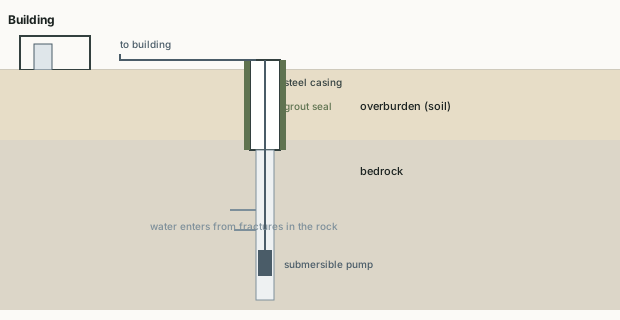
| Part | Where it is | Its job |
|---|---|---|
| Casing | Top of the well, through the soil | Keeps soil and surface water out of the borehole |
| Grout seal | Around the casing | Seals the casing to the rock against surface contamination |
| Borehole in bedrock | Below the casing | Where water enters from fractures in the rock |
| Submersible pump | At the pumping depth selected for the well | Delivers water under the selected pump and control arrangement |
| Pressure tank | Inside the building | Provides drawdown/storage under the tank and control design |
Standard drilled-well construction as used across Vermont; a licensed driller confirms your well's specifics.
What a well is, under the yard
A drilled well needs construction records identifying its borehole, casing and any required seal; not every installation has the same diameter or grouting requirement. Below the casing, the hole continues into bedrock, and water seeps in through fractures in the rock. A submersible pump hangs near the bottom on a pipe, pushing water up whenever the building calls for it.
Inside the building, a pressure tank stores water under pressure so the pump does not have to run every time a tap opens. That is the whole system in outline: casing and grout to keep it clean, rock fractures to supply it, a pump to lift it, and a pressure tank to smooth the delivery. Assessment should cover the actual source, delivery, controls and plumbing rather than assume every supply has the same components.
The three questions every well owner faces
Quantity comes first: a well's yield, measured in gallons per minute, determines whether it comfortably supplies the household or needs storage and careful use. An inadequate yield needs a documented demand and storage assessment before deciding whether the source can serve the property.
Quality and reliability are the other two. Quality is what the water contains. The Vermont-specific concern is naturally occurring arsenic, uranium and radon, none of which you can taste or see.
Reliability is the pump and pressure system that has to keep delivering, and it is the part most likely to need a repair over the years. Each of these has its own section on this site.
Why testing is on you in Vermont
A municipal water system is tested constantly by the utility. A private well is not tested by anyone unless the owner arranges it, and the obligations for rentals and new sources differ from an existing owner-occupied well. That gap matters because the things most worth knowing about Vermont well water, arsenic, uranium, radon, bacteria, are invisible and tasteless.
The Vermont Department of Health publishes recommended test panels for exactly this reason, and testing at purchase and periodically afterward is how owners catch a problem before it becomes a health issue. Treating your own water testing as routine maintenance, the way you treat pumping a septic tank, is the single most important habit of owning a well here.
From the borehole to the tap
A drilled well receives groundwater through fractures in bedrock. A submersible pump lifts that water through a drop pipe to the building. The pressure tank stores water against compressed air, while the pressure switch starts and stops the pump at its set points.
No water, low pressure and rapid cycling describe different failures in that chain. Record the pressure gauge reading and whether the pump is cycling before calling for service. The symptom guides the first check; it does not establish which part has failed.
Follow the supply from bedrock to pressure tank
How a private well works: water reaches your tap from a drilled well through a simple chain: fractures in the bedrock feed water into the borehole, a submersible pump near the bottom pushes it up a pipe, and a pressure tank inside the building holds it under pressure so it is there the instant you open a faucet. The pump does not run continuously. A pressure switch turns it on when the tank's pressure drops to a set low point, for example 40 psi, and off when it reaches a high point, for example 60 psi on a matching pressure-switch setup, so the tank delivers water between cycles and the pump rests.
A healthy system gives steady pressure without the pump starting for every small draw of water. When that changes, the investigation follows the pump, switch, tank air charge and controls while also checking supply piping and the operating water level.
Record whether there is no water at all, weak flow throughout the building, or a pressure change at only one fixture. Those observations narrow the investigation without proving that a particular part needs replacement.
A drilled well's water comes from fractures in the bedrock, not an underground lake. As the borehole passes through the rock, it intersects cracks that carry groundwater, and those fractures are what supply the well. This is why a well's yield depends on the rock it happens to hit, and why two wells a short distance apart can produce very differently.
Near the bottom of the borehole hangs a submersible pump, a sealed motor-and-pump unit sized to the well's depth and the household's demand. The pump is installed below the intended operating water level; a falling water level can leave it without an adequate supply, and it pushes water upward through a drop pipe whenever the system calls for it. It is submerged and out of sight, so its condition is judged by how the water behaves at the tap.
Water travels up the drop pipe to a pressure tank inside the building. In a diaphragm or bladder tank, compressed air is separated from the stored water.
That air cushion delivers water between pump cycles, so opening a tap does not require an immediate pump start. A gauge reading taken while the system remains pressurized is not the same measurement as the tank's drained precharge.
Rapid clicking of the pump on and off, or short cycling, calls for checks of the pressure tank, precharge and switch settings; the symptom alone does not prove which component failed. Air spitting from taps can mean the pump is drawing air because the water level has dropped. Reading the symptom back to the link is the first step in any diagnosis, and it is why 'no water' and 'poor pressure' are investigated differently even though both feel like a well problem.
Identify a drilled, dug or driven supply
Types of private wells . Private wells come in three types, and which one you have shapes both how much water you get and how well protected it is. A drilled well is constructed with drilling equipment and casing; a bedrock well takes water from fractures, while a drilled well in unconsolidated material has a different intake arrangement.
A drilled well is cased and grouted and draws from deep rock, so proper construction can reduce the risk of surface contamination. A dug well is wide and shallow, dug into the soil and lined with stone or tile. A dug well holds a lot of water but sits in shallow groundwater more exposed to contamination and to going dry.
A driven well is a pipe driven into shallow, sandy soil, common only where those soils exist. The wellhead shows which you have: a small steel casing pipe is a drilled well, a large round concrete or stone cover a dug well. The type matters most for water safety, so shallow wells warrant closer testing.
A drilled well is bored deep, often over a hundred feet, with a steel casing through the soil and grout sealing it to the bedrock. It draws from deep in the rock and its top is sealed against surface water running down the outside, which helps keep shallow contaminants from entering along the casing; dissolved contaminants can still occur in the supply. Use the actual completion report to identify the construction rather than assuming its type from the age of the house.
Its main limitation is yield: a drilled well produces only as much as the rock fractures it hits, so a deep bedrock well can still be low-yield. But that is managed with storage and use habits, and the trade for a reliable, protected supply is worth it. A drilled well still needs testing and assessment of the available yield.
A dug well is the old wide, shallow well. Several feet across, lined with stone, brick or concrete tile, reaching only into the shallow groundwater in the soil.
A dug well can hold a large volume, but that same shallowness leaves it more exposed to surface contamination from runoff, and more likely to drop or go dry in a dry spell. Many older Vermont properties still have one.
A driven well is a pipe with a screened point driven down into shallow sand or gravel, workable only where those soils exist and the water table is high. Like a dug well, it draws from shallow ground and shares the same greater exposure. Neither shallow well type establishes safe drinking water from appearance alone; construction, runoff protection and laboratory testing matter.
The wellhead gives it away. A drilled well shows as a steel casing pipe, sticking up out of the ground with the supply connection through a pitless adapter below the frost line, often with a cap and a vent. A dug well shows as a large round cover a few feet in diameter, concrete, stone or tile, because the well itself is that wide.
Your well completion report, if you have one, states the type and depth outright. Knowing the type tells you what to expect: a drilled well can have protected construction while still having limited yield or dissolved contaminants, while a dug or driven well may have ample water but needs closer attention to contamination and drought. If you are unsure, a well professional can identify it quickly.
Where does a drilled well get its water?
From fractures in the bedrock, not an underground lake. As the borehole passes through rock it intersects cracks carrying groundwater, and those fractures feed the well. This is why yield depends on the specific rock a well hits and why nearby wells can produce very differently.
Does the well pump run all the time?
No. A pressure switch starts the pump when tank pressure drops to a cut-in point and stops it at a cut-out point, so the pump runs in cycles and the pressure tank delivers water in between. A pump running continuously outside its intended control mode needs investigation.
What does the pressure tank do?
The pressure tank stores water under a cushion of compressed air, so you get pressure at the tap without the pump running every time. The tank also spaces out the pump's cycles, protecting it from wear. A correctly charged tank is central to steady pressure and pump longevity.
Why does air sputter from my faucets?
Air spitting from taps can mean the pump is drawing air because the water level in the well has dropped below it, or air is entering the system somewhere. On a low-yield well during heavy use, it can indicate the well is being drawn down faster than it recovers.
How deep is the pump in the well?
The submersible pump hangs near the bottom of the borehole, at an appropriate operating depth below the expected water level, at a depth set by the well's construction. Its exact position is on the well or pump installation records, and a pump installer knows how to retrieve and replace it.
Can I see or reach the pump?
Not without pulling it. The submersible pump is down inside the well, so its condition is judged by how the water behaves at the tap instead of by inspection. Retrieving it to service or replace it is a job for a pump installer with the right equipment.
How do I know if it's the pump or the tank?
The symptom helps choose the next check: total loss can involve power, the switch, the pump, piping or water level; rapid cycling also calls for tank, precharge and control checks. Weak pressure can be either. A pump installer confirms it by checking the tank's air charge and the pump's output.
Who services a well water system?
A well driller or pump installer with the qualifications required for the work handles the pump, drop pipe, pressure tank and controls. For water quality instead of delivery, a certified lab and the Department of Health guidance apply. Describe whether you have no water, poor pressure or a quality concern so the request routes correctly.
How a private well works: service details and questions
How a private well works: water reaches your tap from a drilled well through a simple chain: fractures in the bedrock feed water into the borehole, a submersible pump near the bottom pushes it up a pipe, and a pressure tank inside the building holds it under pressure so it is there the instant you open a faucet. The pump does not run continuously. A pressure switch turns it on when the tank's pressure drops to a set low point, say 40 pounds, and off when it reaches a high point, say 60, so the tank delivers water between cycles and the pump rests
A healthy system gives steady pressure without the pump running every time you use water. When something goes wrong, it is almost always one link in this chain: the pump, the pressure switch, the tank's air charge, or the controls. Understanding the chain is what lets you tell 'no water at all' from 'poor pressure,' which point at different parts
Water travels from the pump to the pressure tank, and the tank feeds every tap
The path of water through a drilled well system
Groundwater enters the borehole through cracks in the rock: the well's actual source
Sits below the water level near the bottom and pushes water up the drop pipe on demand
Carries water from the pump up to the building
Holds water under a cushion of compressed air so the pump does not run at every tap
Starts the pump at the cut-in pressure and stops it at the cut-out pressure
Standard components of a residential drilled-well water system
From the rock to the pump
Near the bottom of the borehole hangs a submersible pump, a sealed motor-and-pump unit sized to the well's depth and the household's demand. The pump sits below the water level so it is always primed, and it pushes water upward through a drop pipe whenever the system calls for it. It is submerged and out of sight, so its condition is judged by how the water behaves at the tap
The pressure tank and switch that smooth delivery
The tank holds a cushion of compressed air above the water, so it delivers water under pressure for a while without the pump running
A pressure switch watches the tank: when pressure falls to the cut-in point as you use water, it starts the pump. When it rises to the cut-out point, it stops it
This on-off cycle is what gives you steady pressure while sparing the pump from running constantly. A correctly charged tank cycles the pump a sensible number of times
A waterlogged tank with too little air makes the pump switch on and off rapidly, which is both a symptom and a cause of wear. The tank and switch are therefore central to how the whole system feels at the tap
Why the chain explains the symptoms
Because delivery is a chain, the symptom tells you the link. No water at all points to power, the pressure switch or the pump
The parts that start the flow. Water that comes but with weak or fluctuating pressure more often points to the pressure tank's air charge or a failing pump that cannot keep up
Rapid clicking of the pump on and off, short cycling , points squarely at the pressure tank. Air spitting from taps can mean the pump is drawing air because the water level has dropped. Reading the symptom back to the link is the first step in any diagnosis, and it is why 'no water' and 'poor pressure' are investigated differently even though both feel like a well problem
No. A pressure switch starts the pump when tank pressure drops to a cut-in point and stops it at a cut-out point, so the pump runs in cycles and the pressure tank delivers water in between. A pump that runs constantly is a sign something is wrong
What is the pressure switch?
The pressure switch is the control that turns the pump on and off based on tank pressure. On at the cut-in setting, off at the cut-out setting, commonly around 40 and 60 pounds
A faulty switch can leave you with no water or a pump that will not stop. It is a common diagnostic point
Why do I have no water at all?
No water points to the parts that start the flow: power to the pump, a tripped breaker, the pressure switch, or a failed pump. It is investigated differently from weak pressure, which more often involves the pressure tank or a pump that runs but cannot keep up
Why is my water pressure weak?
Weak or fluctuating pressure often comes from the pressure tank's air charge being wrong or a pump that is failing and cannot maintain pressure. Because these are different links in the chain than a total no-water fault, poor pressure and no water are diagnosed as separate problems
What causes the pump to click on and off rapidly?
Rapid on-off cycling, called short cycling, points at the pressure tank. A lost air charge or a ruptured bladder, so the tank no longer holds a cushion. Short cycling is worth fixing promptly, since the constant cycling wears out the pump
The submersible pump hangs near the bottom of the borehole, below the water level so it stays primed, at a depth set by the well's construction. Its exact position is on the well or pump installation records, and a pump installer knows how to retrieve and replace it
The symptom points the way: no water at all leans toward power, the switch or the pump, while rapid cycling leans toward the pressure tank. Weak pressure can be either. A pump installer confirms it by checking the tank's air charge and the pump's output
A licensed well driller or pump installer handles the pump, drop pipe, pressure tank and controls. For water quality instead of delivery, a certified lab and the Department of Health guidance apply. Describe whether you have no water, poor pressure or a quality concern so the request routes correctly
Types of private wells: service details and questions
Private wells come in three types, and which one you have shapes both how much water you get and how well protected it is. A drilled well is a narrow, deep, steel-cased shaft that reaches into bedrock, by far the most common type on Vermont properties. A drilled well is cased and grouted and draws from deep rock, so it is the best protected from surface contamination.
A dug well is wide and shallow, dug into the soil and lined with stone or tile. A dug well holds a lot of water but sits in shallow groundwater more exposed to contamination and to going dry
The drilled well drawn here is cased and grouted, which sets it apart from dug and driven wells
The three well types compared
A steel-cased drilled well; confirm its dimensions in the completion report
Best protected; yield depends on the rock
Large round cover, several feet across
Ample water; more exposed and drought-prone
A small-diameter pipe in sandy soil
Only works in sandy soils; shallow exposure
General characteristics of drilled, dug and driven wells; your well's specifics are on its completion report
Drilled wells, and why they dominate
A drilled well is bored deep, often over a hundred feet, with a steel casing through the soil and grout sealing it to the bedrock. It draws from deep in the rock and its top is sealed against surface water running down the outside, so it is the best-protected type against bacteria and surface contamination. It is also the type a modern driller installs , so most Vermont wells built in recent decades are drilled
Its main limitation is yield: a drilled well produces only as much as the rock fractures it hits, so a deep bedrock well can still be low-yield. But that is managed with storage and use habits, and the trade for a reliable, protected supply is worth it. When people say 'a well' in Vermont today, they almost always mean a drilled one
Dug and driven wells, and their exposure
A driven well is a pipe with a screened point driven down into shallow sand or gravel, workable only where those soils exist and the water table is high. Like a dug well, it draws from shallow ground and shares the same greater exposure. Both types can supply good water, but their shallowness is why they deserve closer testing and wellhead protection than a deep drilled well
Telling which one you have
The wellhead gives it away. A drilled well shows as a steel casing pipe, four to six inches across, sticking up out of the ground or ending in a buried pitless adapter, often with a cap and a vent. A dug well shows as a large round cover a few feet in diameter, concrete, stone or tile, because the well itself is that wide
Your well completion report, if you have one, states the type and depth outright. Knowing the type tells you what to expect: a drilled well is deep and well protected but possibly low-yield, while a dug or driven well may have ample water but needs closer attention to contamination and drought. If you are unsure, a well professional can identify it quickly
What are the three types of wells?
Drilled, dug and driven. A drilled well is a deep, narrow, cased shaft into bedrock. A dug well is a wide, shallow well in soil
A driven well is a pipe driven into shallow sandy ground. Drilled wells are by far the most common on Vermont properties today
How do I tell what kind of well I have?
Look at the wellhead. A small steel casing pipe four to six inches across is a drilled well
A large round concrete or stone cover several feet across is a dug well. Your well completion report also states the type and depth if you have it
Which type of well is best?
A drilled well is the best protected, since it is deep, cased and grouted against surface contamination. Dug and driven wells can supply good water but are shallower and more exposed. 'Best' depends on the site. A correctly constructed drilled well is the modern standard, though
Is a dug well safe to drink from?
It can be, but its shallowness leaves it more exposed to surface contamination and runoff than a deep drilled well, so it warrants closer and more frequent testing. Good wellhead protection and regular testing are especially important for a dug well
Can a dug well go dry?
Yes, more readily than a deep drilled well, since it draws from shallow groundwater that drops in a drought. Many dug wells that are fine most of the year struggle in a dry late summer, which is one reason some owners eventually convert to a drilled well
What is a driven well?
A pipe with a screened point driven into shallow sand or gravel where the water table is high. It only works in the right soils, which limits it to certain areas, and like a dug well it draws from shallow ground. It shares the same greater exposure to contamination
Should I convert my dug well to a drilled well?
It is a common upgrade when a dug well goes dry, tests poorly, or the owner wants a better-protected supply. It costs real money, so it is driven by a specific problem rather than done preemptively. A driller can advise whether it makes sense for your property
How deep is a typical drilled well?
It varies widely with the local geology, from under a hundred feet to several hundred, because the driller goes as deep as needed to find adequate water-bearing fractures. Your completion report records the actual depth, which also affects the pump size and the cost of any pump work
Does the well type affect water quality?
It affects exposure. Shallow dug and driven wells are more vulnerable to surface contamination like bacteria and runoff, while deep drilled wells are better protected from those but can carry the deep-rock contaminants Vermont is known for, such as arsenic. Testing is essential either way
Can I still use an old dug well?
Many are still in use and can provide good water if they test clean and yield enough. The keys are regular testing given the shallow exposure, keeping contamination sources away from the wellhead, and having a plan if it runs low in a drought. A professional can assess its condition
Which type do new Vermont homes use?
New construction almost always uses a drilled bedrock well, since it is the best-protected, most reliable type and is what modern drillers install. Dug and driven wells are largely a legacy of older properties instead of something newly built today
Who can identify my well type?
Any well driller or pump installer can identify it quickly from the wellhead and equipment, and your completion report states it if available. Describe what your wellhead looks like in the request form and it is routed to a professional who can confirm the type and its implications
Types of private wells
The main construction types for private wells are drilled, dug or bored, and driven. Vermont Health also identifies springs as an important private drinking-water source. Identify the actual construction from the completion report and an inspection, then assess condition, laboratory results and available supply separately.
A drilled well can have less exposure to surface contamination than a shallow well, but its depth does not prove that the water is safe or that it will meet household demand. A round cover or a short casing pipe is a clue, not a substitute for the record. For example, if a purchase file contains an old dug-well record and a newer drilled-well report, establish which source is connected before assigning either test result to the home.
Check the report location, sampling date and treatment equipment against the installed supply. A record for a different source cannot establish this one’s condition.
Construction tells you how the source was developed
EPA distinguishes dug or bored holes, driven pipe and machine-drilled wells. Its general descriptions put dug wells at about 10–30 feet and driven wells at about 30–50 feet; these are descriptions, not Vermont design limits or a way to infer an unmeasured depth. Drilling can reach much deeper water-bearing formations.
Casing, grout and the cap help exclude unwanted water and debris. EPA defines a pitless adapter as the connector that carries water through the casing below frost level.
It is not a reason for the well cap to terminate below ground. Ask the driller to identify each component and document defects before planning changes.
Surface protection and water chemistry are different questions
Vermont Health describes drilled wells as less exposed to surface runoff, while minerals in the bedrock can still affect their water. Missing grout can allow contaminated water to enter around the casing. Inspect the seal and surrounding drainage as well as the visible cover.
Dug wells collect shallow groundwater and need particular attention to surface-water entry. Health recommends permanent disinfection and more frequent bacteria testing for dug wells and springs, including after heavy rainfall or drought.
Ask the laboratory and treatment professional how the actual results affect use of the source. A clear sample or an intact cap alone does not establish water quality.
Before replacing an older source
Separate the complaint into supply, construction and water quality. Keep the completion report, service findings, laboratory reports and any measured production or recovery results together. A new pump can address a delivery fault without changing the aquifer; a deeper hole is not an established remedy for every low-pressure or contamination complaint.
CDC advises owners to inspect and maintain private wells and test their water. Get an assessment of the identified defect and the proposed correction before comparing rehabilitation, treatment or a replacement source. Confirm applicable Vermont siting, construction and new-source testing requirements with the licensed driller and designer.
A record to hand to the service provider
Record the source location, known construction type and completion-report number. Photograph the accessible exterior from ground level without removing a secured cover. Record recent flooding and earthwork.
Note service dates and drought symptoms. Give those observations to the provider deciding what to examine.
For a property purchase, ask which source supplies the taps and whether treatment or storage equipment is included. Do not assume that a visible old well remains connected. The question is the installed supply and its documented condition, not simply which well style the property once used.
Does a drilled well guarantee safe water?
No. Surface protection, naturally occurring contaminants and laboratory results are separate considerations. Test and assess the actual source.
What does a driven well look like in the records?
Look for driven pipe with a screened point and the recorded formation and depth. EPA describes driven wells as shallow sources; a professional should confirm the actual installation.
Is a spring a dug well?
They are different source categories. Vermont Health distinguishes a spring, where groundwater emerges at the surface, from a dug well excavated into shallow groundwater.
Can the cap tell me the depth?
No. An accessible cap helps locate and inspect the exterior. Use the completion record and professional assessment to establish construction and depth.
Should every old dug well be replaced?
Assess its condition, supply and test results first. Treatment, rehabilitation and replacement answer different defects; obtain a proposal tied to the findings.
Is water from a roadside spring safe?
Vermont Health advises against using roadside springs for drinking or cooking. Obtain a known safe source instead.
Which records should a buyer request?
Request the source completion record, available permits, laboratory reports and service records, identifying the supply connected to the home.
Can I open the well to identify it?
Leave secured covers and equipment to a qualified professional. Start with records and a ground-level exterior observation.
Spring-fed water supplies
Spring-fed water supplies collect groundwater where it emerges naturally at the surface. On some older Vermont properties it is collected in a spring box or buried tank and piped, often by gravity, to the building. When it works, it is elegant: no pump, no electricity, just water flowing downhill.
A spring draws shallow groundwater where runoff, animals and surface contamination can reach the collection area, so the spring box needs protection. That makes safety the central question. A spring supply can provide good water, but only with a correctly protected spring box, a supply that does not run short in late summer, and regular testing.
Bacteria especially, because surface exposure makes bacterial contamination the primary risk. Many properties that once relied on a spring have added treatment such as ultraviolet disinfection, or replaced it with a drilled well, because the exposure is hard to eliminate. If you rely on a spring: test it, protect it, know its seasonal behavior.
How a spring supply is put together
A spring supply captures water where it naturally surfaces. A spring box or buried collection tank is built at the emergence point to gather the water and keep debris, animals and surface runoff out, and a pipe carries it to the building. On a hillside property, the fall of the land often provides the pressure, so the whole system can work by gravity with no pump at all.
That simplicity is the appeal. A gravity spring keeps running in a power outage and costs nothing to pump.
But the same feature that makes it simple, drawing water right at the surface, is what makes it vulnerable. The spring box is the entire defense between surface contamination and your tap, so its construction and upkeep matter more than almost anything else about the system.
Why springs are the most exposed source
A drilled well draws from deep rock behind a sealed casing. A spring draws from shallow groundwater at the point it meets the surface, where rain runoff, animals, agriculture and other surface sources reach it most directly. That makes bacterial contamination the leading concern, and it is why a spring needs more frequent testing than any well.
The exposure also makes a spring sensitive to weather and season. A spring that runs freely in spring can slow to a trickle in a dry late summer, and its quality can change with rainfall as surface water reaches it faster. Owners who rely on springs learn their spring's seasonal rhythm the way well owners learn their yield, because both determine whether the supply is dependable.
Using a spring safely
Safety with a spring rests on three things: a sound, protected spring box that excludes surface water and animals; regular testing, with bacteria high on the list given the exposure; and often treatment, most commonly ultraviolet disinfection, to guard against the bacterial risk that surface sources carry. Testing after heavy rain, when contamination is most likely to arrive, is particularly informative.
Because the exposure is inherent, some owners eventually add treatment permanently or replace the spring with a drilled well for a better-protected, more consistent supply. That is a cost-and-comfort decision. A well-managed spring can serve a property for generations, but it asks more vigilance from the owner than a drilled well does, and that vigilance is the price of the simplicity.
What is a spring box?
A structure built at the spring's emergence point to collect the water and exclude surface runoff, debris and animals. It is essentially the entire defense between surface contamination and your tap, so its construction and upkeep are central to whether a spring supply is safe.
Can a spring run dry?
Yes. Many springs slow markedly in a dry late summer, and some stop entirely, since they draw from shallow groundwater that responds quickly to weather. Knowing your spring's seasonal behavior is essential to judging whether it is a dependable year-round supply.
Do I need treatment for spring water?
Often yes. Because of the bacterial risk that surface exposure carries, many spring supplies use ultraviolet disinfection or another treatment as a safeguard. Whether you need it should follow testing, but a spring is more likely to warrant treatment than a deep drilled well.
How often should I test spring water?
Vermont Health recommends annual bacteria testing and the Homeowner Testing Package every five years for a private well or spring. Changes after rain or prior contamination can justify additional sampling with the lab’s guidance.
Should I replace my spring with a well?
Some owners do, for a better-protected and more consistent supply, particularly if the spring tests poorly or runs short in summer. It is a real expense, so it is driven by a specific problem. A well-managed spring can serve for generations if you accept the vigilance it requires.
Does a spring supply work in a power outage?
Gravity can keep delivering water without a pump, but an electric UV treatment unit stops disinfecting during an outage unless it has an effective backup. Follow the treatment system’s shutdown and restart instructions before relying on that water.
Why does my spring water change after rain?
Rain sends surface water toward the spring faster, which can cloud the water and raise the risk of bacterial contamination reaching it. A quality that shifts noticeably with rainfall is a sign of surface influence, and it is exactly why testing after heavy rain is informative.
Is a spring supply legal in Vermont?
Existing spring supplies are used on many older properties. But any new or replacement water supply, and the standards it must meet, fall under state rules and a licensed designer's scope. For a new build, confirm the requirements instead of assuming a spring will qualify.
Who can assess my spring supply?
A water-system professional or well driller can evaluate the spring box, flow and delivery, and a certified lab handles testing. Describe that you have a spring supply and any quality or flow concern in the request form, and it is routed to someone who works with spring systems.
| Source or construction | What to identify | Limitations to assess |
|---|---|---|
| Drilled well | Completion record, aquifer, casing and seal | Construction category does not establish yield or water safety |
| Dug well | Collection structure, cover and shallow source | Assess surface-water entry, yield and actual test results |
| Driven well | Screened point and suitable unconsolidated material | Confirm geological suitability, construction and available water |
| Spring supply | Collection works, protection and delivery | Assess source protection, seasonal supply and water quality |
Vermont Health private-drinking-water guidance and the actual source construction records.
| Item | Explanation |
|---|---|
| Protect the spring box | Have the collection structure, cover and drainage assessed for surface-water and animal entry. |
| Test regularly, especially for bacteria | Use Vermont Health’s routine private-water package and additional tests appropriate to the source and circumstances. |
| Test after heavy rain | Report changes after heavy rain, flooding or repairs; follow the Health guidance for safety, sampling and any retest. |
| Consider treatment | Select treatment from the complete water results and product requirements; UV does not address every chemical or supply problem. |
| Know the seasonal flow | Many springs slow in late summer; understand whether yours stays dependable year-round. |
General guidance for private spring supplies; the Vermont Department of Health provides testing recommendations.
Private wells in Vermont: construction records and water quality
How do I know how deep my well is?+
The well driller's completion report, filed with the state, records the depth, yield and construction. Vermont maintains a database of these reports, and your own paperwork or the previous owner may have a copy. If you have no records, a driller can often estimate from the visible casing and pump equipment.
How much water should a well produce?+
Yield is measured in gallons per minute, and while more is better, many Vermont bedrock wells have modest yields that are managed with storage and sensible water use instead of being replaced. What matters is whether the well reliably meets the household's peak demand, not a single ideal number.
What are the most common well problems?+
Loss of pressure or no water, a pump or pressure-tank issue; short cycling or noise from the pressure system; and water-quality concerns like arsenic, iron or bacteria. The moving parts, pump and tank, are the ones most likely to need replacement over the life of the well.
How long does a well pump last?+
A submersible pump commonly lasts on the order of a decade or more, depending on use, water quality and cycling, and a pressure tank has its own lifespan. Both are replaceable components instead of reasons to redrill.
A pump failure is a repair. A reduced supply needs an assessment of recovery, demand and the available remedies.
Can a well run dry?+
A well can produce less in a drought or heavy-use period, and a low-yield well can be drawn down faster than it recovers. Owners manage that drop with conservation, storage or, occasionally, deepening or hydrofracturing the well, instead of treating it as a permanent loss of the water supply.
Is well water safe to drink?+
Well water can be excellent. But safety is not automatic and is not guaranteed by clear, good-tasting water. The Vermont-specific contaminants, arsenic, uranium, radon, are invisible and tasteless, so test with the Department of Health’s recommended package.
Do I need to treat my well water?+
Only if a test shows a problem. Many Vermont wells need no treatment. Others need it for arsenic, iron, hardness or bacteria.
Treatment should follow a test result and target the specific issue found, instead of being installed generically. Testing always comes before any treatment decision.
What maintenance does a well need?+
Periodic water testing, attention to the pump and pressure tank when symptoms appear, and keeping the wellhead protected and free of contamination sources nearby. A well is lower-maintenance than a septic system day to day, but the testing it does need is the part owners most often neglect.
Who do I call about my well?+
A licensed well driller or pump installer for the well and pump system, and the Vermont Department of Health or a certified lab for water testing. Describe whether your issue is water quantity, quality or pressure in the request form, and it is routed to the right specialist.