Well drilling
Drilling a well means boring down through the soil and into bedrock until the hole intersects enough water-bearing fractures to supply the property. Casing passes through the overburden, and sealing requirements follow the applicable rules and site conditions; bedrock water enters through fractures. Because Vermont water comes from rock fractures instead of a uniform aquifer, depth and yield are not known in advance.
The driller goes deeper until the well produces enough, so cost is quoted per foot. A typical Vermont well is a few hundred feet deep, though it varies widely by site. Where a well can go is governed by setbacks from the septic system, property lines and other features, so siting comes before drilling.
The main things to understand are how deep the well went, what yield it produces, and how the casing and grout protect the water. Each has its own page in this cluster.
What happens during a drill
The driller establishes the construction method and required casing and seal for the site. Retain the well completion record so the installed details can be checked when a problem or alteration is assessed. From there it drills a narrower hole into the rock itself, and the operation continues until the well is intersecting enough fractures to supply the household.
Because the water is in the rock's fractures and nobody can see them in advance, the driller cannot promise a depth beforehand. They drill until the yield is adequate, testing the flow as they go. That uncertainty is inherent to bedrock wells and is the reason drilling is priced by the foot instead of as a flat sum.
Depth, yield and where the well can go
Two numbers define the finished well: its depth, and its yield in gallons per minute. Depth follows the geology, the driller goes as far as needed, and yield is what the rock delivers, which can be generous or modest. A low-yield Vermont well is common and managed with storage and sensible use instead of being abandoned.
Before any of that, the well has to be sited legally. It must sit a required distance from the septic tank and leachfield, property lines, surface water and other contamination sources, and it needs practical access for the rig. Getting the location right is a step that comes before the drill arrives, since a well in the wrong place is a permanent problem.
What protects the water, and what it costs
The casing and grout at the top of the well are what keep it clean, sealing the drinking-water source off from the shallow, contamination-prone ground above. Construction details and laboratory results answer different questions; depth or a drilled-well label cannot establish drinking-water safety.
Depth drives most of the cost. Drilling is priced per foot, plus the casing, the pump and pressure system, and access to the site.
A deeper well, difficult access, or a low-yield hole that must be drilled further all raise the total. Because depth is unknown until you drill, a well budget is best treated as a range, not a fixed figure.
The drilling sequence
The driller positions the rig at the approved location, sets casing through loose soil into competent rock, and seals around it to prevent surface water from entering. The driller evaluates yield as drilling proceeds and discusses the agreed next decision if the result is inadequate. Depth cannot be fixed in advance from a neighboring well.
A finished borehole still needs a pump, a below-frost building connection, pressure equipment, disinfection and water testing. Keep the completion report showing depth, yield and construction. Confirm which of these finishing steps the drilling quote includes.
Casing, borehole, pump and commissioning
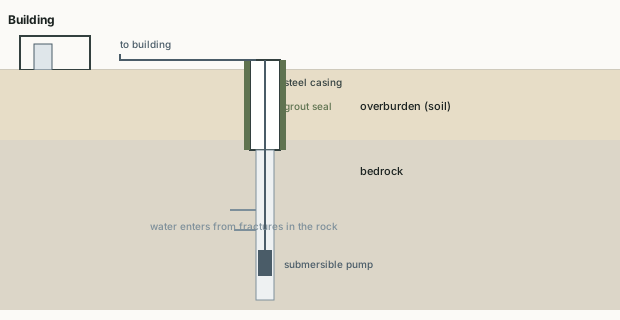
The well drilling process . The well drilling process: the drilling process runs through a clear sequence, even though the depth it reaches is unknown at the start. The rig arrives and sets up over the sited location, then advances steel casing down through the loose soil to solid bedrock and grouts around it to seal out surface water.
With the top sealed, the rig drills a narrower hole into the rock, blowing cuttings and water out as it goes, and the driller watches the flow to judge when the well is producing enough. Once the yield is adequate, the borehole is complete. The driller then installs the submersible pump on its drop pipe, sets the pitless adapter that carries water underground to the building, and connects the pressure tank and controls inside.
Finally the well is disinfected, tested, and the completion report, depth, yield, construction, is filed with the state. Ask the driller to separate borehole work from pump installation, disinfection and water-test turnaround in the proposed schedule.
Drilling day begins with the rig positioned over the location chosen during siting. The first step is setting the casing: steel pipe driven or drilled down through the soil overburden until it reaches competent bedrock, which keeps the loose ground and any shallow surface water out of the well.
Around that casing, the driller places grout, a sealing material that fills the annular space between the casing and the surrounding ground, keeping surface water from running down the outside of the casing and contaminating the supply. The casing and seal reduce the route for shallow contamination; they do not remove contaminants already dissolved in groundwater, and it is done before the hole goes into rock.
With the top sealed, the rig drills a narrower borehole down into the bedrock. Compressed air or fluid lifts the rock cuttings out of the hole, and as the bit passes through fractures, water enters. The driller monitors how much water the hole is producing, since that flow is the whole objective.
This is the stage where the well's depth and yield are determined, and it is why the same rig can finish one well shallow and drill another far deeper on a nearby lot. When the flow is adequate, the borehole is done.
A finished borehole is not yet a water supply. The driller or a pump installer lowers the submersible pump on its drop pipe to the correct depth, fits a pitless adapter so the water line leaves the casing below the frost line and runs underground to the building, and connects the pressure tank, switch and wiring inside.
The well is then disinfected to clear any contamination introduced during drilling, and the water is tested. The driller files a completion report with the state recording the depth, yield and construction, which becomes the permanent record of your well. Use the laboratory results and applicable permit conditions to establish whether further treatment or work is needed before drinking the water, and that completion report is worth keeping with your property papers.
The well drilling process: service details and questions
Finally the well is disinfected, tested, and the completion report, depth, yield, construction, is filed with the state. For a straightforward residential well the drilling itself is often a day or two, with the pump and connection work following
The rig sets casing first, grouts it, then drills on into the rock
Well drilling, step by step
The rig is positioned over the sited, setback-compliant location
Steel casing is set through the soil to bedrock to keep the well clean
The casing is sealed to the ground so surface water can't follow it down
The hole continues into rock until the well produces enough water
The submersible pump, pitless adapter, pressure tank and controls are installed
The well is disinfected and tested, and the completion report is filed with the state
Typical sequence for a residential drilled well; a licensed driller confirms the specifics
Setup, casing and grouting
Around that casing, the driller places grout, a sealing material that fills the annular space between the casing and the surrounding ground, keeping surface water from running down the outside of the casing and contaminating the supply. This casing-and-grout step is what makes a drilled well a protected source, and it is done before the hole goes into rock
Drilling into rock and finding water
There is no predetermined stopping depth. The driller continues until the well yields enough to serve the household reliably
Pump, connection and finishing up
The driller files a completion report with the state recording the depth, yield and construction, which becomes the permanent record of your well. From there the system is ready to use, and that completion report is worth keeping with your property papers
What are the steps in drilling a well?
The rig sets up, sets steel casing through the soil to bedrock, grouts it to seal out surface water, drills into rock until the yield is adequate, then the pump, pitless adapter and pressure system are installed, the well is disinfected and tested, and a completion report is filed with the state
How long does drilling a well take?
For a straightforward residential well, the drilling itself is often a day or two once the rig is on site, with the pump and connection work following. Difficult rock, great depth or access challenges can extend it, and permitting adds to the overall timeline beyond the drilling
What is the casing for?
The steel casing lines the top of the well through the loose soil, keeping soil and shallow surface water out of the borehole. It is set down to competent bedrock and, with the grout around it, is what makes a drilled well a protected water source instead of an open hole
Where does grouting happen in the drilling sequence?
Grout is a sealing material placed around the casing to fill the space between it and the surrounding ground, so surface water cannot run down the outside of the casing into the well. It is done before drilling into rock and is essential to keeping the supply clean
How does the driller know when to stop?
They monitor the water the hole produces as they drill and continue until the yield is adequate to serve the household reliably. There is no fixed target depth. The stopping point is when the well produces enough water, so depth varies so much between sites
What is a pitless adapter?
A fitting that lets the water line leave the well casing below the frost line and run underground to the building, so the connection does not freeze. It is installed as part of finishing the well and is standard for a cold-climate drilled well in Vermont
Is the well disinfected after drilling?
Yes, as a standard step. Drilling can introduce contamination, so the well is disinfected before use and the water is tested. This is a normal finishing step, and a new well should be confirmed safe by testing before it is relied on for drinking water
What is a well completion report?
The record the driller files with the state documenting the well's depth, yield and construction. It becomes the permanent record of your well, is useful for pump work and sales, and Vermont maintains a database of these reports. Keep your copy with your property papers
Does drilling make a mess?
Drilling blows rock cuttings and water out of the hole, so there is some slurry and disturbance around the wellhead during the work, which is cleaned up as part of the job. It is a normal part of the process instead of a sign anything is wrong
Can I be there while they drill?
You can, and it is often useful to be available for decisions, but the work is done by the crew and you do not need to participate. Knowing the sited location and having access clear for the rig is the main help the property owner provides
When can I use the water?
After the pump and pressure system are installed, the well is disinfected, and testing confirms the water is safe. The borehole alone is not a usable supply until those finishing steps are complete, so plan for the connection and testing after the drilling day itself
Who handles the whole process?
A licensed well driller does the drilling and files the report, and a driller or pump installer handles the pump and pressure system. For a new supply a licensed designer may be involved. Outline the work in the request form and it goes to the right professionals
How deep a well needs to be: service details and questions
How deep a well needs to be: there is no fixed depth for a Vermont well. The driller goes as deep as the rock requires to reach enough water-bearing fractures, and that cannot be known before drilling. Most drilled wells reach a few hundred feet.
Neighboring wells can differ dramatically, though, because the fractures that supply them are unevenly distributed in the bedrock. Depth is driven by where adequate water is found, not by a target number. Two things worth understanding follow from that.
First, a deeper well is not automatically a better one. It simply means adequate water was deeper, and depth adds cost because drilling is priced per foot
Second, depth interacts with water quality: deeper bedrock wells are well protected from surface contamination but can carry naturally occurring minerals from the rock, such as arsenic, which is a testing question rather than a depth you can drill past
The casing ends at bedrock. Depth below that depends on where water is found
What well depth does and doesn't tell you
What depth tells you
Is it a good well?
How far to adequate water
Whether yield meets demand
Is the water safe?
Better protection from surface contamination
Whether arsenic or radon are present: test for those
What will it cost?
More depth means more per-foot cost
The final total until drilling is done
Will it run dry?
Little on its own
Yield and recovery govern that, not depth alone
Why there is no set number
In a drilled well the water comes from fractures in bedrock, and those fractures are scattered unevenly through the rock. The driller advances until the hole has intersected enough of them to supply the household, so the finished depth reflects where the water happened to be, not a standard the well was drilled to meet
This is why two wells on adjacent lots can be very different depths. One may hit a productive fracture zone shallow, another may have to go far deeper for the same yield. A driller can estimate a likely range from the completion reports of nearby wells , but the actual depth is discovered during drilling instead of set in advance
Deeper is not the same as better
It is easy to assume a deeper well is a superior one, but depth only tells you how far the driller had to go to find adequate water. A shallower well that produces well is not inferior to a deep one
It simply found water sooner. Since drilling is priced per foot , a deeper well mainly means a larger bill, not a better supply
What matters is whether the finished well delivers enough water reliably, which is a question of yield instead of depth. A moderately deep, good-yielding well is an excellent outcome
A very deep, still-modest well is a more expensive one. Judging a well by its depth alone misses the number that governs whether it serves the household
Depth, protection and water quality
Depth does relate to water quality. You just can't drill past the part that matters. A deep, cased and grouted bedrock well is well protected from surface contamination like bacteria and runoff, which is a genuine advantage of drilled wells over shallow ones
The trade is that deep bedrock water can carry minerals dissolved from the rock. In Vermont, naturally occurring arsenic , uranium and radon are the notable ones. These are not solved by drilling deeper or shallower
They are found by testing and addressed by treatment if present. So depth buys protection from the surface, while the deep-rock contaminants remain a testing matter regardless of how far down the well goes
How deep should a well be in Vermont?
There is no set depth. The driller goes as deep as needed to reach adequate water-bearing fractures, which cannot be known in advance. A typical well is a few hundred feet, but neighboring wells vary widely because the fractures that supply them are unevenly distributed in the bedrock
Why can't the driller tell me the depth beforehand?
Because the water is in rock fractures no one can see until drilling intersects them. The driller can estimate a likely range from nearby wells' completion reports, but the actual depth is discovered during drilling, so wells are priced per foot instead of as a fixed job
Is a deeper well better?
Not necessarily. Depth only reflects how far the driller had to go to find adequate water. A shallower well that produces well is not inferior
It found water sooner. What matters is reliable yield, not depth, and since drilling is priced per foot, a deeper well mainly means a larger bill
How deep a well needs to be
How deep a well needs to be in Vermont cannot be set from a statewide average. The useful evidence is the proposed demand, nearby completion reports and the water encountered during drilling. Agree on a stopping decision.
The driller should explain how additional footage, an inadequate yield or a dry hole would be handled before work starts. Greater depth does not guarantee more water, and the depth alone cannot establish drinking-water safety. Keep those questions separate.
The finished report records construction, depth and yield; laboratory testing addresses the contaminants included in the sample panel. Nearby records help frame an estimate, but a poorly located record may describe a different setting.
Ask to see the original report. Use the historical figures below as background, then have the provider define the investigation and equipment needed for this property rather than treating a published median as a drilling target.
Reading Vermont’s historical depth figures
A 2009 Vermont Geological Survey compilation reports a median depth of 260 feet and a mean of 293.02 feet across its well dataset. These are historical summaries. They describe the records assembled for that map, rather than today’s drilling activity or the depth a new house should specify.
The dataset contains 92,315 wells, with 10,807 located wells. The authors say only 12 percent have reliable locations.
Most are completed in bedrock, but many records lack a well-type entry. That limits how confidently a nearby map point can be assigned to a particular parcel or construction method.
The map’s warning is explicit: it must not be used to predict yield or depth. Read the original completion reports when they are available. Compare the recorded location and construction details before asking a driller how those observations affect an estimate for your site.
Set a decision before paying for more footage
Ask the driller to separate the estimated drilling depth from the contractual terms. The proposal should identify the per-foot charge, casing allowance, additional work and the point at which you will discuss a poor result. Drilling farther is an option to evaluate, rather than proof that usable water will eventually appear.
A low-yield result also raises a demand and storage question. Have the provider document the measured yield and the applicable design assessment before selecting storage or another intervention. A larger pump cannot create groundwater that the source cannot supply.
Obtain the completion report after construction and retain later changes with it. The borehole depth, pump setting and available water are different measurements. A replacement pump decision needs its operating conditions and required delivery, not simply the number at the bottom of the drilling report.
Water quality still needs its own evidence
Do not infer safety from depth or from clear-looking water. Vermont Health recommends private-water testing because contaminants may have no useful taste, odor or appearance. Have the laboratory identify the appropriate panel and collection instructions for the source and the intended question.
Construction and condition matter alongside laboratory results. Ask the provider to identify the casing, cap, sealing requirements and potential contamination pathways for the actual installation. Grouting requirements depend on the applicable rules and site conditions; a drilled-well label does not prove that every well has the same seal.
Keep test dates and any treatment records with the construction report. If a result needs action, follow the Health Department’s guidance for that contaminant and confirm the result and treatment performance as directed. Additional drilling is not a substitute for identifying the water-quality problem.
Does a deeper well have cleaner water?
A deep, cased and grouted well is better protected from surface contamination like bacteria, which is an advantage of drilled wells. But deep bedrock water can carry naturally occurring arsenic, uranium or radon, which are found by testing rather than avoided by depth. Depth is not a substitute for testing.
How deep are most Vermont wells?
Commonly a few hundred feet down. But the range is wide since it depends entirely on local geology and where water-bearing fractures happen to be. The completion reports for wells near you, which the state keeps, give the best sense of the typical depth for your area.
Can a well be too shallow?
A shallow drilled well may draw from ground more exposed to surface contamination and may be more affected by drought, so there are protection and reliability reasons a driller continues into deeper rock. The right depth is the one that reaches adequately protected, reliable water for the site.
Does depth affect how much water I get?
Only indirectly. Yield comes from the fractures the well intersects, not from depth itself, so a deep well is not guaranteed to produce more than a shallow one. The driller keeps going until yield is adequate, so depth and yield are related during drilling but not proportional.
Will a deeper well stop it from running dry?
Not reliably. Whether a well runs low in a drought is governed by its yield and how fast it recovers, not simply its depth. A deep, low-yield well can still be drawn down faster than it recovers, which is managed with storage and use habits instead of by depth alone.
How do I find out how deep my existing well is?
The well completion report filed with the state records the depth, yield and construction. Your own paperwork or the previous owner may have a copy, and Vermont maintains a database of these reports. A driller can also estimate from the visible equipment if no record exists.
Does deeper cost more?
Yes. Because drilling is priced per foot, more depth means a higher bill, along with the casing and any additional work. This is the main reason a deeper well is not automatically better: it produces adequate water at a higher cost, not necessarily better water.
Can they stop drilling once they hit water?
The driller continues until the well is producing enough water reliably, not just at the first trace of it, because an inadequate yield would leave you short. Judging when the yield is sufficient for the household is part of the driller's job during the drill.
Who decides how deep to drill?
The licensed driller, based on the yield they measure as they go and their experience with the local geology. Note the property in the request form. It then goes to a driller who knows the typical depths in your area and can estimate a likely range before starting.
The well drilling process
The well drilling process includes site preparation, borehole construction, the required completion record and the separate work that makes the water supply usable. Ask the licensed driller to identify the intended location, access requirements and how drilling depth and yield will be documented. Agree how additional depth is priced without treating an estimated depth as a guarantee.
Casing and sealing protect the constructed well; the pump, controls, building connection, disinfection and water testing also need a named scope. A finished hole alone does not establish safe drinking water or reliable delivery inside the house.
Obtain the well completion report and laboratory results, then retain the final equipment information. If more than one contractor is involved, make clear who coordinates the connection and confirms the remaining work before occupancy.
The well drilling process before the rig arrives
Confirm the approved supply location and any access or utility constraints with the professionals responsible for the project. Tell the driller about an existing septic layout and neighboring wells.
Establish who protects the work area, handles drilling discharge and restores the agreed surface disturbance. Equipment access should not be improvised across an existing disposal field.
From construction record to an operating supply
The completion report records what was constructed and observed during drilling. It is distinct from the pump specification and laboratory report.
Ask the installer to match the delivery arrangement to the source and household requirements, and identify any storage or treatment proposal separately. Keep the records together so later pump work is based on the real well rather than a remembered depth.
Well yield and flow rate
Well yield is how much water a well produces, measured in gallons per minute during drilling, and it is the number that really determines whether a well serves a household. Compare production with actual demand. A modest yield needs assessment of storage and the demand the property places on the supply.
What matters is not one ideal figure but whether the well meets the household's peak demand, several fixtures at once, without running short. Where the steady yield is modest, storage bridges the gap: the well's slow production fills a tank or its own deep column between peaks, and the household draws from that reserve during heavy use. Storage cannot create water; source production must replenish the usable reserve between periods of heavier use.
Have a driller assess suitable rehabilitation or supply options for the well. Compare peak household demand with the measured source production and usable storage together.
What yield measures
Yield is the rate at which water enters the well from the rock, expressed in gallons per minute and measured while drilling. It reflects how productive the fractures the well intersected are, and it is determined by the geology rather than by anything the owner does. A well with a generous yield keeps up with any household demand as it happens.
A low yield does not mean the well is inadequate. It means the steady supply is modest and has to be paired with storage to handle peaks. Because Vermont bedrock frequently gives modest yields, a low completion-report figure needs interpretation alongside recovery, storage and actual household demand.
The yield figures the Vermont rules use
For a well designed to deliver 5 gallons a minute or less, the Vermont rules set the long-term yield at 50 percent of the well driller's estimated yield. For a source within that design-rate category, a driller estimate of 6 gallons per minute gives a 3-gpm long-term estimate, subject to the exceptions requiring analysis in §1-1107(b).
Section 1-1109(d) exempts specified pumped supplies, including a single-family residence with a pump capable of meeting instantaneous peak demand, from its subsections (a) and (e). Where subsection (e) applies, peak demand above long-term yield requires compliant storage or the specified testing. Have the designer identify which provision applies.
Where §1-1110 storage is required, its calculations use the design flow: 55 percent of it when yield meets the design rate, or the full design flow when the yield falls between two thirds and all of the design rate. Casing storage in a deep bore counts toward the total.
How storage bridges a low yield
The key insight is that households do not use water at a constant rate. They use it in bursts. A well only needs to produce enough over a full day to cover total use, provided there is a reserve to draw on during the short peaks.
That reserve is storage. Either the deep column of water standing in the well casing itself, or a separate storage tank.
So a well yielding just a gallon or two a minute can serve a family: during a heavy morning of showers and laundry, the household draws down the reserve faster than the well refills it, and over the quiet rest of the day the well replenishes the reserve. Sizing that storage to the household's peaks is how a modest yield becomes a fully adequate supply.
When and how to improve a low yield
If a well's yield is too low even with storage, there are options short of abandoning it. Hydrofracturing injects water under pressure to open or clear fractures in the rock, and it often improves a low-yielding drilled well. Drilling deeper, or occasionally a new well, is the fallback when fracturing does not deliver.
Reducing peak demand helps too. Water-efficient fixtures and spreading heavy use across the day lower the peaks the storage has to cover.
The right approach depends on how far short the well falls and how the household uses water, which a driller can assess. A low-yield source needs a measured supply and storage assessment before selecting work.
Is a low-yield well a problem?
Not by itself. Low-yield wells are common in Vermont bedrock and are managed with storage instead of replaced. A well producing only a gallon or two a minute can serve a family, since a reserve covers short peaks while the well refills over the quieter rest of the day.
What is hydrofracturing?
It is injecting water under high pressure to open or clear the rock fractures that feed a well, used to improve a low-yielding drilled well. It often boosts yield enough to solve the problem. A driller can advise whether it is worth trying before deepening the well or drilling a new one.
Can a well's yield change over time?
It can decline if fractures gradually clog or during a drought when groundwater is low, and it can be restored by hydrofracturing in some cases. A yield that drops noticeably is worth investigating, since it affects whether the storage and use that worked before still keep up.
How is yield measured?
The driller measures the flow the well produces during drilling, in gallons per minute, and records it on the completion report. A more detailed flow or drawdown test can be done to understand how the well behaves under sustained pumping, which is useful when the yield is marginal.
Will a deeper well have more yield?
Not reliably. Yield comes from the specific fractures a well intersects, not from depth itself, so drilling deeper does not guarantee more water. The driller continues until yield is adequate, but a deep well can still be low-yield if the rock it passed through was not productive.
What yield do I need for a family of four?
Rather than a fixed number, a family of four needs a supply that covers its peak simultaneous use, which many modest-yield wells handle with appropriate storage. A driller can match your household's peak demand to the well's yield and the storage needed, which is more meaningful than a generic figure.
Can I run out of water with a low-yield well?
If demand during a peak exceeds the reserve, yes. But that is what proper storage sizing and sensible use prevent. Running short means the storage is undersized for the household's peaks or the yield has dropped, both of which can be diagnosed and addressed.
Does a storage tank take a lot of space?
Storage can be the well's own deep water column or a separate tank, and the size depends on the yield and the household's peaks. A pump installer sizes it to bridge your specific demand, so it is scaled to need instead of being a fixed, large installation for every low-yield well.
Who assesses whether my well produces enough?
A licensed well driller or pump installer can measure the yield and match it to your household's demand and storage. Describe your water concerns and household size in the request form, and it is routed to a professional who can tell you whether your supply is adequate or needs help.
Where a well can go
Where a well can go depends on the permitted location and required separation from contamination sources, neighboring systems and other features that the water supply could affect. Most importantly the septic system, but also property lines, surface water, and other wells. These required distances are called isolation distances or setbacks, and they keep a drinking-water source from being placed where wastewater, runoff or a neighbor's system can reach it.
The separation between a well and a leachfield is the one that most often governs siting, since a property has both and they must be kept well apart. The specific numbers are set by the Vermont Wastewater System and Potable Water Supply Rules and confirmed by a licensed designer or the regional office for your parcel.
Obtain the applicable setback and permitted location from the designer in writing. The spot also needs practical access for the rig.
Why siting comes first
A well is permanent. Putting it in the wrong place is not something you fix later. You would have to drill a new one.
The location is worked out before drilling, checking that the spot meets the required separations and that the rig can reach it. Siting is a planning step, not a decision made when the rig shows up.
On most Vermont properties the governing limit is the septic system: the well must be kept a required distance from the tank and especially the leachfield, keeping effluent that is still being treated in the soil away from the drinking-water source. A property that has both a well and a septic system has to fit them on the lot with that separation preserved, which is often the tightest part of the layout.
What the setbacks protect against
Isolation distances keep a well away from sources of contamination and interference. Beyond the septic system, they govern separation from surface water like streams and ponds, from property lines and neighboring systems, and from other potential contamination sources on or near the parcel. Each distance exists since that feature could, if too close, put something into the well that should not be there.
These rules are why a well cannot simply go wherever is convenient. On a small or awkward lot, satisfying every setback at once can be the real design challenge, and it is one reason a licensed designer is involved when a well and septic system are being planned together on a difficult site.
Confirm the applicable rule category
Section 1-1104 distinguishes bedrock or confined wells from unconfined surficial supplies. Its separation table also distinguishes the well’s design yield and whether the wastewater feature is uphill, downhill or beside the well. Use the applicable category, not a single setback copied from a neighboring property.
Ask the designer to place the isolation zones on the proposed parcel drawing, including relevant neighboring features. Any permitted reduction or enlarged zone needs its supporting determination; the table does not authorize an owner to move a boundary.
Who determines where my well goes?
A licensed designer sites the well to the current rules as part of designing the water and wastewater systems, and the regional permitting office confirms specific questions. On a straightforward lot a driller may handle it, but a tight or complex site benefits from a designer's involvement.
Can I drill a well close to my neighbor's property?
Only if it meets the required setbacks from the property line and from the neighbor's septic system and well. Boundaries and neighboring systems carry their own separations. A well near a line has to be checked against those distances by a designer or the regional office before drilling.
What if my lot is too small to meet the setbacks?
Ask the designer to show the proposed well and wastewater locations on the same plan, including the required isolation zones and any site-specific authorization. Sometimes the layout can be reworked. Occasionally a lot constrains what is possible, which is important to learn before buying or building.
Does surface water affect where a well can go?
Yes. A well must be kept a required distance from streams, ponds and other surface water, both to protect the well from surface contamination and to keep the arrangement compliant. On a lakeshore or streamside lot, that separation can be one of the limits that shapes the whole site plan.
Can I move an existing well?
A well cannot be relocated. Moving it means drilling a new one and correctly decommissioning the old one, so getting the location right the first time matters so much. If an existing well is poorly sited, a designer can advise on whether a new, compliant well is warranted.
Do setbacks apply to replacing a failed system?
Yes. When a septic system is replaced near a well, or a new well is drilled near an existing system, the separations still apply and are part of what the designer works out. Fitting a compliant replacement onto an already-developed lot is a common Vermont challenge that the setbacks drive.
Who helps me site a well?
A licensed designer, and the regional permitting office for specific questions, with a well driller confirming access. Describe your project and whether you have or need a septic system in the request form, and it is routed to a professional who can site the well correctly.
Can a grouted well casing shorten the septic distance?
Sometimes. Where the state grants a reduction in the isolation zone, it may require grouting as a condition. When a two-year time-of-travel zone is used, no point of the zone may be closer than 50 feet to a grouted well or 100 feet to an ungrouted one.
Well casing and grouting
Well casing and grouting protect the upper part of a drilled water supply against surface contamination, with construction requirements that matter alongside depth and yield. The casing is a steel pipe set through the loose soil to bedrock, lining the upper well so soil, debris and shallow groundwater cannot seep into the borehole. The grout is a sealing material placed in the space around the casing, bonding it to the surrounding ground keeping surface water from running down the outside of the casing and reaching the water below.
The casing, seal and wellhead need assessment as an installed assembly. Well depth alone does not establish protection from contamination or the quality of the water.
When a well develops bacterial contamination that testing cannot otherwise explain, a failed casing or grout seal is a prime suspect. It is the barrier meant to keep surface contamination out.
What the casing does
The casing is the steel pipe you can often see sticking up at the wellhead. It lines the well through the overburden, the soil and loose material above bedrock, and is set down into competent rock. Its job is structural and protective at once: it holds the loose upper ground back from collapsing into the hole, and it keeps soil and shallow groundwater from entering the well from the sides.
Below the casing, the well is open borehole in solid rock, which does not need lining. So the casing protects precisely the vulnerable upper zone, where the well passes through the ground most exposed to surface contamination. A sound casing is the first half of what makes a drilled well a protected source instead of an open pipe to the shallow ground.
What the Vermont rules require of casing and grout
Section 1-1205 of the Vermont rules sets the construction basics. Casing must extend at least 18 inches above finished grade, and the cap must be permanent, tight fitting, watertight and shaped to shed water and snow, and it cannot come off without a tool or key. Steel casing must have a drive shoe when driven into bedrock, and 7-inch steel casing needs a wall of at least a quarter inch.
Plastic casing must be Schedule 80 or SDR 21 or heavier, and joints must be threaded or fully welded. Grouting is not automatic.
The state requires it when a leachfield isolation zone is reduced or when site conditions call for it, and it recommends it if the well could someday become a public water source. When grout is not required, the space around the casing is filled with native material such as drill cuttings.
What the grout adds
The casing alone would still leave a gap: the space between the outside of the casing and the surrounding ground. Without a seal, surface water could run down that annular space alongside the casing and enter the well below, bypassing all the protection the casing provides. Grout closes that path.
Grout is a sealing material, cement or bentonite based, placed in that annular space to bond the casing to the ground and block any downward flow of surface water along it. With the casing keeping contamination out from the sides and the grout sealing the outside, the two together form a continuous barrier between the clean water and the surface.
Whether grouting is required depends on the applicable rule and site conditions. Read the completion report.
Compare it with the approved design. Do not assume every Vermont well was grouted.
When casing or grout fails
Because casing and grout are the barrier against surface contamination, a failure in either is a leading suspect when a well tests positive for bacteria or shows surface influence that its depth would not otherwise explain. A corroded or cracked casing, a poor or missing grout seal, or a damaged wellhead cap can all let contamination bypass the protection.
This is one reason a well showing unexplained bacterial contamination is investigated at the wellhead, not just treated at the tap. A driller can assess the casing and seal, repair or extend them, and ensure the cap and vent are sound. Keeping the area around the wellhead clean and free of contamination sources supports the barrier the casing and grout provide.
Can a bad casing cause contaminated water?
Yes. Have the provider investigate the wellhead, cap and casing condition when interpreting an unexplained bacteria result. Follow the Health Department’s water-use advice while the cause and remedy are established. The barrier failing is a prime suspect when depth alone would not explain the result.
How deep does the casing go?
It is set through the soil overburden down into competent bedrock, so its length depends on how deep the soil is before solid rock. The completion record should identify the casing depth, borehole depth and construction details.
Have the driller explain any proposed extension or other repair against those records. The casing protects exactly the vulnerable upper section.
Does the whole well need to be cased?
No. Only the upper part through the soil, down into bedrock. The rock below is stable and does not require lining, so the casing lines the section most exposed to surface contamination and the borehole continues open in the rock beneath it.
How do I know if my grout seal is good?
It is not visible from the surface at all. A driller assesses it when contamination or surface influence appears in testing, or during other well work. Unexplained bacteria, or water quality that shifts with rainfall on a deep well, can point to a compromised seal worth investigating.
Can casing and grout be repaired?
Often yes. A driller can assess and repair or extend the casing, re-establish or improve the grout seal, and replace a damaged cap. Because these are the barrier protecting the water, fixing a compromised seal is addressing the cause of contamination rather than just treating the symptom at the tap.
What is the wellhead cap for?
It covers the top of the casing to keep insects, debris and surface water from entering the well from above, and it includes a screened vent. A missing, loose or damaged cap is an easy way for contamination to get in. A sound cap is part of protecting the well.
Why does my deep well have bacteria?
Use the construction record, wellhead assessment and current laboratory results to evaluate this supply. So bacteria that its depth does not explain often point to the casing, grout seal or cap letting surface contamination bypass the protection. Such a result is investigated at the wellhead instead of assumed to be a deep-water problem.
Does keeping the wellhead area clean help?
Yes. Keeping contamination sources, animal waste, fuel, chemicals, standing water, away from the wellhead supports the barrier the casing and grout provide, since it reduces what could reach a compromised seal. Wellhead protection is a simple, ongoing part of keeping well water safe.
Who inspects well casing and grouting?
A licensed well driller, who can assess the casing, seal and cap and repair them if needed. Describe any water-quality concern, especially unexplained bacteria, in the request form, and it is routed to a driller who can check whether the well's protective construction is intact.
| Stage | What happens | Why it matters |
|---|---|---|
| Siting | The legal, accessible location is chosen | Confirm applicable isolation zones and equipment access before committing |
| Casing | Steel casing is set through the soil to bedrock | Keeps soil and surface water out of the well |
| Grouting | The casing is sealed to the rock | Blocks surface contamination from following the casing down |
| Drilling | The hole continues into bedrock until yield is adequate | Measured yield and the approved supply design determine what further work is appropriate |
| Pump & pressure | The pump and pressure tank are installed | Turns the borehole into a working water supply |
General sequence for a residential drilled bedrock well; a licensed driller confirms the specifics for your site.
| Question | What the assessment needs |
|---|---|
| Adequate water | Measured yield, proposed demand and any required storage |
| Water safety | Appropriate laboratory results and construction/condition findings |
| Price | Defined drilling, casing, pump, controls and connection scope |
| Drought resilience | Available water and recovery over relevant conditions, not depth alone |
General relationships for drilled bedrock wells; your well's specifics are on its completion report.
| Document | Issued for | Keep with it |
|---|---|---|
| Drilling record | Construction and reported yield | Location information |
| Equipment schedule | Pump and controls | Model and installer details |
| Laboratory report | Sampled water quality | Sample date and treatment context |
Construction, equipment and water-quality records document different parts of the supply.
| Quantity | Meaning |
|---|---|
| Driller estimate | Initial reported production, not automatically the design yield |
| Design rate | Rate the proposed supply is designed to provide |
| Instantaneous peak demand | Simultaneous fixture demand, distinct from daily flow |
| Required storage | Determine applicability first; then use the prescribed calculations |
Vermont rules §§1-1107–1-1110. Exemptions and testing requirements matter; a single gpm number is insufficient.
| Situation | What the rules require |
|---|---|
| Design rate 5 gpm or less | Long-term yield equals 50 percent of the driller's estimated yield |
| Peak demand above long-term yield, pumped well | Storage sized to the peak demand, or an abbreviated pumping test |
| Yield at least two thirds of the design rate but below it | Storage equal to the design flow |
| Yield at or above the design rate | Storage of 55 percent of the design flow, or a calculated volume |
| Drilled or driven well | Casing storage above the pump cut-off level can count toward the required volume |
Vermont Wastewater System and Potable Water Supply Rules, sections 1-1107 to 1-1110, November 6, 2023 edition, with 2024 corrections.
| Item | Explanation |
|---|---|
| Distance from the septic system | The usual governing limit: separation from the tank and especially the leachfield. |
| Distance from surface water | Separation from streams, ponds and other surface water that could contaminate the well. |
| Distance from property lines and other wells | So neighboring systems and boundaries are respected. |
| Other contamination sources | Fuel storage, farm operations and similar features carry their own required separations. |
| Rig access | The legal location also has to be reachable by the drilling equipment. |
The categories of setback under the Vermont Rules; confirm the actual distances with a designer or the regional office.
| From the well to | Bedrock or confined aquifer well | Unconfined surficial aquifer well |
|---|---|---|
| Property line | 10 | 10 |
| Surface water, normal high water | 10 | 25 |
| Building or foundation | 5 | 5 |
| Driveway serving fewer than 3 homes | 5 | 10 |
| Roadway, parking lot or larger driveway | 25 | 25 |
| Septic tank or other wastewater tank | 50 | 75 |
| Leachfield, well up to 2 gpm (uphill and sides / downhill) | 100 / 200 | 150 / 500 |
| Leachfield, well over 2 and up to 5 gpm (uphill and sides / downhill) | 150 / 300 | 150 / 500 |
| Fuel oil tank and piping | 25 | 100 |
| Cemetery | 100 | 150 |
Vermont Wastewater System and Potable Water Supply Rules, section 1-1104, November 6, 2023 edition, with 2024 corrections. The Secretary can reduce a zone, sometimes with a grouted casing, or require a larger one.
| Component | What it is | What it keeps out |
|---|---|---|
| Casing | Steel pipe through the soil to bedrock | Soil, debris and shallow groundwater from the sides |
| Grout seal | Sealant in the space around the casing | Surface water running down the outside of the casing |
| Wellhead cap | The cover on top of the casing | Insects, debris and surface water from the top |
| Bedrock borehole | Open hole in solid rock below the casing | Construction and stability must be assessed; do not assume every borehole needs no lining |
General function of well construction components; a licensed driller assesses your well.
Well drilling: footage, completion reports and equipment
How much water will the well produce?+
Yield, measured in gallons per minute, is whatever the rock fractures deliver, and it is found during drilling. Many Vermont wells have modest yields that are managed with storage and sensible use instead of replaced. What matters is meeting the household's peak demand, not a single ideal number.
Where can a well be drilled on my property?+
Have the designer identify the approved location on the parcel plan and confirm that the drilling equipment can reach it without disturbing protected areas. Siting comes before drilling, since a well in the wrong place is a permanent problem that a designer or driller helps you avoid.
How long does it take to drill a well?+
Just a day or two. A residential well is often drilled in a day or two once the rig is on site.
Difficult rock, depth or access can extend it. Installing the pump and pressure system and any permitting add to the timeline too.
Do I need a permit to drill a well?+
Water supplies fall under Vermont's design and permitting framework, particularly for a new build, and well completion reports are filed with the state. Confirm the requirements for your situation with a licensed driller or designer instead of assuming, since a new supply is treated differently from work on an existing well.
What if the well is low-yield?+
Low-yield results are common in Vermont bedrock and manageable. Options include storage tanks to bank water for peak use, sensible water habits, and sometimes hydrofracturing to open more fractures or drilling deeper. A low yield is rarely a reason to abandon the effort.
What is hydrofracturing a well?+
It is injecting water under pressure to open or clear the rock fractures that feed the well, used to improve a low-yielding drilled well. It is a recognized technique when a well underperforms, and a driller can advise whether it is worth trying before drilling deeper or elsewhere.
Can I drill a well anywhere there's no water main?+
Yes, with conditions. A property without municipal water needs a well, but the location must meet setback rules and the geology must support it.
Most Vermont sites can be drilled successfully, though a few difficult ones require extra depth or techniques. A driller assesses feasibility for your specific parcel.
Who drills wells in Vermont?+
Licensed well drillers, who also file the required completion report with the state recording depth, yield and construction. For a new supply you may also involve a licensed designer. Tell us the property in the request form and it goes to a driller who works your area.