The septic drain field
The septic drain field, also called a leachfield, is where soil treatment happens: clarified effluent from the tank flows through perforated pipe laid in gravel-filled trenches, trickles down through the soil beneath, and is filtered and broken down by soil organisms before it ever reaches groundwater. Unlike the tank, a sealed structure, the field's performance depends entirely on soil condition, so anything that compacts it, saturates it, or clogs its pore spaces with solids reduces how much water it can accept. Field sizing follows authorized design flow, the applicable soil-based application rate and the complete system criteria.
Actual condition and loading, not a universal lifespan range, inform its remaining service. A designer must distinguish failed treatment soil from a repairable pipe or distribution defect before recommending replacement. Everything upstream, from pumping the tank on schedule to keeping vehicles and roots off the field, protects this one irreplaceable piece of the system.
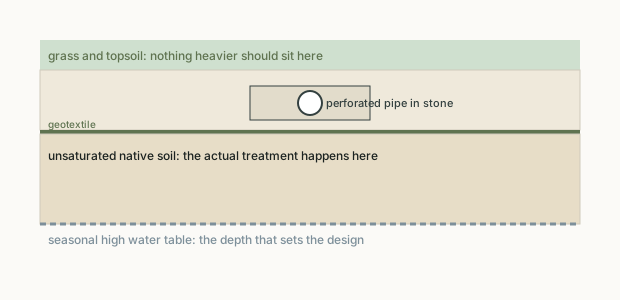
| Check | What it involves |
|---|---|
| Pump the tank on schedule | Measured pumping removes accumulated solids and reduces the risk of solids carryover; it does not prevent every field fault. |
| Keep the effluent filter clean | Follow the installed model’s instructions; assess any alarm or restriction promptly. |
| Never drive or park on it | Compaction destroys the soil structure that lets water percolate. |
| Keep trees and roots well back | Roots seeking moisture can invade and crack field pipe. |
| Route runoff away from it | Excess surface water saturates soil that is already doing its job. |
Standard field-protection practices reflecting how leachfield soil treatment works.
How soil does the treatment
Effluent leaving the septic tank still contains pathogens, nutrients and dissolved material that the tank's settling process cannot remove. That work happens in the soil itself, as water percolates slowly downward through layers of biologically active soil that filter out pathogens and break down organic material before it reaches groundwater.
The field’s soil texture, structure and depth to groundwater or bedrock matter during design because the receiving soil must both accept and treat the wastewater. Those are related requirements, not a guarantee that faster drainage supplies better treatment.
Ask the designer to identify the limiting layers and the applicable application rate for the proposed location. Vermont’s current rules do not establish the required footprint from an old percolation reading alone.
Why fields fail, and why failure is permanent
A field fails when its soil pore spaces clog with the fine solids that a neglected tank, a bypassed baffle, or a clogged effluent filter let through over years. Once clogged, that biological mat at the base of the trenches does not clear itself. The soil has lost the structure that let water percolate through it.
Other causes are physical: driving or parking on the field compacts the soil the same way, tree roots can invade and crack pipe, and a field simply undersized for the household hits its capacity sooner than a correctly sized one would. The diagnosis determines whether a component repair can restore operation or a new permitted treatment area is needed.
What protects a healthy field
Everything upstream of the field exists to keep solids and excess water away from it. A tank pumped on schedule, a working effluent filter, and sound baffles keep solids from ever reaching the trenches. Even distribution from a level d-box keeps any one section from being overloaded while the rest goes underused.
On the surface, keeping vehicles, structures and deep-rooted trees off the field, and directing roof and surface runoff away from it, prevent the compaction and saturation that shorten a field's life. None of these habits are expensive. All of them are cheaper than the field replacement they prevent.
Find the cause before choosing a replacement layout
In the meantime, if the failure is severe, water use restrictions or a temporary solution may be necessary to manage the household's wastewater until the new system is complete and in service.
The process starts with a professional evaluation confirming the field has failed rather than the tank simply being overdue for pumping. This distinction matters, since a tank problem is a far smaller fix than a field replacement , and getting the diagnosis right avoids unnecessary expense.
Once failure is confirmed, understanding why it happened, age, neglect, an undersized original design, or a site condition like a rising water table, can inform how the replacement is designed, sometimes leading to a larger or differently engineered system than the original.
A licensed designer evaluates the proposed treatment area and prepares a design for the permitted use and observed soil conditions. That design accompanies the wastewater application before construction.
This step is often the longest part of the overall timeline, since permit review depends on the regional office's workload and the complexity of the design, with the application requirements depending on the site and proposed design.
Once permitted, an installer following the approved plan builds the new field according to the design, which follows the same excavation, tank connection, and field construction sequence as any new installation, though without needing to replace the existing tank unless it too shows problems.
Managing the household in the meantime depends on how severe the failure is. Some households can continue with reduced water use, while a severe failure with active backups may require an authorized temporary wastewater arrangement agreed with the designer and permitting authority until the new field is ready.
Separate design flow, receiving soil and the approved footprint
How big a septic drain field needs to be . How big a septic drain field needs to be: a septic drain field's required size is calculated from two numbers: the house's design flow, based on bedroom count, and the soil application rate supported by the site evaluation and current rules. Vermont's wastewater rules translate those numbers into a required square footage of trench or bed bottom, called the application area, the actual surface through which effluent must percolate into the soil.
Fast-draining, sandy soil needs less area per gallon of design flow since it accepts water quickly. Slow, tight or clay-heavy soil needs considerably more area for the same household, depending on the permitted application rate.
Design flow comes from bedroom count under a standard state formula that estimates gallons per day the system must be able to handle at peak household use. Current household use alone does not establish the permitted design flow, since the design must accommodate the home's potential future occupancy, not just its current residents.
The permitted soil application rate is not obtained merely by timing water in a hole. Vermont removed percolation-test references in its 2023 amendment. Have the designer identify the evaluated soil properties and the rule provision supporting the rate used in the area calculation.
Sandy or gravelly soils perc quickly and require the least field area for a given design flow, all else equal. Loam soils fall in the middle. Clay-heavy or tightly compacted soils perc slowly, requiring a design based on their own evaluated soil properties to handle the identical household flow.
In the slowest or shallowest soils, a conventional buried field may not be feasible at any size, which is when a raised mound system or other engineered design becomes necessary instead of simply enlarging a standard trench field.
Your required size comes from the applicable design flow, soil application rate and site evaluation on your specific lot, performed by a licensed designer as part of the permitting process. Any number quoted without site-specific testing is a rough estimate at best.
From the house's design flow, based on bedroom count, and the applicable soil loading rate. Together they determine the required application area, the surface area through which effluent must percolate into the soil.
Bedroom count, which drives design flow, is the main household factor, but soil type can matter just as much or more. A small home on slow soil can need a larger field than a bigger home on fast-draining soil.
What a replacement estimate needs before a price
Drain field replacement . A failed drain field needs an assessment of the failure and the replacement options before the treatment area and layout are chosen. The process starts with a site and soil evaluation of the proposed treatment location, which a licensed designer uses to size the replacement to Vermont's wastewater rules.
The design is then submitted for a state permit before construction begins. Cost varies widely with soil conditions, field size and site access, so a meaningful price must identify the approved system, quantities and site work rather than assume a universal range.
Separate the application, design, review and construction stages when asking for a schedule. The assessment must identify whether the existing disposal area can be used under an approved plan or whether another suitable location is needed.
An assessment must distinguish soil-treatment failure from a repairable problem in a pipe, filter, pump or distribution component. Where the treatment area cannot function under an approved repair, the designer evaluates a suitable replacement location instead of promising that a chemical product will restore it.
This means a replacement design starts largely from scratch: a new soil evaluation, and a design sized to current bedroom count and soil conditions, which may differ meaningfully from whatever standard applied when the original field was installed decades earlier.
A licensed septic designer conducts the soil testing, prepares the design, and submits it to the state for a wastewater permit. This step cannot be skipped, since installing a septic system without a permit is both illegal and a serious liability if the property is ever sold.
Permit review time varies by season and regional office workload, and a site needing a raised mound system or other engineered solution because of poor soil or a high water table takes longer to design and approve than a straightforward conventional field.
Field size, driven by bedroom count and applicable soil application rate, is the biggest cost factor, since a slow-draining soil needs proportionally more field area for the same household. Site access matters almost as much. A field requiring extensive tree clearing, ledge removal or difficult equipment access costs more than an open, easy site.
A mound or other engineered system, needed where natural soil or water table conditions rule out a conventional buried field, adds both material and labor cost compared to the simplest design. Getting comparable quotes from installers working to the approved design, once the design is set, is the practical way to see where your specific site lands in the range.
Check which components a proposed restoration changes
Drain field rejuvenation and restoration . A handful of restoration techniques, resting the field, aerating or jetting the trenches, and chemical treatments marketed to break down the clogging layer, can sometimes extend the life of a struggling field, but none reliably reverses a field that has failed, and the evidence for the more aggressive treatments is mixed at best. Resting a field removes its wastewater load for an approved period, allowing the clogging layer to change; it requires an authorized alternative disposal arrangement and does not repair broken components or guarantee renewed treatment capacity.
Aeration or jetting, which physically disturbs the clogged layer, has a mixed record and can worsen things by pushing solids deeper. Chemical additives promising to dissolve the clogging layer are widely sold but lack strong evidence, and a professional's assessment of your field's condition beats any product's marketing claims when deciding whether restoration is worth attempting before full replacement.
Resting means taking a field out of active service, through an authorized alternative wastewater arrangement, for an extended period, for a duration established for the approved arrangement. During that rest, the biological mat causing the clogging can partially decompose without new effluent constantly adding to it, sometimes restoring meaningful percolation capacity.
This approach works best on a field that is struggling but not completely saturated, and it requires having somewhere else for wastewater to go during the rest period, which is not an option every property has. It is useful in the right circumstances, not a universal fix.
Aeration or jetting techniques physically inject air or water pressure into the clogged soil layer to try to break it up and restore permeability. Results vary considerably by soil type and how far the clogging has progressed, and there is a real risk of pushing fine solids deeper into the soil profile instead of removing the problem.
Chemical or enzyme treatments sold to dissolve the biological clogging mat are widely available, but the evidence supporting their effectiveness is thin and largely anecdotal rather than independently verified. EPA does not recommend bacterial or chemical additives as domestic wastewater maintenance; an operating problem needs assessment rather than a product guarantee.
Restoration techniques are most worth considering when a field shows early or intermittent symptoms instead of persistent, severe failure. Occasional slow drains that clear seasonally, instead of constant surfacing effluent or backups that never stop. A professional evaluation of how far the clogging has progressed is the starting point.
On a field that has failed severely, sustained surfacing, backups regardless of water use, a d-box that shows no acceptance at any outlet, a restoration proposal needs evidence that it addresses the documented failure while the symptoms continue to affect the household and property. Getting a straight assessment before spending money on treatment avoids throwing good money after a field that needs replacing regardless.
Do I need a new permit to replace a failed septic system?
Yes. A new wastewater permit is required for the replacement design, based on the applicable site evaluation, permitted use and replacement layout.
Can I use my house while my septic system is being replaced?
It depends on failure severity. The provider and permitting authority must establish what use or temporary arrangement is appropriate, while a severe failure with active backups may require a temporary solution until the new system is ready.
Does a failed septic system need a whole new tank too?
Not always. A sound tank may be retained if it suits the approved design; other components still need assessment. The findings should identify structural condition, fittings and required capacity before reuse is assumed.
How much does it cost to replace a failed septic system?
Costs vary with soil conditions, field size and site access. The dedicated cost guide breaks down the design and construction items to compare in a full replacement.
How do I find a suitable new field location on my property?
A licensed designer identifies candidate areas and tests them, considering setback requirements, soil conditions, and available space. This is part of the design process instead of something a homeowner determines alone.
Can I finance a septic system replacement?
Vermont homeowners can review the available program eligibility and application requirements before assuming funding is available for a replacement. The grants, loans and financing guide covers what's available.
Why does soil type matter so much for field size?
Fast-draining sandy soil accepts water quickly and needs less area. Slow, tight or clay-heavy soil accepts it much more gradually and needs considerably more area, according to its evaluated application rate, to handle the same household flow.
Can I make my drain field smaller to save money?
No. The required size is determined by Vermont's wastewater rules based on your design flow and soil testing, so an installer cannot substitute a smaller unapproved layout merely to lower the price.
Does the field size include the whole yard area it sits in?
No. The required 'application area' is the trench or bed bottom surface where effluent contacts soil, which is smaller than the total footprint including spacing between trenches and setback buffers around the field.
Can I add a garage or addition without affecting my field size requirement?
Adding bedrooms triggers a review of whether your existing field meets the new design flow requirement. Other changes can also affect use or layout, so have the proposal compared with the permit rather than using bedroom count alone to rule out review.
How accurate are online drain field size estimates?
Not very, for a specific property. They can give a rough sense of typical ranges, but the only figure that matters for permitting is based on the permitted design flow and current soil-evaluation basis for the site.
Does a smaller lot limit how big my drain field can be?
It can, since the field also needs to meet setback distances from wells, property lines, water bodies and the house, which combined with a large required area can make some small lots challenging to permit.
Who performs the percolation test and sizing calculation?
A licensed septic system designer evaluates the soil and site requirements and calculates the required field size as part of preparing the design submitted for a Vermont wastewater permit.
Do I need a permit to replace a septic drain field?
Yes. A new field requires a state wastewater permit based on a design from a licensed septic designer, which includes soil testing on the proposed new location. Installing without a permit is illegal and a major liability.
Why does a mound system cost more than a conventional field?
A mound is a raised, engineered structure built where natural soil or water table conditions rule out a buried field, requiring more imported material and specialized construction than a standard trench field.
Can I use my septic tank while the field is being replaced?
Have the provider and permitting authority establish the appropriate arrangement for the documented failure. An active failure means water use must be minimized or a temporary solution arranged during construction, which your contractor can advise on for your specific situation.
Does my whole yard need to be tested again for a replacement?
Not the whole yard, but the specific proposed new field location needs the applicable site and soil evaluation, since suitable soil elsewhere on the property may differ from the original, now-failed area.
Is a bigger drain field always more expensive?
More treatment area adds work, but soil, system type and access must also be compared. A small field on difficult, ledge-heavy ground can cost more than a larger field on easy soil.
How do I choose an installer for a field replacement?
Get quotes from installers working to the permitted design once the design is permitted, and ask about their experience with your specific soil conditions and design type, especially if a mound or engineered system is required.
Can a failing field be caught before it needs full replacement?
Sometimes. Early signs caught during routine maintenance or an inspection occasionally allow a smaller, targeted fix. A field left to fail fully needs an assessment of the replacement options rather than an unsupported restoration promise.
Replacing a failed septic system: service details and questions
Replacing a failed septic system in Vermont runs through a defined sequence: confirming the failure with an evaluation, testing and designing a new field in a suitable location, submitting that design for a state wastewater permit, and then having a licensed installer build the new system once approval comes through. Because the old field is abandoned instead of repaired, the new field often goes in a different area of the property, so the process starts back at soil testing instead of skipping to construction. From the moment failure is confirmed to a working replacement, homeowners can realistically expect anywhere from a few weeks to a few months, driven mostly by permit review time and whether the site needs a straightforward conventional field or a more involved mound system
A failed field often means replacing more than the field alone
Replacing a failed septic system, step by step
1. Confirm the failure
A professional evaluation rules out a simple full-tank issue
2. Test the new field location
Since the old area's soil no longer treats wastewater
3. Design and permit
Sized to current bedroom count and new site conditions
4. Manage the household meanwhile
Reduced water use, or a temporary solution if severe
5. Construct the new field
Built by a licensed installer to the approved design
Standard sequence for a Vermont septic field replacement from confirmed failure to a working new system
Step one: confirming and understanding the failure
Step two: testing, design and permitting
A licensed designer tests a proposed new field location
The old area's soil has lost its treatment capacity, and produces a design sized to the home's current bedroom count and the new site's soil conditions, which submits to the state for a wastewater permit
This step is often the longest part of the overall timeline, since permit review depends on the regional office's workload and the complexity of the design, particularly if a mound or other engineered system is required because of the site's soil or water table
Step three: construction and returning to normal
Once permitted, a licensed installer builds the new field according to the design, which follows the same excavation, tank connection, and field construction sequence as any new installation, though without needing to replace the existing tank unless it too shows problems
Managing the household in the meantime depends on how severe the failure is. Some households can continue with reduced water use, while a severe failure with active backups may require a temporary solution like a holding tank until the new field is ready
How long does it take to replace a failed septic system?
From confirmed failure to a working replacement, plan on a few weeks to a few months, driven mostly by permit review time and whether the site needs a conventional or engineered design
Yes. A new wastewater permit is required for the replacement design, based on current soil testing at the new field location and the home's current bedroom count
It depends on failure severity. Moderate cases often allow continued use with reduced water consumption, while a severe failure with active backups may require a temporary solution until the new system is ready
Not always. If the tank itself is structurally sound, only the field is replaced. The tank is reused unless it also shows cracking, corrosion or baffle failure
What causes a septic system to need full replacement?
Most often, a drain field that has clogged beyond repair from age, neglect, an undersized original design, or a rising water table. The tank alone rarely requires full system replacement
Costs vary with soil conditions, field size and site access. The dedicated cost guide breaks down the typical Vermont range for a full replacement
Can the new field go in the same spot as the old one?
Rarely. The old area's soil has lost its treatment capacity, so the new field needs a different, suitably tested location elsewhere on the property
What happens to my old failed drain field?
It's abandoned in place instead of removed or repaired, since there's no benefit to disturbing soil that has already lost its ability to treat wastewater
Is emergency septic replacement possible in Vermont?
A true emergency can sometimes be expedited through the permitting process, but full replacement still requires soil testing, a design and permit approval. There's no way to fully skip those steps even under urgent circumstances
Will my homeowner's insurance help pay for septic replacement?
Rarely. Septic failure from normal wear or age is considered a maintenance issue instead of a covered peril, though it's worth checking your specific policy
Some financing options exist for Vermont homeowners facing a major septic replacement. The grants, loans and financing guide covers what's available
Signs of drain field failure: service details and questions
The clearest signs a drain field is failing are ground over the field that stays wet or spongy with no rain to explain it, a sewage odor in the yard, grass noticeably greener or more lush than the surrounding lawn, and household drains that stay slow right after the septic tank has been pumped. That last sign is the key diagnostic: a full tank causes symptoms that clear once pumped, while a failing field causes symptoms that return within days because the problem is downstream of the tank entirely. Other signs include effluent backing up into the lowest fixtures, standing water pooling in the field area, and, in advanced cases, visible surfacing of effluent on the ground
A failed field cannot be repaired, so catching these signs early and getting a professional evaluation before the situation worsens keeps a bad problem from becoming a full replacement sooner than necessary, or a health hazard on your property
Failure shows at the surface, but it starts in the soil below the stone
Full tank vs failing field: telling the signs apart
More likely a full tank
More likely a failing field
After pumping the tank
Symptoms clear and stay gone
Symptoms return within days
Over the tank lid only
Over the drain field trenches
No strong seasonal link
Unusually green or lush over the field
General diagnostic guidance; a professional evaluation confirms the actual cause
Slow drains throughout the house, gurgling, and eventual backups into the lowest fixtures can indicate either a full tank or a failing field, so the timing matters. A tank that was simply overdue leaves those symptoms gone for good once it's pumped. A field that can no longer keep up produces the same symptoms again within days of that same pump-out
Reduce water use immediately to buy time and slow any progression. Hold off on laundry, long showers and dishwasher loads. Then arrange a professional evaluation , which includes pumping the tank to rule it out, checking the distribution box for uneven flow , and inspecting the field area itself for surfacing or saturation
Do not wait for symptoms to worsen on their own, since a field problem caught early sometimes allows for a smaller, targeted repair, a d-box fix, a partial area replacement, while a field left to fail completely requires a full, more expensive replacement
What does a failing septic field look like?
Wet or spongy ground over the field, unusually green or lush grass, a sewage odor in the yard, and sometimes standing effluent visible at the surface in advanced cases. Indoors, slow drains that don't clear after pumping the tank are the key sign
Pump the tank and watch what happens next. Symptoms that clear and stay gone mean the tank was the issue. A quick return within days points at the field, which can no longer accept water at the rate the household produces it
Sometimes, if caught early. A d-box repair or a targeted area fix can address a localized problem. Once the soil across the field has clogged broadly, though, replacement is the only real option
How big a septic drain field needs to be: service details and questions
How big a septic drain field needs to be: a septic drain field's required size is calculated from two numbers: the house's design flow, based on bedroom count, and the soil’s applicable application rate, established from the current soil evaluation and rule provisions. Vermont's wastewater rules translate those numbers into a required square footage of trench or bed bottom, called the application area, the actual surface through which effluent must percolate into the soil.
Fast-draining, sandy soil needs less area per gallon of design flow since it accepts water quickly. Slow, tight or clay-heavy soil needs considerably more area for the same household, sometimes two or three times as much
This is why two houses with the same bedroom count can need very differently sized fields depending on the soil evaluation on their specific lot. On typical Vermont soils, a 3-bedroom home's field commonly falls somewhere between several hundred and over a thousand square feet, but the applicable evaluation and design calculation establish the required area
The soil under the stone sets the area. Slower soil needs more of it
How the applicable soil application rate affects field area
Relative field area needed
Smallest: soil accepts water readily
Slow (clay, tight soil)
Largest: sometimes double or more
Very slow or shallow
May require a mound instead of a standard field
Illustrates the general relationship between soil application rate and required field application area under the applicable sizing method; site-specific testing sets the actual figure
The two numbers that set the size
Design flow comes from bedroom count under a standard state formula that estimates gallons per day the system must be able to handle at peak household use. This number does not change based on your actual household size, since the design must accommodate the home's potential future occupancy, not just its current residents
In older reports, percolation rate comes from a perc test : water is introduced into a test hole and the rate at which the level drops is timed and recorded. A faster rate means the soil accepts water more readily and needs less area to disperse the same design flow. A slower rate means the opposite The timed test alone is not the current Vermont application-rate determination; ask the designer for the applicable soil evaluation and loading-rate basis.
Why soil type changes the field size so much
Sandy or gravelly soils perc quickly and require the least field area for a given design flow, all else equal. Loam soils fall in the middle. Clay-heavy or tightly compacted soils perc slowly, sometimes requiring more receiving area than a faster-draining site under the applicable design method to handle the identical household flow
What a typical Vermont field size looks like
There is no single number that applies to every property, but as a general range, a 3-bedroom home on reasonably favorable Vermont soil often needs a field somewhere in the several-hundred to low-thousand-square-foot range, with larger homes or slower soils pushing well beyond that
Your actual required size comes from the applicable soil evaluation and design calculation on your specific lot, performed by a licensed designer as part of the permitting process. Any number quoted without site-specific testing is a rough estimate at best
How is septic drain field size calculated?
From the house's design flow, based on bedroom count, and the applicable application rate supported by the soil evaluation. Together they determine the required application area, the surface area through which effluent must percolate into the soil
Does a bigger house always need a bigger drain field?
What is a percolation test?
A timed measurement of how fast water drains through the soil at a proposed field site, done with a test hole filled to a set depth. Your field's required size is calculated directly from that rate
Fast-draining sandy soil accepts water quickly and needs less area. Slow, tight or clay-heavy soil accepts it much more gradually and needs considerably more area, sometimes double or more, to handle the same household flow
What is a typical drain field size in Vermont?
There is no single number. A 3-bedroom home on reasonably favorable soil often falls somewhere in the several-hundred to low-thousand-square-foot range. Only the applicable site evaluation and design calculation establish the figure for a given property
No. The required size is determined by Vermont's wastewater rules based on your design flow and soil testing, and an undersized field would not receive a permit and would fail well before its expected lifespan
What happens if my soil percs too slowly for a standard field?
A raised mound system or other engineered design is used instead, which adds imported material above grade rather than simply enlarging a buried field in soil that cannot support one at any size
Adding bedrooms triggers a review of whether your existing field meets the new design flow requirement. Additions that do not add bedrooms do not change the sizing calculation
Not very, for a specific property. They can give a rough sense of typical ranges, but the only figure that matters for permitting is based on your site’s applicable soil evaluation and design calculation
A licensed septic system designer evaluates the soil, identifies the applicable application rate and calculates the required field size as part of preparing the design submitted for a Vermont wastewater permit
Drain field replacement: service details and questions
Replacing a failed drain field means designing and permitting an entirely new field, elsewhere on the property, since the failed soil does not regain its capacity to treat wastewater. The process starts with the applicable soil evaluation at a proposed new location, which a licensed designer uses to size the replacement to Vermont's wastewater rules.
The design is then submitted for a state permit before construction begins. Cost varies widely with soil conditions, field size and site access, landing anywhere from the high four figures into five figures for a conventional design, with a mound or other engineered system on difficult soil costing more
From application to a finished field, the process takes a few weeks to a few months, driven mostly by permit review time and whether the site needs a raised design. Because the failed field is abandoned in place, siting the replacement is as much about finding suitable soil as staying clear of the old, unusable area
A replacement rebuilds these layers, and often the soil they sit on
What drives drain field replacement cost and time
Lower cost / faster
Higher cost / slower
Slow soil needing a larger field
Open, easy equipment access
Tree clearing, ledge, tight access
Off-peak season, simple design
Peak season, complex design
General guidance on cost and time drivers for a Vermont field replacement; exact figures depend on the specific design and site
Why the new field goes somewhere else
A failed field's soil has lost the structure that let it treat wastewater, and that condition does not reverse on its own. Rather than attempt to rehabilitate the old area, the standard approach is to test and permit a new location on the property with soil capable of doing the job correctly
This means a replacement design starts largely from scratch: a new soil evaluation and the applicable loading-rate determination, and a design sized to current bedroom count and soil conditions, which may differ meaningfully from whatever standard applied when the original field was installed decades earlier
Permitting and the design process
What drives the cost
Field size, driven by bedroom count, permitted flow and applicable soil application rate, is the biggest cost factor, since a slow-draining soil needs proportionally more field area for the same household. Site access matters almost as much. A field requiring extensive tree clearing, ledge removal or difficult equipment access costs more than an open, easy site
A mound or other engineered system, needed where natural soil or water table conditions rule out a conventional buried field, adds both material and labor cost compared to the simplest design. Getting quotes from more than one licensed installer, once the design is set, is the practical way to see where your specific site lands in the range
How much does it cost to replace a septic drain field in Vermont?
It lands anywhere from the high four figures into five figures for a conventional design, more for a mound or other engineered system on difficult soil. The detailed cost guide breaks down what drives a project toward either end
Can a drain field be replaced in the same spot?
Rarely. The failed soil does not regain its capacity to treat wastewater, so the standard approach is to design and permit a new field in a different, suitable area of the property
How long does it take to replace a drain field?
From permit application to a finished field, plan on a few weeks to a few months, driven mostly by permit review time and whether the site needs a raised mound or other engineered design
What happens to the old, failed drain field?
It is abandoned in place instead of removed or repaired, since disturbing it offers no benefit once the soil has lost its treatment capacity. The new field is sited elsewhere on the property
Often no, or only with significant restriction. An active failure means water use must be minimized or a temporary solution arranged during construction, which your contractor can advise on for your specific situation
Not the whole yard, but the specific proposed new field location needs its own applicable soil evaluation, since suitable soil elsewhere on the property may differ from the original, now-failed area
Yes, since field size is one of the largest cost drivers, but soil type and site access can matter just as much. A small field on difficult, ledge-heavy ground can cost more than a larger field on easy soil
Will my homeowner's insurance cover drain field replacement?
Rarely. Septic system failure from normal wear or age is considered a maintenance issue, not a covered peril, though it is worth checking your specific policy since terms vary
Get quotes from more than one licensed installer once the design is permitted, and ask about their experience with your specific soil conditions and design type, especially if a mound or engineered system is required
Sometimes. Early signs caught during routine maintenance or an inspection occasionally allow a smaller, targeted fix. A field left to fail fully almost always requires the larger replacement process described here
Drain field rejuvenation and restoration: service details and questions
A handful of restoration techniques, resting the field, aerating or jetting the trenches, and chemical treatments marketed to break down the clogging layer, can sometimes extend the life of a struggling field, but none reliably reverses a field that has failed, and the evidence for the more aggressive treatments is mixed at best. Resting a field, taking it out of use for months to a year while wastewater is diverted elsewhere, is the technique with the most legitimate support: it lets the biological clogging mat partially decompose and can restore some percolation capacity on a field that is struggling but not saturated
Restoration works on these layers from the pipe down. Results depend on how far the soil has clogged
Drain field restoration techniques compared
Diverting wastewater elsewhere to let the mat decompose
Best-supported option, needs an alternate for wastewater
Physically disturbing the clogged soil layer
Mixed: can sometimes worsen clogging
Chemical / enzyme additives
Marketed to dissolve the biological mat
Weak, largely anecdotal evidence
General industry guidance on restoration technique reliability; results vary by soil type and severity of failure
What resting a field can do
Resting means taking a field out of active service, by diverting wastewater to an alternate field or holding tank, for an extended period, for the designer’s specified operating interval. During that rest, the biological mat causing the clogging can partially decompose without new effluent constantly adding to it, sometimes restoring meaningful percolation capacity EPA’s technical guidance describes resting as part of a planned alternating-field system; it does not make a universal recovery promise or authorize diverting wastewater to an unapproved location.
Physical and chemical treatments: a more mixed picture
Chemical or enzyme treatments sold to dissolve the biological clogging mat are widely available, but the evidence supporting their effectiveness is thin and largely anecdotal rather than independently verified. Some products may offer marginal help on an early-stage problem. None are a substitute for addressing a failed field
When restoration is worth trying versus when it's just delay
On a field that has failed severely, sustained surfacing, backups regardless of water use, a d-box that shows no acceptance at any outlet, restoration attempts mostly delay an inevitable replacement while the symptoms continue to affect the household and property. Getting a straight assessment before spending money on treatment avoids throwing good money after a field that needs replacing regardless
Can a failed septic drain field be restored?
Sometimes partially, if caught before severe, sustained failure. Resting the field is the technique with the most legitimate support. A field that has failed completely, with constant surfacing or backups, needs replacement instead
What does resting a septic field mean?
Taking the field out of active use for an extended period, for the designer’s specified operating interval, by diverting wastewater elsewhere, which allows the clogging biological mat to partially decompose and can restore some percolation capacity EPA’s technical guidance describes resting as part of a planned alternating-field system; it does not make a universal recovery promise or authorize diverting wastewater to an unapproved location.
Do septic field additives work?
The evidence is weak and largely anecdotal. No independently verified product reliably reverses a clogged field, though some may offer marginal help on very early-stage issues. They are not a substitute for addressing real failure
Is aerating or jetting a drain field a good idea?
Results are mixed and depend heavily on soil type and how far clogging has progressed. There is a real risk of pushing solids deeper into the soil instead of removing the problem, so results are unpredictable
How do I know if restoration is worth trying for my field?
It's most worth considering for early or intermittent symptoms rather than severe, constant failure. A professional evaluation of how far the clogging has progressed is the way to decide before spending money on treatment
Can I rest my field if I don't have an alternate system?
Not easily. Resting requires diverting wastewater elsewhere during the rest period, which not every property can do without installing a temporary or secondary system, making it impractical in many situations
How long does resting a field take to show results?
Use the designer’s inspection interval before assessing whether the field’s receiving capacity has improved, since the biological decomposition process that restores capacity happens gradually, not quickly EPA’s technical guidance describes resting as part of a planned alternating-field system; it does not make a universal recovery promise or authorize diverting wastewater to an unapproved location.
Should I try restoration before replacing my drain field?
It's worth a professional assessment first. Restoration can be worthwhile for a struggling but not fully failed field, but attempting it on a severely failed field just delays an inevitable, and possibly larger, replacement
Are there risks to trying chemical treatments on my field?
Some aggressive chemical treatments carry a risk of harming the beneficial bacteria the system relies on, or of environmental concerns depending on the product, so it's worth understanding what's in a product before using it
Does a septic professional recommend restoration or replacement?
A good professional bases the recommendation on the specific condition of your field, how far clogging has progressed, whether symptoms are intermittent or constant, instead of defaulting to either option regardless of your situation
Can restoration extend a field's life significantly?
In the right circumstances, yes, potentially by years, particularly with successful resting. It is not, however, a permanent fix. A restored field remains more vulnerable to reclogging than one that never had the problem
Is it cheaper to try restoration or just replace the field?
Restoration techniques cost less upfront than full replacement. If they fail to work on a severely compromised field, you end up paying for both the attempted restoration and the eventual replacement
Signs of drain field failure
Drain field failure can produce persistent wet ground, sewage odor or a backup, but those observations alone do not identify the failed component or establish that the field needs replacement. The timing helps the service provider investigate, but it does not identify the cause by itself. A blocked pipe, clogged filter, pump fault, groundwater or distribution problem can also produce recurring symptoms.
Other signs include effluent backing up into the lowest fixtures, standing water pooling in the field area, and, in advanced cases, visible surfacing of effluent on the ground. Arrange an evaluation before choosing repair or replacement. Keep people and pets away from suspected effluent and reduce wastewater use while the cause is investigated.
Give the provider the last pump-out date, measured findings and any alarm history. Ask what it could inspect and which further tests are needed before authorizing construction.
The signs to watch for outdoors
Wet, spongy or squishy ground over the field with no recent rain to explain it is one of the most reliable outdoor signs, since it means effluent is reaching or nearing the surface instead of percolating down through the soil as designed. Grass that is unusually green, tall or lush compared to the rest of the yard often accompanies it, since surfacing effluent effectively over-fertilizes that patch of lawn.
A sewage odor anywhere near the field, especially after rain or heavy household water use, is another strong indicator. In the most advanced stage of failure, effluent can pool or seep visibly at the surface, which is both an obvious sign and a direct health hazard that should not be ignored.
The signs to watch for indoors
Slow drains throughout the house, gurgling, and eventual backups into the lowest fixtures can indicate either a full tank or a failing field, so the timing matters. Record whether symptoms changed after pumping and how much water was used. The inspector still needs to examine the inlet and outlet, filter, pump and distribution system; normal tank refill is expected during use.
A field that is failing seasonally, worse in wet spring conditions, better in a dry summer, is a common Vermont pattern, since a high water table pushes closer to the trenches during wet periods and leaves the field less capacity to accept more water.
What to do when you see these signs
Ask the evaluation to cover the tank, filter, pump and distribution equipment as applicable, together with the treatment area and available permit and service records. The provider determines whether pumping is needed and documents any limitations on what it could inspect.
Ask which observations establish the defect, which remain inconclusive and what repair or permit decision follows. A replacement proposal should identify why a smaller permitted remedy will not address the diagnosed condition.
How do I tell if it's the tank or the field?
Have the whole wastewater path inspected. Symptom timing after pumping is useful evidence, but a recurring backup can also arise from a blocked pipe, filter or pump fault. Do not diagnose field failure from tank refill alone.
Can a failing drain field be fixed without full replacement?
Sometimes, if caught early. A d-box repair or a targeted area fix can address a localized problem.
Define the cause, extent and permitted remedy from the assessment. A surface symptom alone cannot select replacement.
Is a wet spot in my yard always a septic problem?
Not always, but a wet spot specifically over the drain field with no rain to explain it, especially paired with odor or unusually lush grass, is a strong sign the field is struggling instead of a coincidental drainage issue.
Does a failing field smell bad all the time?
Not necessarily constantly, but odor often appears or worsens after rain or heavy household water use, when the field is under the most stress and effluent is closest to the surface.
Why does my field seem worse in spring?
Vermont's spring thaw and rain raise the water table, which reduces the unsaturated soil available to treat effluent and can push a marginal field into visible failure that eases a little once the ground dries out in summer.
Is standing effluent on the ground dangerous?
Yes. Surfacing effluent is a direct health hazard. It can contain pathogens. Keep people and pets away from any visibly wet or odorous area over the field and arrange service promptly instead of waiting.
Can I just avoid using water to stop the symptoms?
Reducing water use slows the problem and can buy time, but it does not fix a failing field. It only reduces the load on soil that has already lost some of its capacity to treat water.
How urgent is a suspected drain field failure?
Treat it seriously and arrange an evaluation soon, particularly if effluent is surfacing or backups have reached the house. A field problem caught early sometimes allows a smaller fix than one left to progress fully.
Does lush grass over the field always mean failure?
Not always. It can also reflect normal soil moisture from a healthy field, but combined with wetness, odor, or symptoms that persist after pumping, it becomes a meaningful sign worth having checked.
Will a septic inspection catch early field failure?
A complete inspection includes checking the field area for surfacing and saturation, and the distribution box for even flow, which can catch early-stage problems before they become obvious from inside the house.
What happens if I ignore a failing drain field?
The soil's condition continues to worsen, symptoms progress from occasional slowness to regular backups and surfacing effluent, and the eventual replacement tends to be larger and more expensive than an earlier, smaller intervention would have been.
Drain field replacement
Drain field replacement in Vermont starts with finding why the existing system stopped working and determining what the property can support. A broken pipe or distribution-box defect calls for a different scope from an inadequate soil treatment area. Obtain the existing permit, drawings and service findings before ordering excavation.
A licensed designer evaluates soil, seasonal groundwater, design flow and isolation distances, then determines the replacement layout and permit requirements. A new location may be needed, but neither the location nor reuse of existing components should be assumed before that evaluation. Ask for a written plan showing the field, replacement area, access and any tank or pump work.
Give bidders the same scope before comparing construction prices. The permitted design and installation certification belong with the house records, alongside the operating instructions for any new pump or treatment equipment.
Confirm which part needs replacement
Ask the evaluator to distinguish a pipe, filter, distribution or pumping defect from a treatment-area failure. A pump-out can manage an immediate problem without resolving its cause. The written findings should identify what was inspected and what remains uncertain.
Vermont’s minor-repair definition covers certain component replacements, subject to its conditions. Replacement of a failed disposal area is a different project. Have the designer identify the applicable authorization before construction, including any proposed variance.
Evaluate the usable land and the existing components
The current soil evaluation uses excavations, soil texture and structure, groundwater evidence and rock depth. A timed perc result alone does not establish a replacement design. The designer must also account for nearby wells, boundaries, slopes and proposed use.
Do not assume every failed field must be rebuilt elsewhere or that every old tank can remain. Ask which components meet the approved replacement design, what must be abandoned and what the permit requires for that work.
Get comparable construction scopes
Provide each bidder the same approved drawing and requested scope. Separate excavation, imported material, tank or pump work, electrical work, access restoration and final grading. Identify responsibility for inspections and installation certification.
Ask how unexpected ledge, groundwater or unsuitable excavated material will be priced. Confirm the construction window with the designer and installer; a generic number of weeks does not account for the site, permit review and equipment availability.
Plan household wastewater during the work
Agree on restrictions and any temporary pumping before the old system is disconnected. Surface discharge is not an acceptable temporary outlet. Ask who to contact if sewage backs up or the high-water alarm sounds during construction.
Keep the final permit, as-built information, certification and maintenance instructions together. Mark the treatment and replacement areas before later landscaping or driveway work.
The replacement sequence, from diagnosis to construction
Replacing a failed septic system in Vermont runs through a defined sequence: confirming the failure with an evaluation, testing and designing a new field in a suitable location, submitting that design for a state wastewater permit, and then having an installer working to the approved design build the new system once approval comes through. Where the evaluation establishes that the existing treatment area cannot be reused, the replacement needs a suitable approved location, so the process starts back at soil testing instead of skipping to construction. Ask for a schedule that separates evaluation, design, permit review and construction; site constraints and the approved system type determine the work rather than a fixed completion promise.
A licensed designer evaluates the proposed treatment location and prepares a design for the permitted use and the observed soil conditions. The design and application go to the wastewater permitting authority before construction.
Once permitted, an installer working to the approved design builds the new field according to the design, which follows the same excavation, tank connection, and field construction sequence as any new installation, though without needing to replace the existing tank unless it too shows problems.
Must the new field be somewhere else?
That depends on the evaluated site and approved design. Do not assume either a new location or reuse of the old area before the designer determines the permitted scope.
Can the existing tank stay?
Only if its condition, capacity and configuration meet the replacement design. Ask for the tank findings and the designer’s decision in writing.
Does a perc result determine the new size?
No. Vermont uses soil evaluation and application rates along with flow, separation and layout requirements. A timed test alone is insufficient.
What should competing quotes include?
Use the same drawing and include materials, excavation, electrical work, inspections, certification and restoration. Ask how unforeseen conditions are charged.
Can I keep using water during construction?
Agree on the operating restrictions and any temporary pumping with the professionals before work starts. Do not discharge sewage onto the ground.
Does insurance pay for the work?
Ask the insurer about the cause and the policy’s actual terms before relying on coverage. Obtain the evaluator’s written findings for that discussion.
What if the approved wastewater drawing does not match the equipment on the property?
Give the designer both records and the inspection findings before accepting a replacement scope. For example, a drawing identifying gravity distribution and an installed pump are a discrepancy to resolve, not interchangeable descriptions for bidding. The revised plan should identify the components retained, replaced or abandoned and any authorization needed for that arrangement.
What should be handed over after construction?
Request the permit and conditions, installation certification, actual component locations and the operating instructions for installed equipment. Check who retains photographs or measurements of work that becomes buried. These documents let a later service company locate the system and understand the approved construction without assuming that the original proposal describes everything installed.
How big a septic drain field needs to be
How big a septic drain field needs to be in Vermont depends on the approved design flow and the soil application rate, plus layout and isolation requirements. The rule uses flow and the allowed rate to calculate trench bottom area; the worked comparison below holds flow constant so the effect of the selected rate is visible. These examples are not a proposed design: soil texture and structure establish the applicable rate, while depth, groundwater, slope, linear loading, trench spacing and well separation can require more land or a different system.
A timed perc test alone does not set the footprint. Ask the designer for the selected rate, the area calculation and the complete layout, including the replacement area, before planning a garage, driveway or addition. Compare the proposed layout with the permit drawing, not only the area arithmetic.
Calculate the trench bottom area
The starting formula in §1-917 is TA = DF ÷ AR: bottom trench area equals design flow divided by the application rate. If the approved flow is 420 gallons per day, a 1.5 application rate gives 280 square feet, 1.0 gives 420, and 0.5 gives 840. The designer must select a rate allowed for the actual soil and system.
The rate comes from the rule’s soil texture and structure method and field evaluation. It is not a rate the owner chooses to make a small lot work. Other permitted systems have their own criteria and allowable reductions, so the formula is a starting point rather than a complete design.
The field footprint is larger than its bottom area
A bottom-area result omits the land between trenches, setbacks and isolation zones, access, slope effects and the replacement area. Where linear loading is calculated, the rule also sets minimum trench length from design flow divided by that loading rate. A field can meet the area arithmetic and still not fit the usable contour of the lot.
Ask for the plan showing the entire reserved area. A future building, driveway, retaining wall or well can interfere with that layout even when it does not change the home’s wastewater flow. Keep the approved drawing with the property records before arranging other excavation.
What to ask when the proposed field will not fit
Have the designer identify the specific limiting condition: treatment depth, groundwater, soil application rate, slope, a well isolation zone or insufficient area. The next step may be a different location or an allowed system type; a mound is not a universal solution to every failed sizing test.
An added bedroom or change of use can require a new flow assessment. A larger tank does not make the field area requirement disappear. Resolve both the capacity and the physical layout through the permit process before relying on an online size estimate.
Is field size just a perc-test result?
No. The current Vermont application-rate method uses soil texture and structure, with other site and system requirements. A percolation reading alone does not establish the footprint.
What does 420 square feet mean in the example?
It is illustrative trench bottom area at a 420-gallon daily flow and a 1.0 application rate. It is not the whole yard area reserved for the system.
Does doubling the rate halve the starting area?
In the area formula, yes: design flow divided by 1.0 is half the area from the same flow divided by 0.5. Only the designer’s supported, permitted rate may be used.
Can I build a garage over the reserved area?
Review the full approved site plan first. The field, replacement area, access and isolation requirements can limit construction even if the garage adds no wastewater.
Does another bedroom affect field size?
It can increase the design flow and require a capacity and permit review. Use the proposed occupancy and permitted calculation rather than present household water use.
What if the lot is too small?
Have the designer assess the usable site and permitted alternatives. Do not reduce the required area or assume a variance will be granted to fit a preferred building plan.
Can I turn the calculated area into one long trench?
The area equation is only one design check. Trench length, spacing, slope and any linear-loading limit still apply to the permitted arrangement. Ask the drawing to show each trench and the usable contour; a rectangle with the right square footage is not enough to establish that wastewater can be distributed as required.
Which number should I compare with a survey drawing?
Compare the complete field and replacement-area layout, including its isolation zones, with the surveyed parcel and relevant neighboring features. The worked bottom-area calculation describes an infiltrative surface, not a boundary survey. Keep dimensions in their stated units so gallons per day, square feet and the larger reserved land area are not confused.
Mound and raised septic systems
Mound and raised septic systems use a constructed treatment bed above natural grade when the permitted design needs separation that the undisturbed soil cannot provide. A designer may select a mound where the evaluated soil, groundwater and rock depth allow that design but rule out a conventional field. A mound still needs suitable native soil and enough usable land.
It does not make every site permittable. A pump moves effluent up into the mound, where it disperses through the constructed sand layer and gets the same biological treatment a conventional field provides, just engineered above instead of into native soil. Mound systems cost more than conventional fields because of the imported sand, the added pump and controls, and more involved construction, but on a site where nothing else will pass permitting, a mound is the difference between a working system and no viable option at all.
Why some Vermont sites require a mound
The most common trigger is shallow soil over bedrock or a high water table, both of which limit how much unsaturated soil is available beneath a conventional trench to treat effluent before it reaches groundwater or ledge. Vermont's rules require enough separation for that treatment to happen safely, and a shallow site simply cannot provide it underground.
Soil that percs far too slowly presents a related problem. A conventional field would need an impractically large area, or would pond and surface. An approved mound can add treatment depth, but the underlying soil still has to accept the flow at the permitted rate.
How a mound works
Effluent from the septic tank is pumped, instead of gravity-fed, up into a network of small distribution pipes within the mound's sand core, since gravity alone cannot reliably reach the elevated bed. A pump chamber and control panel manage timed dosing, spreading effluent evenly rather than all at once.
From there, the process mirrors a conventional field: effluent percolates down through the engineered sand and into the native soil beneath, receiving the same biological treatment. The mound's visible above-ground shape, a long, low, grass-covered berm, is a normal and expected part of the design, not a sign of a problem.
Cost and maintenance differences
A mound system costs meaningfully more than a comparable conventional field, driven by the volume of imported sand required, the pump and electrical controls, and more involved construction and inspection during installation. On a site where no other option is permittable, though, the cost comparison is moot. A mound is what makes the property buildable at all.
Ongoing maintenance adds one item beyond a standard field: the pump and its controls need periodic checking, since a failed pump means effluent cannot reach the mound at all. Otherwise, mound systems are pumped and maintained on the same schedule as a conventional tank and field.
Why would my Vermont site need a mound system?
Soil depth, seasonal groundwater and application-rate limits can rule out a conventional field. The designer must establish that a mound itself meets the applicable requirements.
Can I build a house without a mound if my perc test fails?
Sometimes an alternative engineered design fits the site instead, but if the soil and water table conditions require one, a mound or comparable raised system is the path to a permittable septic system.
How big does a mound system need to be?
It is sized using the same bedroom-count design flow as a conventional field, translated into the required sand bed dimensions by the designer based on the site's specific limiting conditions.
Does a mound system need more maintenance than a regular field?
One additional item. Keep pump and control service in the operating plan.
Ask the provider to identify the required checks, alarm response and records for the installed dosing equipment. Otherwise, pumping the tank follows the same schedule as any system.
What does a mound system look like above ground?
A long, low, grass-covered berm, often several feet high depending on design requirements. It is a visible, expected feature of the landscaping on a lot with this type of system, not a defect.
Can grass be mowed on top of a mound system?
Yes. Regular mowing is fine and standard practice. The concern is the same as with any field, avoiding vehicle traffic, deep-rooted plantings, or structures that would compact the sand or damage the buried distribution pipes.
How long does a mound system last?
Comparable to a well-maintained conventional field when correctly designed, installed and maintained, though the added pump introduces one more part that can eventually need repair or replacement.
Is a mound system a sign of a bad building lot?
Not necessarily. It reflects normal Vermont soil variation instead of a defect, and many mound systems serve homes and lots without issue. It does mean the lot required an engineered instead of conventional solution.
Who decides if a mound system is required?
A licensed septic designer, based on soil excavation findings, application rates and the site evaluated against Vermont's wastewater rules for minimum soil depth and water table separation on the specific proposed field site.
What you can put over a septic drain field
What you can put over a septic drain field: grass is the safest, most common cover for a septic drain field. Its roots are shallow, it does not damage buried pipe, and mowing must avoid rutting or compacting wet ground. Beyond grass, the rule of thumb is that anything with deep roots, anything heavy, and anything permanent should stay off the field.
Trees and large shrubs are a real risk because roots seek moisture and can grow into and crack pipe or clog the gravel bed. Vegetable gardens are discouraged, both for the tilling that disturbs the system and the questionable safety of growing food above wastewater treatment. Vehicles, sheds, patios, decks and any structure with a foundation should never go over a field.
The weight compacts soil the field depends on to percolate water, and a structure blocks access needed for future pumping, inspection or repair. When in doubt about a plant or landscaping plan, ask a professional before you dig.
What's safe
Ordinary lawn grass is the standard, recommended cover for a drain field. Its shallow, fibrous root system does not threaten buried pipe, it helps manage surface moisture through evapotranspiration, and regular mowing puts negligible weight on the soil. Keep the vegetation suitable for the permitted system and avoid disturbing its soil cover.
Shallow-rooted perennial flowers or ground cover can also be planted over a field without much concern, as long as planting holes stay shallow and any digging avoids the buried pipe depth, which is noted on the system's design if you want to check before planting.
What to avoid
A safe setback distance from the field's edge for anything with a substantial root system is worth confirming with your designer or a local arborist.
Vegetable gardens are commonly discouraged for two reasons: tilling disturbs soil that is doing biological work, and growing food crops directly in ground that receives treated wastewater raises reasonable health concerns even though the soil is treating the effluent as designed.
What must never go over it
Vehicle and structure loads compact the soil structure the field depends on to let water percolate through, and compaction from even occasional vehicle traffic can cause damage that shows up as failure symptoms months or years later.
A permanent structure also blocks the access a pumper or repair crew needs if something ever needs attention, and in many cases building over a septic field violates the setbacks required by your original wastewater permit, which can create real problems if you ever sell or need a permit for other work.
Maintaining the planting above the field
Keep grass or shallow-rooted ground cover over the field. Mow without rutting wet soil, and direct roof and surface water away from the treatment area. Mark the field and replacement area on the property plan before arranging landscaping.
Trees, shrubs, paving and structures can obstruct access, damage pipes or reduce the soil’s ability to treat wastewater. Check proposed work with the designer before planting or building.
Can I park my car over the septic field?
Keep parking, deliveries and equipment storage away from the field. Mark the protected area on the site plan before authorizing landscaping or vehicle access. Keep the area free of vehicle traffic entirely.
Can I build a shed over my drain field?
Keep sheds and other structures outside the permitted treatment and replacement areas. Have the designer review a proposed footprint before arranging construction. Have the designer check the proposed structure against the permit drawing and access requirements.
Can I put a patio or deck over my septic system?
No. The same reasoning applies as any structure: weight compacts the soil and the permanent cover blocks access. Keep patios, decks and similar hardscaping well clear of the field area.
What plants are safe near a septic drain field?
Shallow-rooted grasses and perennials are safe. Anything with a substantial or aggressive root system, including most trees and large shrubs, should be kept a safe distance away to avoid pipe or gravel damage over time.
Can I drive my lawn mower or ATV over the field?
A standard lawn mower is fine. Mow only when the ground is firm enough to avoid rutting, with equipment appropriate for the system. Heavier equipment, including ATVs or utility vehicles used repeatedly, can contribute to compaction over time and is best avoided if there's an alternative route.
How close can a fence be to a septic drain field?
A simple fence with shallow, small post holes is less of a concern than a permanent structure, but check your system's design drawing before digging any post holes to avoid buried pipe.
Does snow removal or plowing hurt a drain field?
Do not store plowed snow over the field or plow its insulating snow cover away. Driving heavy plow equipment across it can compact the soil the same as any vehicle traffic, so route plowing around the field area when possible.
Can I install a pool near my septic field?
Keep a pool, whether in-ground or above-ground, well clear of the field. Both the excavation for an in-ground pool and the weight of a filled above-ground pool risk damaging buried pipe or compacting the soil.
What should I do if I already built something over my field?
Have a septic professional evaluate whether it is causing damage, since removing the structure may be necessary to protect the field's function and to bring the property back into compliance with setback requirements.
Drain field rejuvenation and restoration
Drain field rejuvenation is not a diagnosis or a guaranteed alternative to replacement. Before paying for aeration, jetting or additives, have the system evaluated to distinguish a damaged pipe, clogged filter, uneven distribution, excess water entry and a treatment-area failure. Ask what evidence shows that the proposed treatment addresses the measured cause and what authorization the work requires in Vermont.
Chemical reconditioners deserve particular scrutiny: EPA’s 2024 additives fact sheet describes hydrogen peroxide’s history of damaging soil structure when used as a drainfield reconditioner. A product’s national advertising also does not establish current Vermont approval. DEC separates active and expired technology authorizations.
Resting or alternating a field requires an approved wastewater route and an operating plan rather than discharging elsewhere on the property. Request the inspection findings, proposed method, limitations and follow-up criteria before committing money, especially when sewage is surfacing or backing into the house.
Find the defect before selecting a treatment
The evaluator should inspect the flow path and available records. A filter, pipe, pump or distribution fault needs a different remedy from insufficient soil treatment capacity or groundwater entering the system. Symptom timing after pumping alone does not establish which condition exists.
Ask for the observed defect, the components examined and the basis for the proposed remedy in writing. A sales promise about a longer field life is not evidence that the problem on this property has been identified.
Avoid chemical damage and unapproved diversion
EPA’s additives fact sheet warns that certain chemical products can harm the system or groundwater. Its hydrogen-peroxide example concerns loss of soil structure, so a product marketed to reopen a field should not be treated as harmless routine care.
Resting an area requires a lawful alternative for wastewater and a defined operating plan. Do not divert sewage to a ditch, ground surface or unapproved holding arrangement. Ask how performance will be evaluated and what happens if the proposed method does not work.
Does recurring trouble after pumping prove I need rejuvenation?
No. A pipe, filter, pump, distribution problem or groundwater can produce similar symptoms. Have the system evaluated before choosing a product or treatment.
Are chemical reconditioners harmless?
Do not assume that. EPA documents soil-structure damage from hydrogen peroxide used for reconditioning and warns about other potential system or groundwater effects.
Can I rest the field by sending sewage somewhere else?
Only through a lawful, approved arrangement. Do not discharge untreated sewage onto the ground or into a ditch to take the field out of use.
Is there a guaranteed recovery time?
No fixed interval establishes recovery for every field. Require a documented cause, operating plan, performance criteria and follow-up assessment.
What if sewage is surfacing now?
Reduce wastewater use, keep people and pets away and contact a septic professional promptly. Do not delay that response while trying a marketed treatment.
How can I compare a proposed restoration with replacement?
Ask each proposal to address the same documented defect and identify the authorization, components, wastewater restrictions and verification involved. A treatment intended for organic clogging does not repair a broken distribution pipe or supply missing treatment soil. Compare what the method is claimed to change with the evaluator’s evidence, rather than comparing a sales label with a complete replacement price.
What evidence would show that the proposed remedy worked?
Agree on the observations, measurements and follow-up interval appropriate to the diagnosed condition before authorizing treatment. Record use and weather alongside alarms or surfacing effluent so a temporary reduction in loading is not confused with restored performance.
Ask what next action follows if the agreed criteria are not met. A quiet alarm alone is insufficient documentation.
| Observation | What to record |
|---|---|
| Wet or odorous ground | Location relative to the permitted field, rain and recent use |
| Backup or slow drains | Fixtures affected and timing |
| Symptoms after pumping | Service findings and water use since the visit |
| Alarm | Panel indication and pump or power history |
These observations guide an inspection; none establishes the cause alone.
| Document | Decision it resolves |
|---|---|
| Inspection findings | Component repair or treatment-area replacement |
| Soil and site evaluation | Usable location and treatment design |
| Approved plan | Comparable construction quantities and scope |
| Operating plan | Wastewater restrictions during the work |
Scope follows the evaluated defect and approved Vermont design.
| Allowed application rate, gallons/ft²/day | Starting bottom area |
|---|---|
| 1.5 | 280 ft² |
| 1.0 | 420 ft² |
| 0.5 | 840 ft² |
Arithmetic from §1-917(a): TA = DF ÷ AR. Example rates are not selections for a particular property. Other design and layout checks still apply.
| Factor | Conventional field | Mound system |
|---|---|---|
| Location | Buried trenches in native soil | Raised bed of imported sand above grade |
| Effluent delivery | As specified by the approved distribution design | As specified by the approved mound and dosing design |
| Site suitability | Soil, groundwater and separation must support the approved design | Site conditions and approved design establish whether a raised treatment area is appropriate |
| Cost comparison | Price the complete proposed scope | Include imported material, equipment, access and service requirements |
| Maintenance | Inspect and service the actual installed components | Include the specified dosing/control equipment and treatment-area care |
General comparison of mound and conventional field systems as used in Vermont; site-specific design governs the exact requirements.
| Item | Safe over the field? |
|---|---|
| Lawn grass | Yes: the standard, recommended cover |
| Shallow perennials or ground cover | Yes, with care around planting depth |
| Vegetable garden | Discouraged |
| Trees and large shrubs | No: roots damage pipe and gravel |
| Vehicles or parking | No: compacts the soil |
| Shed, deck, patio or any structure | No: compacts soil and blocks access |
Standard guidance reflecting how compaction, roots and structures affect leachfield function.
| Evidence to request | Decision it supports |
|---|---|
| Inspection findings | Which component or treatment function failed |
| Current approval and permit review | Whether the proposed modification is authorized |
| Product and method limitations | Risks to soil, equipment and groundwater |
| Wastewater and monitoring plan | Lawful operation and a way to assess the result |
Match the proposed work to an evaluated defect and applicable authorization.
The septic drain field: treatment soil and distribution
How long does a septic drain field last?+
Review the installed design, service history, loading and actual condition. Age alone cannot establish how long the field will continue to function.
What are the signs a drain field is failing?+
Slow drains that don't clear after pumping, sewage odor or standing wet ground over the field, and unusually lush or green grass above the trenches are the common signs. The dedicated signs-of-failure guide covers each in detail.
How is a septic field sized?+
The field area depends on the permitted design flow and the applicable soil application rate, with other layout and separation requirements also considered. Ask the designer to identify the method and the evaluated soil properties behind those figures. Tighter receiving soil can require more area for the same flow, but a timed perc result alone is not the current Vermont design basis.
What is a mound system and why would I need one?+
It is a raised drain field built above natural grade, used where the soil is too shallow, too wet, or too poorly draining for a conventional buried field. It is a common design solution on difficult Vermont sites.
Does a drain field need maintenance?+
The field itself needs little direct maintenance. Everything upstream, pumping the tank, cleaning the filter, keeping the d-box level, protects it. The field's condition is mostly a reflection of how well the rest of the system has been cared for.
Can tree roots damage a drain field?+
Yes. Roots seeking moisture can grow into and crack field pipe or the gravel bed around it, especially from trees planted too close. Keeping significant trees and shrubs well back from the field prevents this.
How much area does a drain field take up?+
It varies with household size and soil type, from a few hundred to well over a thousand square feet, since tighter soils require proportionally more field area to accept the same volume of water.
What can I plant over a septic drain field?+
Grass and other shallow-rooted plants are appropriate. The dedicated guide on what to put over it covers safe landscaping choices and what to avoid, including deep-rooted trees and shrubs.
How much does it cost to replace a drain field?+
Costs vary widely with size, soil conditions and site access. The cost guide breaks down the typical range for a Vermont replacement, which is the largest single expense in the whole septic system's life.