Septic system maintenance
Septic system maintenance combines measured pumping, equipment service, wastewater habits and protection of the treatment area. EPA recommends inspecting a household system at least every three years and describes three to five years as a typical pumping interval, with more frequent attention for powered or alternative components. The actual product instructions, permit and service findings determine additional duties.
Keep the sludge and scum measurements, completed repairs and next-service recommendation with the property records. Avoid treating a calendar interval as proof that the tank is in good condition or the field cannot fail. Food scraps, grease, wipes and chemicals add different loads or risks.
Use appropriate waste disposal instead of the drain. Keep vehicles, structures and unsuitable planting off the treatment area, and route surface water away under the approved site design.
For an alarm, backup or suspected effluent, reduce input and arrange prompt diagnosis rather than wait for the next scheduled pump-out. Maintenance manages risks; it does not promise a particular number of service years.
| Check | What it involves |
|---|---|
| Pump on schedule | Use service measurements and loading to set pumping; keep the findings and completed work in the service record. |
| Watch what goes down the drain | Non-biodegradables and harsh chemicals harm the system. |
| Use a garbage disposal sparingly | Food waste adds solids; tell the service provider how the household uses the system. |
| Protect from winter freezing | Keep snow cover intact; avoid driving over the system. |
| Keep roots and structures off the field | Keep the treatment and replacement areas clear under the approved design and planting guidance. |
The standard set of homeowner maintenance habits that protect a Vermont septic system's expected lifespan.
The habits that matter most
Measured pumping removes accumulated solids. Equipment service, wastewater habits and field protection address additional risks; none guarantees that every fault is prevented. Everything else on this list is about reducing what enters the tank and protecting the field once water leaves it.
What goes down the drain matters almost as much: non-biodegradable items, excess grease, and harsh chemicals all either fail to break down in the tank or actively harm the bacterial processes the system depends on, pushing more material toward the field than it was designed to handle.
A cold-climate routine, with intervals
The rules govern how a Vermont system is designed and installed, not how often you pump it. The interval comes from tank size and household use, and the EPA suggests inspecting a conventional system at least every three years and pumping every three to five. A house with a garbage disposal, a large family or a small tank sits at the short end.
Winter and mud season add their own jobs. Keep the risers and lids clear and marked so a pumper can find them under snow. Do not drive on the field, especially in March and April when the soil is saturated and frost is leaving the ground.
Leave the snow over the field unplowed, because the cover insulates the pipes and stone. Then check the alarm, if you have a pump, before the ground freezes.
What protects the system between pump-outs
A garbage disposal, used heavily, adds solids load beyond what many tanks were sized for. Using one sparingly, or composting instead, keeps the tank's accumulation rate closer to what the design assumed. Vermont winters add a seasonal dimension: keeping snow cover intact and avoiding vehicle traffic over the system prevents freezing.
Landscaping choices made once tend to matter for decades. Grass is safe, but trees and structures placed over or near a field cause damage that often isn't discovered until it has already progressed, since baffles, pipes and soil structure are all invisible once buried.
Why maintenance is a choice, not luck
A system that has been pumped on schedule, kept free of the wrong materials, and protected from freezing and physical damage will reliably outlast one that hasn't, all else being equal. The variables that determine a septic system's lifespan are largely under a homeowner's direct control.
This is good news: unlike some home systems where failure can strike regardless of care, a septic system's biggest risks are addressed by cheap, simple, well-understood habits, so the payoff for consistent maintenance is so large relative to the modest effort it requires.
Review planting and surface-use limits before changing the ground above the field.
Keep planting and runoff changes clear of the treatment area
Landscaping over a septic system . Landscaping over a septic system: treated as ongoing maintenance rather than a one-time decision, landscaping over a septic system mostly means keeping grass healthy and mowed over the field and tank area, avoiding new plantings with aggressive roots as the landscape matures, and periodically checking that surface drainage still directs water away from the area instead of pooling toward it. A lawn safely grassed over at installation can gradually accumulate risk if a homeowner later adds a tree near the field's edge, lets a shrub planted just outside the setback grow into it, or changes grading nearby in a way that redirects runoff onto the system.
None of it registers as a problem immediately. Periodic attention still matters years after installation.
Keep risers visible and accessible instead of burying the access under landscape material, and mowing must avoid loading or damaging the system. The goal, maintained year after year, is keeping the area as unchanged and undisturbed as it was designed to be.
Landscaping over a septic system is not a decision made once at installation and then forgotten. Trees grow, shrubs planted a safe distance away can spread roots toward the field over years, and grading changes elsewhere in a yard can inadvertently redirect surface water toward the system.
This is why an annual or biannual walk of the area, checking for new growth encroaching on the field's setback and confirming drainage patterns haven't shifted, is a reasonable habit for any homeowner with a septic system, not just something to think about when the system was first installed.
Maintain the grass cover without driving heavy equipment over the field or damaging lids and risers. Healthy grass also helps manage surface moisture through evapotranspiration. The benefit to field performance is real, if small.
Avoid deep aeration or major reseeding projects that disturb soil more than typical lawn care. Discuss lawn amendments with the designer rather than trying to force more growth over an already wet field. The goal is a stable, shallow-rooted lawn, not the deepest, thickest turf possible.
Watch how water moves across your yard as landscaping projects happen elsewhere on the property. A new garden bed, a regraded area, or a downspout redirected during other work can unintentionally send more surface water toward the field than it was designed to handle.
Before adding any new tree or large shrub anywhere near the system, check the setback distance from the field's edge with your septic records or a professional. A planting that seems safely distant when small can, years later, have roots reaching well into the field.
Yes. Regular mowing must avoid loading or damaging the system to a buried septic system and keeps the grass healthy. Healthy grass is the recommended cover for the area.
Additives cannot replace solids removal
Septic additives . Septic additives: septic additives, enzyme, bacterial or chemical products marketed to boost tank performance, break down sludge, or eliminate the need for pumping, are not supported by strong independent evidence and, for the most aggressive claims, are directly contradicted by how a septic tank physically works.
A tank already contains the bacteria it needs, seeded naturally by household wastewater, so products claiming to add beneficial bacteria are adding organisms already present in sufficient quantity. Products claiming to eliminate pumping are the most overstated: sludge and scum are physical layers that settling cannot fully dissolve, and no additive changes that basic process.
Only pumping removes them. Some aggressive chemical solvents marketed for septic use have gone further, in documented cases harming systems by damaging tank seals or pushing solids toward the field instead of helping. EPA does not recommend bacterial or chemical additives for domestic wastewater treatment; arrange measured maintenance and investigate operating problems instead of relying on a product claim.
Bacterial and enzyme additives are marketed as boosting the tank's natural biological processes, supposedly speeding up decomposition of solids and reducing how often pumping is needed. Some go further, explicitly claiming to eliminate the need for pumping altogether if used regularly.
Chemical additives, a smaller category, are marketed more aggressively as dissolving clogs or breaking down accumulated sludge directly, sometimes positioned as a fix for a system already showing signs of trouble instead of routine maintenance.
A septic tank is already a naturally seeded biological environment. Ordinary household wastewater introduces all the bacteria a tank needs, and normal wastewater supplies microorganisms without a purchased starter. Adding more bacteria to an already-adequate population doesn't meaningfully change the settling process.
The claim to eliminate pumping runs into simple physics: sludge and scum are physical solids and semi-solids that settle out of wastewater, and a claim that an additive eliminates pumping should not replace assessment of the accumulated solids. Only physical removal, pumping, takes them out of the tank.
EPA warns that some additives can interfere with waste breakdown, clog the system, damage components or contaminate groundwater. A product sold as a drainfield reconditioner should not be treated as proof that an overloaded or damaged system has been repaired.
Even setting aside the harm risk, the opportunity cost matters: money and trust spent on additives is money not spent on the pumping schedule that protects the system, and a false sense of security from 'treating' the tank can lead to skipping the pump-out that would have caught a real problem early.
The evidence is weak. A tank already contains the bacteria it needs from normal household wastewater, and no additive changes the physical fact that sludge and scum require pumping to remove.
Landscaping over a septic system: service details and questions
None of it registers as a problem immediately. Periodic attention still matters years after installation.
Mulching lightly around risers is fine as long as the lids stay easy to uncover, and mowing with ordinary equipment poses no risk. The goal, maintained year after year, is keeping the area as unchanged and undisturbed as it was designed to be
Plant shallow-rooted grass over the field and keep trees back from the lines
Ongoing septic-safe landscaping maintenance
Keeps grass healthy with no risk to the buried system
Walk the area periodically
Check for new growth encroaching on the field's setback
Confirm other yard projects haven't redirected runoff onto the field
Check setbacks before new plantings
A safe distance today can become too close in years
Keep riser lids uncovered
Light mulch is fine; anything blocking access is not
Standard practices for maintaining safe landscaping over a septic system over time, not just at initial installation
The ongoing maintenance mindset
Keeping the grass, and only the grass, healthy
Regular mowing keeps grass healthy over a field and poses no risk to the buried system. Healthy grass also helps manage surface moisture through evapotranspiration. The benefit to field performance is real, if small
Avoid deep aeration or major reseeding projects that disturb soil more than typical lawn care. Skip fertilizers formulated for aggressive root growth. The goal is a stable, shallow-rooted lawn, not the deepest, thickest turf possible
Managing drainage and new plantings as the yard evolves
Is it safe to mow the lawn over a septic field regularly?
Yes. Regular mowing with ordinary equipment poses no risk to a buried septic system and keeps the grass healthy. Healthy grass is the recommended cover for the area
Do I need to check my septic landscaping every year?
It's a reasonable habit. Walking the area periodically to check for new growth encroaching on the field's setback and confirming drainage hasn't shifted catches problems before they become serious
Can a tree I planted years ago still threaten my septic field?
Yes. Roots grow over time. A tree planted at a seemingly safe distance when small can eventually reach into the field years later, so periodic checking matters, not just a one-time assessment
How does other yard work affect my septic system's landscaping?
A new garden bed, regraded area, or redirected downspout elsewhere on the property can unintentionally send more surface water toward the field than it was designed to handle
Is it OK to fertilize the grass over my septic field?
Standard lawn fertilizer in normal amounts is fine. Avoid products specifically formulated to promote aggressive or deep root growth. A stable, shallow-rooted lawn is the goal
Can I add mulch around my septic riser lids?
Light, easily removable mulch is fine as long as the lids stay accessible and easy to uncover. Anything that requires excavation to reach them defeats the purpose of having risers
How do I know if my septic field's setback distances are still being respected?
Check your original wastewater permit or design records for the setback measurements, then measure current plantings and structures against those distances directly instead of estimating by eye
Does aerating my lawn hurt my septic system?
Standard shallow lawn aeration is fine. Deep aeration or major reseeding projects that disturb soil more than typical care should be approached cautiously near the field area
What should I do if I notice new roots or plants growing near my field?
Assess whether they're within the required setback distance and, if a mature plant is already encroaching, consult a septic professional about whether removal or monitoring is the right next step
Can changing my yard's grading affect my septic system?
Yes. Regrading elsewhere on the property can redirect surface water toward the field. Saturated soil struggles to do its biological treatment work. Any grading project should account for the system's location
Do I need a professional to check my septic landscaping, or can I do it myself?
A homeowner can do the periodic visual walk-through themselves. A professional inspection is more appropriate if you suspect an actual problem, like root intrusion or a real drainage issue, rather than for routine checking
Is it safe to plant flowers over my septic tank lid area?
Shallow-rooted flowers or ground cover are fine as long as they don't block access to any risers and planting holes stay shallow enough to avoid buried pipe
Septic additives: service details and questions
Only pumping removes them. Some aggressive chemical solvents marketed for septic use have gone further, in documented cases harming systems by damaging tank seals or pushing solids toward the field instead of helping. The bottom line: a system with no additives, pumped on a normal schedule, performs as well as or better than one relying on additives instead of that pumping
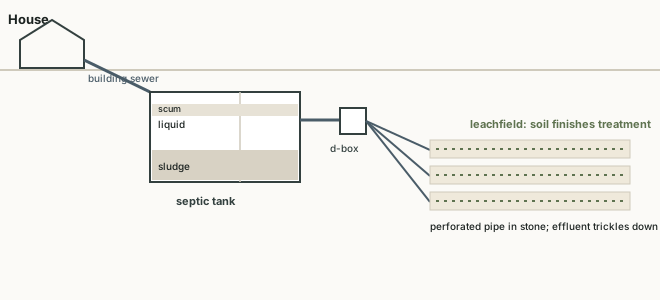
The sludge and scum drawn here are physical layers. An additive does not remove them
Septic additive claims versus what evidence supports
What the evidence shows
Tank is already naturally seeded; adding more has little effect
Speeds up sludge breakdown
No strong independent evidence supports meaningful acceleration
Eliminates the need for pumping
Contradicted by how solids physically accumulate: cannot be true
Some documented cases of damage to seals or the field
General assessment of common septic additive marketing claims against how septic tanks physically function
What additives claim to do
Why the core claims don't hold up
A septic tank is already a naturally seeded biological environment. Ordinary household wastewater introduces all the bacteria a tank needs, and that population re-establishes itself within days of a pump-out without any product added. Adding more bacteria to an already-adequate population doesn't meaningfully change the settling process
The claim to eliminate pumping runs into simple physics: sludge and scum are physical solids and semi-solids that settle out of wastewater, and no enzyme or bacterial process fully dissolves them at the rate they accumulate in a typical household. Only physical removal, pumping, takes them out of the tank
Where additives can actively cause harm
Some aggressive chemical solvent products marketed for septic use have been documented causing real damage. Breaking down tank seals or gaskets they were never intended to contact, or pushing solids toward the outlet and field rather than keeping them contained in the tank where they belong
Do septic tank additives work?
Can additives replace pumping my septic tank?
No. Sludge and scum are physical layers that settling cannot fully dissolve, and no product changes that basic process. Only pumping removes them from the tank
Are septic additives harmful?
Most are simply ineffective instead of harmful. Some aggressive chemical solvents have been documented damaging tank seals or pushing solids toward the field, which is worse than doing nothing at all
Why do septic additives exist if they don't work?
They're marketed products responding to real homeowner anxiety about septic maintenance, but the marketing claims for the strongest promises, eliminating pumping, are not supported by how a tank physically functions
Do enzyme-based septic treatments help at all?
There's no strong independent evidence they meaningfully improve on what a tank's naturally occurring bacteria already accomplish, since household wastewater seeds the tank adequately on its own
Should I use additives after pumping my tank?
It's unnecessary. The tank's bacterial population re-establishes naturally within days of a pump-out through normal household use, without any product needed to restart it
Can additives fix a septic system that's already having problems?
No. A system showing real symptoms needs professional diagnosis and, if the field has failed, replacement. No additive reverses that kind of physical failure
Is it a waste of money to buy septic additives?
Yes for the stronger claims. The money is better spent maintaining a reliable pumping schedule, which is the maintenance task proven to protect the system
Do septic professionals recommend additives?
Most experienced septic professionals do not recommend relying on additives, since their own field experience shows pumping and basic maintenance habits are what determine a system's outcomes
What ingredients are in septic additives?
Products vary, including bacterial cultures, enzymes, or in some cases chemical solvents. Ingredient lists differ by brand, and it's worth reading them if you're considering a product regardless of the general skepticism
Are there any legitimate uses for septic additives?
Some homeowners use them believing they provide marginal help on an early-stage issue, but there's no strong evidence supporting even that limited claim over simply maintaining a normal pumping schedule
How do I know if a septic additive claim is exaggerated?
Any claim to eliminate or significantly reduce the need for pumping should be treated skeptically, since it contradicts the basic physical process by which solids accumulate in a septic tank
Protecting your septic system in winter: service details and questions
Protecting your septic system in winter: protecting a Vermont septic system from freezing comes down to a handful of habits that revolve around one principle: snow is an insulator, and anything that removes or compresses it over the tank and field increases the risk of a freeze. The main defenses are keeping natural snow cover intact instead of plowing, shoveling or repeatedly walking it down. Using water regularly enough that warm wastewater keeps moving through the pipes, so lightly used or vacant homes are more vulnerable than busy ones.
And fixing any dripping fixture, since a slow trickle freezes more readily than normal flow. A seasonal camp closed for winter needs specific winterizing, since it has neither the water use nor necessarily the same snow cover pattern as a year-round home. If a system freezes despite these precautions, it needs professional thawing rather than pumping
Snow on the field acts as insulation, so leave it where it falls
Protecting a Vermont septic system through winter
Steady flow of warm wastewater helps keep pipes from freezing
No regular use means no natural warming flow
Call for thawing, not pumping, if frozen
Pumping doesn't address ice blocking the pipes
A dripping fixture is a specific, often overlooked risk: instead of the periodic flow of normal use, a slow constant trickle sits in the pipe longer and freezes more readily than water that moves through and out at normal volume. Fixing leaks before winter is a simple, worthwhile precaution
A seasonal camp closed for winter needs planned winterizing. It has no ongoing water use to provide warmth and may not accumulate the same protective snow cover as an actively occupied home, a step beyond simply leaving the system alone
If a system does freeze, the fix is professional thawing of the specific frozen section, not pumping, since pumping doesn't address ice blocking flow and may be unsafe or impossible until conditions improve. Recognizing frozen-system symptoms and calling for the right service, instead of assuming a pump-out will fix it, saves time and unnecessary cost
How do I keep my septic system from freezing in Vermont?
Keep natural snow cover intact over the tank and field, use water regularly so warm wastewater keeps flowing, and fix any dripping fixtures. A slow trickle freezes more readily than normal flow
Does snow cover need protecting as part of routine maintenance?
Snow insulates the ground, helping keep a buried system above freezing through the coldest weather. Removing or compacting it strips away protection the system was implicitly relying on
Can I drive or plow over my septic system in winter?
No. It compacts the soil and removes the insulating snow layer at the same time, compounding two separate risks. Route plowing and vehicle traffic around the system area
Call for professional thawing of the frozen section, not a pump-out. Pumping doesn't address the ice blocking flow and can be unsafe or impossible until it thaws
Burial depth is set during design based on regional frost depth, but even a correctly buried system relies partly on snow cover for extra insulation through Vermont's coldest stretches
Some risk exists every winter. A system with intact snow cover, regular use and no dripping fixtures rarely has problems. Freezing is more the exception than the rule when these precautions are followed
Septic additives
Septic additives are not a substitute for pumping or diagnosis. EPA’s 2024 fact sheet advises against bacterial and chemical additives for domestic wastewater treatment: ordinary wastewater already supplies microorganisms, and products can interfere with treatment or contaminate groundwater. Keep the pump-out schedule based on tank measurements and household use.
A product that liquefies solids does not remove their load from the system. Material leaving the tank still reaches the treatment field. If the problem is a slow drain, high-water alarm or wet field, have the cause identified before buying a treatment.
A blocked pipe, failed pump and saturated field require different repairs. Vermont also has an approval register for specific innovative or alternative technologies.
Approval of a named treatment system does not endorse every bottle sold as septic-safe, and an expired product approval is not a current authorization. Ask the designer about the exact product and its approval status.
Read the claim before buying
EPA distinguishes biological products from chemical additives. Neither category replaces removal of accumulated solids. Ask what measured problem the product is supposed to solve and whether the proposal includes inspection of the tank outlet and field.
An additive offered instead of a scheduled pump-out leaves the central maintenance task undone. Keep receipts and sludge or scum measurements so the next service interval follows the tank’s condition.
Trouble after a treatment needs a diagnosis
Tell the service provider the product name, ingredients, quantity and date used. Keep people and pets away from surfacing sewage. Do not pour in additional solvents or enter a tank to inspect it.
A treatment proposal for an existing failed field belongs with the restoration assessment and permit review. Compare the proposed repair with the actual failure: hydraulic overload, structural damage and seasonal groundwater are not interchangeable conditions.
Do I need to add bacteria after pumping?
EPA does not recommend bacterial additives. Ordinary household wastewater supplies microorganisms.
Keep the service schedule based on measured solids and use. Dosing a product does not replace removal of accumulated material.
Can an enzyme product replace pumping?
No. Keep the service interval based on tank measurements and loading. A treatment does not remove the accumulated material.
Does septic-safe mean approved in Vermont?
That marketing phrase is not a DEC approval. Check the exact product in the state register when an approved technology is required.
What should I tell a contractor after using an additive?
Give the product name, ingredients, amount and date used, along with symptoms and the last pump-out record.
Can a chemical cure a flooded field?
A product does not lower seasonal groundwater or repair damaged pipes. Identify the water source and condition of the system.
Should I stop ordinary cleaning products?
Follow product directions and EPA care guidance. Avoid flushing solvents, paint or other hazardous chemicals into the system.
Is a product that breaks up solids the same as removing them?
No. Breaking material into smaller particles does not carry it off the property. Ask where that material will go and how the proposed product affects separation in the tank and loading on the field.
EPA’s warning concerns the functioning treatment process, not simply whether a bottle makes visible solids disappear. Pumping removes accumulated material; a product claim should not obscure that maintenance difference.
What should I compare on an additive sales proposal?
Look for a diagnosed condition, an identified ingredient or technology, the applicable approval and a way to verify the promised result. Compare those claims with EPA’s additives fact sheet and the actual Vermont register entry where relevant. A testimonial about one household does not establish the condition of your tank, pipework or treatment soil, or replace a professional examination of the fault.
What if the product has already been used without symptoms?
Retain the label and record the amount and date for the next service visit. Continue ordinary care and maintenance instead of assuming that a symptom-free period proves benefit or harm. If a backup, alarm or wet field develops, give those records to the evaluator so the assessment can consider the product alongside water use, equipment and groundwater conditions.
What not to flush
What not to flush: a septic system is designed to handle two things: human waste and toilet paper, plus ordinary household wastewater from sinks, showers and laundry. Keep wipes out of septic plumbing even when the package describes them as flushable. Put them in the appropriate solid-waste stream rather than relying on the tank or pump to handle them.
Grease and cooking fat solidify inside pipes and the tank as they cool, restricting flow and adding to the scum layer far faster than normal use. Harsh chemicals, bleach in large quantities, drain cleaners, paint, solvents and pesticides, can kill the beneficial bacteria a tank relies on, and some are simply illegal and hazardous to introduce into groundwater through a septic system. Medications, feminine hygiene products, dental floss, cat litter, diapers and cigarette butts round out the list of items that don't break down, clog pipes, or introduce contaminants the system was never built to treat.
Wipes and paper products
Despite marketing claims, 'flushable' wipes do not break down like toilet paper and are one of the most common causes of clogs both in household plumbing and inside the tank itself, where they can accumulate for years without decomposing.
Paper towels, tissues and other thicker paper products have the same problem. They are engineered to be more durable when wet than toilet paper, which is exactly the opposite of what a septic system needs to keep flow moving freely.
Grease, chemicals and anything that isn't waste or paper
Cooking grease and fat should never go down any drain connected to a septic system. It cools and solidifies inside pipes and the tank, restricting flow and building up in the scum layer faster than normal accumulation, sometimes hardening enough to require professional clearing.
Bleach used in normal laundry amounts is considered acceptable in moderation, but large volumes, along with drain cleaners, paint, solvents, pesticides and other harsh chemicals, can kill the bacterial colonies a tank depends on and, in some cases, are simply illegal to introduce into a system that discharges to soil and groundwater.
The smaller items that add up
Feminine hygiene products, dental floss, cat litter, even brands marketed as flushable or biodegradable, diapers and cigarette butts all either fail to break down at the rate the system needs or introduce material the tank cannot process, contributing to clogs and reducing the effective volume available for actual treatment.
Unused medications deserve special mention: flushing them can introduce pharmaceutical compounds into groundwater through the treatment process, which is both an environmental concern and, for many medications, explicitly discouraged by disposal guidance. A take-back program or household hazardous waste collection is the better option.
Garbage disposals add solids even when the scraps are ground up
Keep food scraps, grease and cooking oil out of the drain. Grinding scraps does not remove their load from the septic tank: the extra solids still have to be pumped out. Compost suitable scraps or put them in the appropriate waste collection.
If you use a disposal, tell the pumper and ask for sludge and scum measurements when the tank is serviced. Set the next visit from those measurements and household use; subtracting a fixed year from every household’s schedule would hide differences in tank size and load.
Can I use bleach if I have a septic system?
Normal laundry amounts are considered acceptable in moderation. Large volumes can harm the beneficial bacteria a tank relies on. Avoid heavy or frequent use.
Can cat litter go down the toilet with a septic system?
No, even brands marketed as flushable or biodegradable. Cat litter does not break down at the rate a septic system needs and contributes to clogs and reduced tank volume.
What household chemicals are safe for a septic system?
Ordinary amounts of standard household soaps, detergents and cleaners are fine. Avoid large volumes of drain cleaners, solvents, paint and pesticides, which can harm the tank's bacteria.
Can I put dental floss down the toilet?
No. Floss does not break down and can tangle with other material, contributing to clogs in pipes or at the tank inlet over time.
Are diapers ever OK to flush with a septic system?
No. Diapers do not break down and are a common, serious clog risk in both household plumbing and the septic system itself.
Does a garbage disposal change what I can put down the drain?
No. A disposal grinds food waste finer but doesn't change the underlying rule. It adds solids load to the tank regardless, which is a separate reason to use one sparingly.
Can paint be washed down a drain connected to a septic system?
Keep paint and solvents out of the septic system. Use the appropriate collection or disposal route for the product and retain its container information if a spill needs advice.
What happens if I accidentally flush something I shouldn't have?
A single instance is unlikely to cause lasting harm. Repeated or large-volume instances of any of these items can accumulate into a real clog or damage the system's bacterial balance over time.
Is toilet paper itself ever a problem for a septic system?
Ordinary toilet paper is specifically designed to break down and is exactly what a septic system is built to handle. It is not a problem in normal amounts.
Protecting your septic system in winter
Protecting your septic system in winter: protecting a Vermont septic system from freezing comes down to a handful of habits that revolve around one principle: snow is an insulator, and anything that removes or compresses it over the tank and field increases the risk of a freeze. The main defenses are keeping natural snow cover intact instead of plowing, shoveling or repeatedly walking it down. Using water regularly enough that warm wastewater keeps moving through the pipes, so lightly used or vacant homes are more vulnerable than busy ones.
And fixing any dripping fixture, since a slow trickle freezes more readily than normal flow. A seasonal camp closed for winter needs specific winterizing, since it has neither the water use nor necessarily the same snow cover pattern as a year-round home.
If a system freezes despite these precautions, have a professional locate the freeze and decide whether thawing or managed pumping is appropriate. Do not run a tap continuously.
Why snow cover is the key variable
Snow acts as a natural insulating blanket over the ground, and a Vermont septic system buried at typical depth relies partly on that insulation to stay above freezing through the coldest stretches of winter. Removing it, by plowing, by repeated vehicle or foot traffic that compacts it, or by clearing it for other reasons, strips away protection the system was implicitly counting on.
This is why driving or parking over a septic system in winter is doubly risky: it both compacts soil the field depends on long-term and removes the insulating snow layer in the short term, compounding two separate risks with one action.
Why usage patterns matter as much as insulation
A system in regular use has a steady flow of comparatively warm wastewater moving through its pipes, which helps keep them above freezing even in cold conditions. A lightly used or vacant system has no such warming flow, so second homes, camps and infrequently visited properties are disproportionately vulnerable to freezing.
Seasonal camps and what to do if it freezes anyway
An unused seasonal camp has no regular warm wastewater flow. Arrange a winterizing plan with the service provider instead of running a tap continuously.
If the system freezes, a professional should locate the blockage and determine whether it can be thawed. When the treatment area cannot accept flow, temporary managed pumping may be needed. Tank buoyancy and groundwater must be assessed before pumping; a pump-out does not thaw a blocked pipe.
Why do vacant or lightly used homes freeze more easily?
They lack the steady flow of comparatively warm wastewater that regular use provides, which helps keep pipes above freezing even in cold conditions.
How do I winterize a seasonal camp's septic system?
It needs planned preparation before closing for the season. It has no ongoing water use for warmth. A local septic professional can advise on the right steps for your specific system.
What should I do if my septic system freezes?
Call a septic professional to identify the frozen section. Thawing may be possible; managed pumping may be necessary when flow cannot resume. Have groundwater and tank buoyancy assessed before pumping.
Can a dripping faucet really cause a septic system to freeze?
Yes. A slow, constant trickle sits in the pipe longer than normal flow and freezes more readily. Fixing leaks before winter is a simple, worthwhile precaution.
Does using more water in winter help prevent freezing?
Regular, normal water use helps. It keeps warmer wastewater moving through the pipes. There's no need to use significantly more water than usual, just not to let the system sit unused.
How deep does a septic system need to be buried to avoid freezing?
Burial and freeze protection follow the approved design and component requirements. Treatment-soil criteria also affect the layout. Ask the designer before changing cover or depth; a generic frost-line rule is not a complete design for every septic component.
Can pipes leading to the septic tank freeze even if the tank itself doesn't?
Yes. Shallow or poorly insulated sections of pipe between the house and tank are often the most vulnerable point, sometimes freezing even when the buried tank itself stays above freezing.
Is it normal for a septic system to have some frost risk every Vermont winter?
Cold, snow cover, use, pipe condition and exposed openings affect the risk. Record any prior freezing and arrange a winter operating plan. Precautions reduce avoidable problems without proving that a particular system cannot freeze.
Should I add extra insulation over my septic system?
For a chronically vulnerable system, one with a history of freezing, added insulation like foam board or extra mulch can help, though it's a targeted fix instead of standard for every system.
Landscaping over a septic system
Landscaping over a septic system starts with locating the tank, disposal area, access openings and any reserved replacement area on the approved plan. Keep a planting or grading proposal separate from that drawing until the designer has checked it. Surface cover, root growth, soil compaction and redirected runoff can affect different parts of the installation.
A lawn-sized space is not automatically available for a patio, driveway or raised bed simply because the tank lid is elsewhere. Mark the service access that must remain available and identify where equipment would travel.
If a contractor proposes adding fill, changing drainage or excavating near the field, ask how the work relates to the authorized system. Choose the layout before ordering materials so the garden project does not force a wastewater repair.
Landscaping over a septic system on its approved plan
Draw the proposed planting footprint and equipment route against the actual system rather than estimating from a greener patch of grass. A replacement area may be unused now while remaining important to the permitted layout.
Ask the designer which surface changes and roots are compatible with the installation. Preserve accessible covers instead of burying them under a finished landscape.
Keep the water route separate from the planting plan
Show where roof runoff and any proposed yard drain would discharge. Sending more water toward the treatment area can create a different problem from root intrusion. Have the landscape contractor identify the final elevations and drainage route before work begins; an attractive planting sketch without those details is not an excavation plan.
| Task | EPA guidance or required check |
|---|---|
| Household inspection | At least every three years under EPA general guidance |
| Household tank pumping | Typically three to five years; use measured solids and actual load |
| Alternative/powered components | More frequent inspection, generally annually in EPA guidance; follow the installed product and permit |
| Field and surface drainage | Keep vehicles off and roof or yard drainage away from the treatment area |
EPA How to Care for Your Septic System, checked October 18,2026; product and permit requirements can add duties.
| What is happening | Next step |
|---|---|
| Routine tank maintenance | Measure accumulated solids and schedule pumping |
| Alarm or surfacing wastewater | Reduce use and arrange diagnosis |
| Proposed treatment technology | Check its exact DEC approval and design conditions |
EPA 2024 additive guidance and Vermont DEC product approvals.
| Item | Why it's a problem |
|---|---|
| "Flushable" wipes | Do not break down; clog pipes and accumulate in the tank |
| Cooking grease and fat | Solidifies in pipes; builds the scum layer quickly |
| Harsh chemicals, solvents, paint | Can disrupt treatment or contaminate wastewater; use appropriate disposal |
| Medications | Do not use the septic system for medication disposal |
| Feminine products, floss, cat litter, diapers | Do not break down; clog pipes and take up tank volume |
Standard guidance on materials that damage or clog a septic system, reflecting how tank bacteria and field soil process waste.
| Item | Explanation |
|---|---|
| Keep snow cover intact | Don't plow, shovel or repeatedly compact snow over the system. |
| Follow the winter operating plan | Do not run extra water to thaw a fault; have occupancy, cover, piping and equipment assessed. |
| Fix dripping fixtures | A slow trickle freezes more readily than normal flow. |
| Winterize seasonal camps specifically | Arrange a closure or winter-use plan for the actual plumbing, tank and pump equipment. |
| Have a professional assess a freeze | Thawing or managed pumping depends on the blockage and groundwater. |
Standard cold-climate septic protection practices; site-specific conditions can vary.
| Proposed feature | Record to check | Decision before purchase |
|---|---|---|
| Planting bed | Disposal and replacement footprints | Appropriate cover and roots |
| Patio or vehicle route | Tank and field locations | Loading and access restrictions |
| New drainage | Finished grades and outlet | Keep added flow away |
The approved wastewater layout identifies features the landscape proposal must accommodate.
Septic system maintenance: service intervals and household use
How often should I do septic maintenance tasks?+
Pumping every three to five years for most households is the anchor task. Everyday habits like watching what's flushed and how much water disposal use apply continuously, not on a schedule.
Do septic additives count as maintenance?+
No. They don't remove accumulated solids the way pumping does and are not a substitute for the physical maintenance habits that protect a system's lifespan.
Is septic maintenance expensive?+
No. Most of the routine is about habits and choices, not spending, aside from periodic pumping, which is far cheaper than the field replacement that neglect eventually causes.
Does a garbage disposal really matter that much for septic health?+
Heavy use adds solids load beyond what many tanks were sized for, shortening the effective pumping interval. Ask how a proposed disposal affects loading and the approved system before installing one.
How does winter affect septic maintenance in Vermont?+
Snow cover insulates the system from freezing. Keeping it intact and avoiding vehicle traffic over the tank and field are seasonal habits specific to a Vermont winter.
What household products should never go down a septic drain?+
Keep wipes, cooking grease, solvents and unwanted chemicals out of the drains, and ask the provider about a disposal or another proposed change that adds loading. The dedicated guide covers the full list.
Can landscaping choices affect septic system health?+
Yes. Grass is safe. Locate the permitted field and replacement area before planning landscaping.
Choose suitable shallow-rooted cover and retain service access. It happens underground and out of sight.
How do I know if I've been maintaining my septic system well enough?+
A routine inspection is the most reliable check. It evaluates the tank, baffles, filter and field directly instead of relying on the absence of visible symptoms alone.
Is it too late to start good septic maintenance on an older system?+
No. Starting good habits now, along with a current inspection to establish baseline condition, still meaningfully protects whatever lifespan the system has left, regardless of past neglect.