The wet yard
A yard that stays wet or soggy well after rain has stopped comes from a short list of causes. Flat or negative grading that gives water nowhere to go. Tight clay soil that doesn't absorb water quickly.
A high seasonal water table leaving little capacity for the soil to accept more. Or concentrated runoff arriving from a larger area upslope. Diagnosing the dominant cause matters, because the fix differs meaningfully.
A grading problem is solved with regrading or a swale. A localized uphill seep may be intercepted by a drain with a suitable outlet. A regional high water table does not automatically become drainable.
Concentrated runoff may need to be addressed further upslope instead of only at the wet spot. A yard wet only briefly after storms, versus one soggy for days or weeks, points toward different causes and different urgency. Persistent wetness near a foundation deserves prompt attention, while an occasionally soft low spot far from any structure is a lower-priority nuisance.
Reading the specific pattern of wetness
How long water lingers after rain stops is diagnostically useful: standing water that drains within a few hours is often just normal, temporary surface pooling on flat ground, while water or soft, spongy soil that persists for days points to something more structural: poor infiltration, a high water table, or ongoing subsurface flow feeding the area.
Where the wetness occurs matters too. A low spot in the middle of an otherwise dry yard suggests a localized grading issue, while wetness concentrated along one side of the property, especially the uphill side, suggests water arriving from beyond your own land instead of a problem originating on your property.
| Check | What it involves |
|---|---|
| Time how long water lingers | Record onset and drying time; duration alone does not establish a structural fault or cause. |
| Note where the wetness occurs | A localized low spot vs. wetness along the uphill side. |
| Check the slope near the wet area | Measure relevant surface slopes and flow paths rather than infer the fix from a wet patch. |
| Consider proximity to a foundation | Describe building entry, erosion or suspected wastewater so immediate hazards are distinguished from a lawn concern. |
| Watch the seasonal pattern | Compare rain, thaw and dry-weather conditions; spring wetness alone cannot establish groundwater depth. |
Standard diagnostic approach for identifying the cause of yard drainage problems before selecting an intervention.
Vermont's wet ground: lake clay, till and mud season
Vermont's wet yards fall into three patterns. In the Champlain Valley the lake-bed clays are slow to drain, so water sits on the surface after rain. On the till uplands a compact layer a foot or two down perches water in spring.
Along valley floors a seasonal high water table rises into the topsoil after snowmelt. Which pattern you have decides the fix, and the state's soil maps show all three.
Angi’s national yard-drainage survey reports a $4,635 average and a $2,147–$7,176 typical project range. It combines different drainage projects and does not price a particular Vermont swale or interceptor drain. Obtain a scope that identifies the water source, route, outlet, excavation, restoration and any required authorization before comparing totals.
Matching the cause to the right fix
Grading and slope problems, flat areas, or spots that slope toward a low point instead of away, are addressed with regrading, which physically reshapes the land to direct surface water where you want it to go, or with swales that create a controlled channel for runoff to follow.
Water table and subsurface flow problems don't respond to surface regrading alone, since the water is moving underground rather than across the top. A localized seep with an available outlet may call for curtain or interceptor drains, buried perforated pipe that catches subsurface flow and redirects it before it reaches and saturates the problem area.
Why urgency depends on location, not just severity
Wetness near a foundation carries real risk regardless of how minor it looks on the surface, since water pressure against a foundation wall, or water that finds its way into a basement or crawlspace, can cause structural and moisture damage that's far more expensive to fix than the drainage problem that caused it.
A soft or occasionally wet low spot well away from any structure, in contrast, is more of a lawn nuisance than a structural threat. It is worth fixing for usability and appearance, but without the same time pressure as anything happening close to a foundation.
Match the wet lawn fix to the water source
Watch the yard during rain before choosing a drain. Water arriving from a downspout needs a different fix from water collecting across a broad hollow.
Check whether the ground dries between storms and whether the wet area lies over the septic field. Sewage odor or surfacing effluent belongs with a septic assessment, not a lawn drainage project.
For a compacted patch outside the septic area, aeration when the soil is workable can improve infiltration. Avoid working saturated clay. A shallow depression may need grading; an intercepted uphill flow may need a curtain drain with a suitable outlet.
A dry well only helps where surrounding soil can absorb the collected water. It will not empty into ground that is already saturated. Keep drainage work clear of the wastewater system and have the drainage route checked against the septic design before excavation.
Swales and regrading
Swales and regrading: regrading and swales are the primary tools for fixing surface-level drainage problems, where water sits or pools because the land's slope isn't moving it where it needs to go, as opposed to subsurface or water-table problems needing a different fix entirely. Regrading means physically reshaping an area's slope, by adding or removing soil, so water flows toward an appropriate discharge point rather than collecting in a low spot. The rule of thumb is at least a few percent grade away from a foundation for the first several feet.
A swale is a shallow, broad, grassed channel graded to carry surface runoff along a controlled path, useful when water needs to move across a yard but a full regrade isn't practical. Both are surface interventions and won't help a yard whose problem is a high water table or subsurface flow, so diagnosing the cause before choosing between these, or a curtain drain instead, matters more than the technique itself.
What regrading involves
Regrading is physical earthwork, adding fill soil to raise a low area, removing soil to lower a high point, or reshaping a slope's angle, done with the specific goal of establishing positive drainage, meaning water consistently moves away from structures and problem areas instead of toward or pooling at them.
Near a foundation specifically, the standard guidance is maintaining a noticeable slope away from the house for at least the first several feet, since this is the zone where water pooling causes the most consequential damage. Further out, a gentler overall grade toward an appropriate discharge point is sufficient.
The grading figure, and what regrading costs
The rule of thumb has a precise version. The model residential code, IRC R 401.3, calls for the ground to fall at least 6 inches within the first 10 feet away from the foundation, a slope of 5 percent.
This model-code benchmark is not a declaration of the legal requirement for every Vermont house. Confirm the applicable local requirements, foundation details and the feasible outlet before selecting the grade.
Specify the proposed elevations, runoff route, stabilized outlet, material quantities and lawn restoration separately. Vermont wastewater isolation requirements depend on the drainage feature and its relationship to the permitted disposal area; have the designer check the applicable rule and approved plan before cutting near a field. Grading can redirect surface runoff but does not establish that groundwater can be lowered.
When a swale is the better tool
A swale makes sense when water needs to travel some distance across a yard to reach a suitable discharge point, but reshaping the entire area between the problem and the discharge point isn't practical or necessary. Instead, a shallow, wide, grassed channel is built specifically to carry that flow along a controlled, intentional path.
A swale is grassed instead of a hard, engineered channel, so it blends into a landscape more naturally than a ditch or pipe would, and it can be mowed like the rest of the lawn. Making it a common choice for managing yard drainage without creating an obviously utilitarian feature.
Why neither fixes a water table or subsurface problem
Both regrading and swales work exclusively on the surface. They redirect water that's moving across the top of the ground, but neither addresses water rising from below due to a high water table, or water moving laterally underground toward a problem area.
This is why correctly diagnosing whether a wet yard's cause is primarily surface-related (grading, slope) versus subsurface (water table, lateral flow) matters before committing to either fix. A beautifully regraded yard over a high water table will still be wet, just from a different, unaddressed source.
What's the difference between regrading and a swale?
Regrading physically reshapes an area's overall slope. A swale needs a defined path and suitable outlet.
Have the proposed grading checked against the property boundaries and the area that will receive the runoff. The two are often used together, depending on the specific layout.
Can I regrade my yard myself?
Minor regrading of a small area is within reach for a capable homeowner with the right tools, but larger projects, especially near a foundation, are often better handled by a professional to ensure proper slope and drainage.
How wide and deep should a swale be?
Dimensions depend on the volume of water it needs to carry and available space, but swales are shallow and broad instead of deep and narrow, so they blend into the landscape and remain mowable.
Does a swale need to be lined or can it just be grass?
Just plain grass works. Most residential swales are simply grassed, which is sufficient for typical yard drainage volumes. A lined or riprap-armored swale is used for higher flow volumes where erosion is a real concern.
How much does regrading a yard cost?
Cost depends heavily on the scope. A small area near a foundation is relatively affordable, while regrading a whole yard is a larger project. A contractor can quote based on your specific site and goals.
Can regrading affect my neighbor's property?
It can, if water is redirected toward a neighboring property rather than to an appropriate discharge point. This is worth discussing with a contractor to avoid creating a new problem for someone else.
How long does a regrading project take?
It depends on the scope. A small area can often be completed in a day or two. A larger, whole-yard regrade takes longer depending on scope, equipment access, and whether new topsoil or seeding is part of the project.
Do I need a permit to regrade my yard in Vermont?
Check with the town and applicable state programs before earthwork. Local zoning, wetlands, flood hazards, stormwater and stream rules can apply. A small project is not automatically exempt.
Can a swale handle heavy Vermont rainstorms?
A correctly sized one can. A swale designed for your yard's actual runoff volume should handle typical storms. An undersized swale built without accounting for real flow volume can be overwhelmed during heavy rain.
Should I regrade before or after installing a curtain drain?
If both are needed, coordinating the work together often makes sense, since regrading affects surface contours a curtain drain's design may need to account for. Discuss the full scope with your contractor upfront.
Curtain and interceptor drains
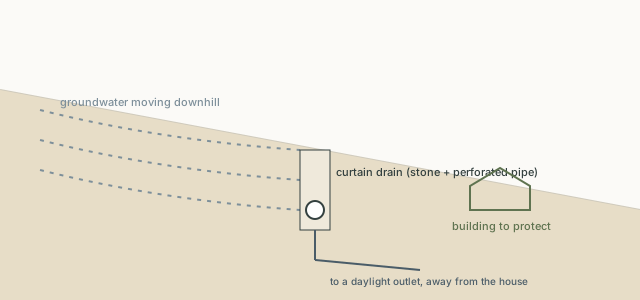
Curtain and interceptor drains: a curtain drain, also called an interceptor drain, is a trench dug perpendicular to the direction subsurface water is flowing, filled with gravel and containing a perforated pipe, positioned upslope of a wet area to intercept water moving laterally underground before it reaches and saturates the problem spot. This differs fundamentally from regrading or swales, which manage water on top of the ground. A curtain drain addresses water moving through the soil itself, often driven by a high water table or a spring feeding groundwater downhill.
Installation excavates a trench deep enough to intercept the water table, lays perforated pipe surrounded by drainage gravel, wraps it in filter fabric to keep soil from clogging the system, and directs collected water to a discharge point away from the protected area. It's the right tool when a wet yard's cause is diagnosed as subsurface flow instead of surface grading.
How a curtain drain physically works
Have the proposed alignment, depth and outlet established from the site assessment. Surface wetness alone does not locate the subsurface flow path.
Essentially forming a barrier that intercepts subsurface flow before it can continue toward the protected area. Water moving through the soil hits the gravel-filled trench, finds it easier to flow into the perforated pipe than continue through the surrounding soil, and is carried away instead.
Depth matters significantly: the trench needs to reach below the water table or the specific soil layer carrying the problematic flow, so a proper diagnosis of where and how deep the subsurface water is moving needs to happen before installation, instead of guessing at a standard depth.
Depth, cost and the septic distances
A curtain or interceptor drain collects subsurface flow through a designed trench and drainage assembly. Its depth, pipe, aggregate, separation from wastewater components and discharge point depend on the actual groundwater conditions and approved work. A generic trench depth or price per foot cannot establish that a drain will work or be authorized here.
Near a septic system Vermont's rules take over. The edge of a leachfield must be 75 feet from a curtain drain downslope of it and 35 feet from one upslope, and a septic tank 10 feet.
The setback is a design limit, not a formality. Discharge must reach a stable outlet on your own land and not onto a neighbor's or into a stream or wetland without the state's approval.
The installation process
After excavating the trench to the necessary depth and along the correct path, upslope of and perpendicular to the flow direction relative to the area being protected, perforated pipe is laid at the trench bottom, surrounded by clean drainage gravel that allows water to move freely into the pipe.
Filter fabric wraps the gravel and pipe assembly to prevent fine soil particles from migrating in and clogging the system over years. Skipping this step is a common shortcut that leads to a curtain drain silting up and losing effectiveness well before it should.
Making sure it's the right fix
A curtain drain can intercept localized lateral seepage when a lower, stable, lawful outlet is available. It cannot be assumed to lower a regional water table. Identify the water-bearing layer and outlet elevation before selecting a trench depth.
This is why a proper diagnosis matters before committing to this fix: installing a curtain drain to solve what's a grading problem wastes the installation cost without solving the wetness, while relying on regrading alone for what's a subsurface flow problem will also fail to fix it. The two fixes solve different problems.
How is a curtain drain different from a French drain?
The names overlap. Ask what flow the proposed drain intercepts. A curtain or interceptor drain is intended to intercept lateral subsurface flow before it reaches the protected area; the outlet and actual construction matter more than the label.
How much does a curtain drain cost to install?
Cost varies with trench length, depth and site access. Get a quote from a drainage contractor based on your specific diagnosed flow path and required trench dimensions.
Can I install a curtain drain myself?
It's possible for a capable, motivated homeowner on a modest scale, but correctly diagnosing flow direction and depth, and achieving proper slope in the pipe, benefits significantly from professional experience.
Why does a curtain drain need filter fabric?
It prevents fine soil particles from migrating into the gravel and pipe over time, which would otherwise clog the system and cause it to lose effectiveness well before it should.
Where does the water from a curtain drain go?
It's directed to an appropriate discharge point away from the protected area. A natural drainage way, a permitted storm connection where allowed, or another lawful stable outlet selected for the site. A dry well in saturated soil cannot be assumed to absorb this flow.
How long does a curtain drain last?
A correctly installed curtain drain with filter fabric can function effectively for decades. One installed without proper fabric or gravel can silt up and lose effectiveness much sooner.
Does a curtain drain need maintenance?
Low-maintenance once correctly installed, though periodically checking the discharge point for blockage and confirming water is still flowing as expected is a reasonable occasional check.
Can a curtain drain protect my basement from water?
Yes, if positioned correctly upslope of the foundation to intercept subsurface flow before it reaches the foundation walls. This is a common and effective use of curtain drains around Vermont homes.
How do I know if my wet yard needs a curtain drain versus a swale?
A professional diagnosis of whether the water is moving primarily on the surface or through the soil underground determines which fix applies. The two problems require different solutions.
| Published national item | Reported amount or limitation |
|---|---|
| Average yard-drainage project | $4,635 |
| Reported typical range | $2,147–$7,176 |
| Site-specific selection | Establish water source, outlet, soils and the complete work before pricing |
Angi national yard-drainage guide read October 18,2026;2203 reported projects. Actual site, outlet, excavation and approval scope determine the quote.
| Situation | What to establish before specifying work |
|---|---|
| Water pools near the foundation | Surface flow, ground clearance and a suitable outlet for any proposed grading |
| Water needs to travel across the yard | Route, slope, erosion protection and discharge rights for a possible swale |
| The whole yard is flat and low | Whether proposed grades can drain without harming buildings or neighboring land |
| The problem is a high water table | Groundwater conditions and feasible discharge; a curtain drain is not an automatic solution |
General guidance for selecting between regrading and swales for a Vermont yard drainage problem.
| Item | Explanation |
|---|---|
| Diagnose the subsurface flow direction and depth | Determines trench placement and depth before digging. |
| Excavate perpendicular to the flow | Positioned upslope of the area being protected. |
| Lay perforated pipe at the trench bottom | Water flows into the pipe rather than continuing through soil. |
| Surround with clean drainage gravel | Lets water move freely into the perforated pipe. |
| Wrap in filter fabric | Specify soil-compatible filter material and detail; fabric alone does not guarantee that clogging cannot occur. |
| Direct collected water to a discharge point | Establish a functioning lawful discharge and any outlet protection or maintenance responsibility before excavation. |
Standard installation sequence for a residential curtain or interceptor drain.
The wet yard: rain patterns and source investigation
Can regrading fix all wet yard problems?+
No. Regrading addresses surface water and slope issues effectively. Subsurface flow requires a separate assessment.
A curtain drain can intercept a localized seep with a suitable outlet. It is not a universal remedy for a high water table.
Why is my yard wetter than my neighbor's even though we're on the same street?+
Small differences add up fast. Grading, soil type, or position relative to the local watershed can produce meaningfully different drainage outcomes even between adjacent, similarly sized properties.
Does a wet yard always need a professional fix?+
Not always. A minor, low-priority soft spot away from structures can sometimes be improved with simple regrading or a swale. Persistent wetness near a foundation warrants a professional assessment.
Can a wet yard be a sign of a septic system problem?+
Yes, if the wet area is over or near a drain field. Otherwise, a wet yard unrelated to septic infrastructure is much more commonly a grading, soil or water table issue.
How much does it cost to fix a wet yard in Vermont?+
Cost varies widely depending on the cause and scope. Simple regrading is relatively affordable, while a curtain drain system or comprehensive site regrading costs more. A contractor can quote based on your specific diagnosis.
Does Vermont's spring thaw make wet yard problems worse?+
Yes, reliably every year. The seasonal water table rises during spring thaw and heavy rain, temporarily reducing soil's absorption capacity and making underlying drainage issues more visible than they are in drier months.
Can I fix a wet yard myself?+
Simple regrading or creating a swale for a minor, low-stakes area is within reach for a capable homeowner. Anything involving subsurface drainage or near a foundation is better handled by a professional.
Will a French drain fix my wet yard?+
It can, specifically for subsurface water issues. A French drain intercepts and redirects underground flow, but it won't help if the actual problem is surface grading, which needs a different fix.
How urgent is fixing a wet yard that's just an inconvenience?+
If it's well away from any structure and only affects lawn usability, it's a lower priority than a wet area near a foundation. Mark the wet area and note how long it remains after rain. Include any nearby foundation, septic field or boundary that affects the proposed outlet.