Septic problems and what they mean
Septic problems and what they mean: most septic problems announce themselves as one of six symptoms: sewage backing up indoors, odors inside or outside, a control alarm sounding, a wet or lush spot over the drain field, slow drains and gurgling, or a system that has frozen. Each points to a different cause. The first task is to control exposure and establish which component or water pathway is involved.
Price and repair extent cannot be inferred from the symptom. A pump-out can temporarily relieve several causes. Recurring symptoms need checks of the building sewer, tank outlet, distribution and field.
An alarm or persistent odor needs prompt investigation. Urgency depends on exposure, liquid level and whether wastewater is surfacing. The two genuine emergencies are sewage inside the house and standing effluent in the yard.
Both are health hazards. Stop adding water and get service; do not wait. Everything else is a signal to diagnose the cause before it becomes one of them.
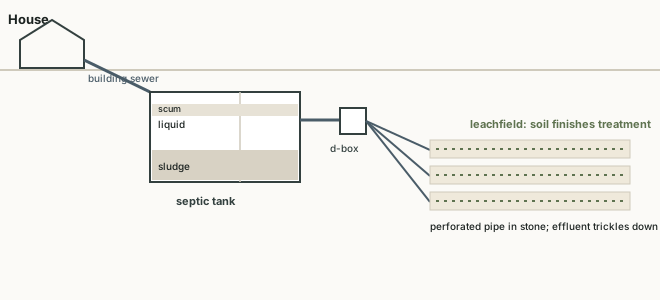
Tank problem or field problem: the question under every symptom
Most septic symptoms come from one of two locations. A tank problem, an overfull tank, a clogged filter, a failed baffle, restricts flow and shows up as backups, gurgling and slow drains that ease once the tank is pumped or the blockage cleared. These are the cheaper problems, because the tank end of the system is serviceable.
A field problem means the leachfield can no longer accept water at the rate the household produces it. Its signatures are different: a wet or unusually green area over the field, effluent surfacing in the yard, and symptoms that come back within days of a pump-out because an empty tank cannot fix a field that will not drain. Sorting a symptom into one of these two buckets is most of the diagnosis.
| Symptom | Possible conditions | Urgency |
|---|---|---|
| Backing up indoors | Blocked sewer, tank/outlet, pump or field problem | Emergency: health hazard |
| Effluent in the yard | Field surfacing or broken component | Emergency: health hazard |
| Odor | Plumbing trap/vent, tank/access or wastewater condition | Warning: diagnose soon |
| Alarm sounding | Pump or high-water-level problem | Reduce use and contact service promptly; active overflow requires immediate exposure precautions |
| Wet / lush spot over field | Possible surfacing effluent or saturated soil; inspect | Warning: evaluate the field |
| Slow drains / gurgling | Local or downstream restriction, venting, pump or treatment-area problem | Reduce water use; arrange diagnosis |
General diagnostic guidance; an on-site inspection confirms the cause and urgency.
Which symptoms are urgent and which are warnings
Two situations are true emergencies. Sewage backing up into living space is a health hazard and a sign the system has nowhere left to send water.
Standing effluent in the yard is the same problem surfacing outdoors.
The rest are warnings that give you time if you act. Odors, a sounding alarm, slow drains and a developing wet spot all say the system is struggling but has not yet failed outright. Treating them promptly, reducing water use and getting the tank checked, is what keeps a warning from becoming one of the two emergencies.
The first moves for any septic symptom
Whatever the symptom, the first move is to reduce water use, because every gallon you add is a gallon a struggling system has to handle. Holding off on laundry, dishwashers and long showers buys time and often keeps a slow drain from becoming a backup.
The second move is to get the tank measured and inspected. That relieves many problems on its own, and it reveals the cause: how full the tank was, the condition of the baffles and filter, and whether effluent is standing in the field. From there the fix is either a cheap tank-side repair or a field evaluation, and a good inspection tells you which.
Slow drains and gurgling: service details and questions
Slow drains and gurgling across the whole house are the septic system's earliest audible warning that water is not moving out the way it should. Gurgling happens when air, trapped by water that cannot drain freely, escapes back through the plumbing; slowness is the same restriction seen at the sink. The key clue is scope.
One slow, gurgling fixture is almost always a local clog or a venting issue in that fixture's own line. Several fixtures slow at once, especially the lowest ones, means the restriction is downstream of the whole house: a tank full of solids, a blockage in the line, or a field that can no longer accept water
Because these are early signs, they are a chance to act before a backup: reduce water use, skip chemical drain cleaners that harm the tank's bacteria, and have the tank measured. If pumping clears it for good, the tank was the cause; if it returns quickly, the field needs a closer look
Whether one drain or every drain is slow shows where along this path to look
One means a local clog or vent; several at once means the tank, line or field
The lowest fixtures in the house struggling first points downstream, at the septic system
Lasting relief means the tank; a quick return means the field needs evaluation
The single most useful diagnostic is how many fixtures are affected. If only one sink, tub or toilet is slow and gurgling while everything else runs fine, the problem is almost certainly local, a clog in that fixture's trap or drain, or a venting issue on that branch, and not the septic system as a whole
For a whole-house pattern, reduce water use and have the tank measured and pumped. Pumping relieves a full tank and, by what happens afterward, tells you whether the tank or the field is the cause: lasting relief means the tank; a quick return means the field. That single observation saves a lot of guessing
Avoid pouring chemical drain cleaners into a septic system. They seldom fix a system-level restriction and can kill the bacteria the tank depends on
For a single-fixture clog, snaking that drain is appropriate. Matching the response to whether the problem is local or system-wide is what keeps a minor slowdown from being mishandled into a bigger one
Why are all my drains slow at once?
A whole-house slowdown means the restriction is downstream of everything, the main line to the tank, a tank full of solids, or a failing drain field, rather than a single clogged fixture. It is the septic system's early warning, and measuring the tank is the right next step
What does gurgling in the drains mean?
Gurgling is trapped air escaping back through the plumbing because water is not draining freely. It signals a flow restriction somewhere in the system, and when it happens across several fixtures it points at the tank, the main line or the field rather than a single drain
Is one slow drain a septic problem?
Rarely. A single slow, gurgling fixture while the others run fine is a local clog or a venting issue in that fixture's own line. Septic-level problems show up across several fixtures at once, especially the lowest ones in the house
Avoid chemical drain cleaners on a septic system. They rarely clear a system-level restriction and can kill the bacteria the tank relies on
For a single-fixture clog, snaking the drain is fine. For a whole-house slowdown, the answer is measuring and pumping the tank, not chemicals
If a full tank is the cause, yes, and pumping also reveals whether the field is involved. Lasting relief means the tank was the problem; drains that slow again within days point to a field that can no longer accept water, which pumping cannot fix
Not yet. They are an early warning that gives you time. But they are the stage before a backup, so ignoring a whole-house slowdown risks it becoming sewage in the house. Acting on slow drains promptly is exactly how you avoid the emergency they precede
Scope is the tell: a local clog affects one fixture, a full tank or failing field affects many at once. Beyond that, what happens after a pump-out settles it. If pumping the tank clears everything, it was the tank; if it does not, look at the main line or the field
Septic alarm going off: service details and questions
A septic alarm is a high-water warning: the liquid level in a pump chamber has risen higher than it should, and the system wants your attention before that becomes a backup. Systems that use a pump, to lift effluent to a mound, a raised field, or uphill, have a float that triggers the alarm when the level climbs, because the pump is not moving water.
The common causes are a tripped breaker, a failed or stuck pump, a stuck float switch, or more water going in than the pump can keep up with. When it sounds, reduce water use sharply, which slows the level's rise and buys time
You can silence the audible alarm while leaving the warning light on, and check whether the pump's breaker has tripped. Beyond that, a stuck float or failed pump needs a technician. The alarm gives you a window of hours before the chamber overflows, so treat it as a same-day matter, not something to ignore
Why the alarm sounds: the level climbs to the top float
Septic alarm response, in order
Reduce water use immediately
Slows the level's rise and lets a working pump catch up
Silence the audible alarm
Use an alarm-silence control only as the controller’s instructions permit; record the warning indication and arrange assessment
Check the pump breaker
Observe whether the pump circuit indicates a trip without opening electrical covers; have the fault checked before re-energizing suspect equipment
Watch the level and light
If the light clears with water reduced, a surge was the cause; if it stays on, the pump or float needs service
Call for service if it persists
A stuck float or failed pump is a repair, and it is a same-day matter before the chamber overflows
General guidance for a residential pump-chamber high-water alarm; a technician diagnoses pump and float faults
The alarm belongs to a pump system, not a simple gravity one. When effluent has to be lifted rather than flowing downhill, it collects in a pump chamber, and a pump switches on at a set level to send it to the field. A separate high-water float sits above the pump's normal range; if the level reaches it, the pump is not keeping up, and the float triggers the alarm
So the alarm does not mean the tank is 'full' in the ordinary sense. It means the pump chamber has risen past its safe working level. It is specific to systems with a pump, so the diagnosis starts at the pump and its power rather than at the septic tank itself
The most common reason is that the pump has stopped running. A tripped breaker cuts its power; a failed or worn-out pump cannot move water; a float switch that is stuck or tangled fails to tell the pump to start. Any of these lets the chamber fill past the high-water mark and sound the alarm
The other cause is volume: a surge of water, a big laundry day, guests, a running fixture, can exceed what a healthy pump can move in the time it has, tripping the alarm temporarily. If reducing water use quiets the situation and the pump catches up, that was likely the cause; if the level stays high with water use cut, the pump or float needs attention
If the controller’s instructions permit silencing the audible alarm, use that designated control and record the warning-light status. Check only the visible breaker indication without opening electrical covers or touching wiring. A high-level alarm can have several causes; silencing it does not restore the pump or establish available storage.
If the alarm persists or the level stays high, reduce wastewater use and arrange assessment. A stuck float, failed pump or electrical fault needs diagnosis instead of repeated resets.
The alarm does not establish how much usable storage remains, so do not assume there are hours or days of capacity. Report any backup or surfacing wastewater and keep people away from the affected area.
What does a septic alarm mean?
It is a high-water warning from a pump system: the liquid in the pump chamber has risen above its safe level, because the pump is not moving water. It exists to warn you before the chamber overflows into a backup, so it should be treated as a same-day issue
Why is my septic alarm going off?
Most often the pump has stopped, a tripped breaker, a failed pump, or a stuck float switch, so the chamber fills past the high-water float. Sometimes a surge of water simply outpaced a working pump. Reducing water use and checking the breaker are the first steps to narrow it down
It is urgent but not an immediate emergency. It is designed to give you a window of hours before the chamber overflows
Cut water use, check the breaker, and arrange service the same day. Ignoring it until it overflows is what turns it into a backup
Hours rather than days, depending on how much reserve the chamber has and how much water the household adds. That reserve exists to give you time: reduce water use and get help before the level reaches an overflow
No. Only systems with a pump, such as those serving a mound, a raised field, or any layout where effluent must be lifted. A simple gravity system has no pump and no alarm. If you have an alarm panel, you have a pump, which changes how the system is maintained
Yes. A large surge, laundry, a full house, a stuck-running fixture, can exceed what the pump moves in the available time and trip the high-water float temporarily. If cutting water use clears it and it does not recur, that was the cause; persistent alarms indicate a pump or float fault
Septic system backing up
Septic system backing up: a septic backup happens when wastewater has nowhere to go and rises back into the lowest drains and fixtures in the house. The cause is one of three things: a blockage in the pipe between the house and the tank, a tank so full of solids that it can no longer pass water, or a drain field that has failed and cannot accept effluent. A single-fixture pattern can guide plumbing checks, but it does not establish the cause.
Several fixtures backing up at once, especially the lowest ones, points at the tank or field. Stop adding water immediately. No laundry, no extra flushing.
Every gallon makes it worse. A backup reaching living space is a health hazard. Keep people and pets clear.
Treat the area as contaminated. Then get the tank measured: pumping often relieves the backup and reveals whether the cause was the tank, a blockage, or a field that needs a closer look.
The three things that cause a backup
A backup needs assessment of the actual flow path, controls and treatment conditions. Closest to the house, the building sewer can clog with grease, roots or a collapsed section, so wastewater cannot even reach the tank. This often shows as a whole-house backup with a tank that turns out to be normal.
Further out, the tank itself can be so full of sludge and scum that it no longer passes water, or a failed drain field can refuse to accept effluent so the tank overfills and backs up behind it. Telling these apart matters because the pipe and tank causes are inexpensive, while a failed field is the costly one.
Reading which cause you have
The pattern of the backup is the clue. Record which fixtures are affected.
Report the sequence. The pattern guides assessment without proving a local or downstream cause.
Several affected fixtures warrant assessment of the shared flow path; the pattern alone cannot identify the failed component. The sewer, the tank or the field.
What happens after a pump-out finishes the diagnosis. If pumping the tank clears the backup and it stays gone, the tank was full or a blockage was relieved.
If the backup returns, the flow path still needs investigation. A clogged filter, broken pipe, pump fault or saturated field can require different repairs; a refilled tank alone does not identify the cause.
What to do the moment it backs up
Stop water use throughout the house immediately. A backup means the system cannot handle what it already has, so adding more only pushes sewage further into the living space. Hold off on every non-essential drain until the cause is addressed.
Treat any sewage that has reached the house as contaminated. Keep people and pets away, ventilate, and plan to clean and disinfect affected surfaces with proper precautions.
Then arrange service. A pump-out relieves most backups and produces the information, tank fullness, baffle and filter condition, field behavior, that tells you whether you are done or the field needs evaluation.
Is a septic backup an emergency?
When it reaches living space, yes. Raw sewage indoors is a health hazard.
Keep people and pets clear, cut water use, treat the area as contaminated, and arrange prompt service. Catching the earlier warning signs, like slow drains, is what prevents it from getting to this point.
Will pumping the tank stop the backup?
Pumping may be required by the findings, but relief after service does not establish the cause or rule out other faults. If the backup returns, inspect the remaining flow path. Refilling after pumping is expected; a pipe, outlet, pump or field fault can still remain.
Can tree roots cause a septic backup?
Yes. Roots can invade the building sewer or the tank's inlet and restrict or block flow, causing a backup with an otherwise normal tank. Clearing the roots and repairing the affected pipe addresses it, and keeping large trees away from the system prevents recurrence.
What should I not do during a backup?
Do not keep using water, do not pour chemical drain cleaners into the system, and do not ignore it hoping it clears. Chemicals rarely fix a septic-level backup and can harm the tank's bacteria, and continued water use pushes more sewage into the house.
How do I clean up after a sewage backup?
Treat everything the sewage touched as contaminated. Wear protection, remove and discard porous materials that cannot be disinfected, clean and disinfect hard surfaces, and ventilate.
For a large backup, professional remediation is worth considering. Address the system cause first so it does not recur.
Can heavy rain cause a backup?
It can. Saturated ground raises the water table around the drain field and cuts its ability to accept effluent, so a marginal field may back up during wet weather and recover afterward. A field that backs up only in heavy rain is often near the end of its usable life.
My basement drain backs up when I do laundry: why?
That points to the system being near capacity: the surge of laundry water exceeds what the tank or field can pass, and it rises through the lowest opening, often a basement floor drain. It is a strong signal to reduce water use and have the tank and field evaluated soon.
How much does it cost to fix a backing-up septic?
A backup needs its restriction or equipment fault located first. Request separate prices for the confirmed repair and any further investigation, including access, cleaning, disposal and restoration where they apply, so a component quote is not confused with a full field replacement.
Can a full septic tank cause toilets to back up first?
Yes. Toilets and the lowest fixtures back up first since they sit at the bottom of the drainage system, so rising wastewater reaches them soonest. A toilet that gurgles and then backs up, along with slow drains elsewhere, is a classic sign the tank or field is at its limit.
Who do I call for a septic backup?
A licensed septic contractor or pumper who can measure and pump the tank and diagnose the cause. Describe the backup and how many fixtures are affected in the request form, and it is routed to a contractor who handles emergencies and can tell a tank problem from a field failure.
Septic smells and odors
Septic smells and odors: a septic odor is the system telling you that sewer gas is escaping where it should not. Indoors, the usual causes are simple: a dry plumbing trap that has lost its water seal, a loose or failed toilet wax ring, or a plumbing vent that is blocked or improperly routed so gases vent into the house instead of above the roof. Outdoors, an odor near the tank can be normal venting on a still, humid day, but a persistent smell over the drain field warrants checking for surfacing effluent.
A sign the field is saturating or failing. The fixes follow the cause: run water into unused drains to refill their traps, reseat a rocking toilet, clear or extend a vent, and for outdoor field odors, have the tank measured and the field evaluated.
A strong or persistent odor, indoors or out, is worth tracking to its source instead of masking. It can be the first and cheapest sign of a problem.
Indoor odors are a plumbing problem, not the tank
When the smell is inside the house, the septic tank is rarely the direct cause. The plumbing that keeps gas out of the house is.
Every drain has a U-shaped trap holding a plug of water that blocks sewer gas, and a trap in a rarely used sink, tub or floor drain can dry out and let gas through. Running water into it for a moment refills the seal and often ends the smell.
Other indoor causes are a toilet whose wax ring has failed so gas escapes around the base, and a plumbing vent, the pipe that lets sewer gases exit above the roof, that is blocked by ice, debris or a nest, or was never routed correctly. When the vent cannot do its job, gas finds its way back through the fixtures instead.
Outdoor odors and what they reveal
Outside, a faint smell near the tank access or vent on a heavy, still day can be ordinary venting and nothing to worry about. What matters is a persistent or strong odor, and where it is.
Over the tank, it can mean a loose lid or a full tank. Over the drain field, it can signal surfacing effluent; have the source checked.
A field that smells is a field that is struggling to absorb what it is given, whether from an overfull tank pushing solids through, saturation after heavy rain, or a field nearing the end of its life. A surfacing field is both a nuisance and a health concern, so an outdoor field odor is the kind that warrants measuring the tank and evaluating the field. Waiting is the wrong move.
Fixing the smell versus masking it
The right fix depends on the source. Tracking the odor down beats spraying over it. Indoors, refill dry traps, reseat a rocking toilet, and have a blocked or short vent cleared or extended.
These are inexpensive and solve it. Air fresheners only hide a signal you want to hear.
Keep people away from suspected surfacing effluent. Contact the service provider.
Have the source assessed before requesting pumping, particularly when groundwater is high. Chasing the actual cause matters because an odor is often the earliest and cheapest warning a system gives, and masking it lets a small problem grow into a backup or a failed field.
Why does my drain smell only sometimes?
A trap that dries out between uses lets gas through until water refills it, so an odor that comes and goes at a guest bath or floor drain is often just an evaporated trap seal. Running water into it periodically keeps the seal intact and the smell away.
What is a plumbing vent and how does it cause odors?
It is the pipe that carries sewer gases up and out above the roof so they do not enter the house. If it is blocked by ice, leaves or a nest, or was routed incorrectly, gases cannot escape that way and instead find their way back through the fixtures, causing indoor odors.
Can a full tank cause odors?
Yes. A tank near capacity can push solids and gas toward the outlet and the field, and a loose or damaged tank lid lets odor escape at the surface. If an odor coincides with slow drains or gurgling, a full tank is a likely contributor and a pump-out often resolves it.
Will pumping the tank get rid of the smell?
It helps if the odor comes from a full tank or surfacing effluent, and it reveals whether the field is involved. It will not fix an indoor odor caused by a dry trap or a bad vent, which are plumbing issues. So match the fix to whether the smell is inside or outside.
Why do I smell sewage when it rains?
Record when the odor occurs and its location, including rain and wastewater use. Persistent odor, wet ground, backups or an alarm need professional assessment. Weather alone cannot distinguish a vent issue, groundwater entry or a treatment-area fault.
Is sewer gas in the house dangerous?
Sewer gas can contain toxic and flammable gases. If you suspect a high concentration in an enclosed space, leave and call the fire department.
Symptoms such as dizziness or nausea warrant medical advice. Do not enter a septic tank to investigate.
Why does my basement smell like septic?
A basement often has a floor drain whose trap dries out, letting sewer gas in, and it is the lowest point where gases collect. Refilling that trap with water solves it. If the smell persists, check for a failed ejector-pump seal or a venting problem.
Can septic additives stop odors?
They do not fix the equipment causes of odor, a dry trap, a bad vent, a full tank or a surfacing field, so they are not a real solution. Some are marketed for odor control, but the reliable fix is finding and correcting the actual source of the escaping gas.
Should I ignore a faint occasional smell?
A faint, occasional outdoor odor near the vent can be normal, but any persistent or strengthening smell is worth tracing, because an odor is often the earliest and cheapest warning a system gives. Masking it with air freshener hides a signal that could save you a larger repair.
Who do I call about a persistent septic odor?
For an outdoor field odor or a suspected full tank, a licensed septic contractor. For an indoor odor that comes from a trap, vent or toilet, a plumber. Describe where you smell it in the request form and it is routed accordingly, since indoor and outdoor odors have different fixes.
Septic alarm going off
A septic alarm going off needs prompt attention to the condition indicated by the installed control panel. A high-water alarm can mean that liquid has reached the warning float, but other panels also report equipment or treatment faults. Read the panel instructions.
Reduce wastewater use while contacting the service provider, and report the warning, recent use, weather and any power interruption. Silence an audible warning only as the installed instructions permit; silencing it does not correct the fault. Keep the warning visible.
Pump performance, controls, inflow and downstream conditions all need consideration, so a quiet alarm after reducing use does not prove that a particular component is sound. Do not enter the chamber or handle exposed electrical equipment. The time available before overflow depends on reserve capacity and continuing use, so ask for a response rather than assuming a fixed safe waiting period.
What the alarm is measuring
Identify which control or treatment component has raised the alarm. When effluent has to be lifted rather than flowing downhill, it collects in a pump chamber, and a pump switches on at a set level to send it to the field. A high-water float responds to liquid reaching its warning level.
Report the indication. The service provider checks why liquid reached that level, including inflow, pump delivery, controls and downstream conditions.
So the alarm does not mean the tank is 'full' in the ordinary sense. Read the indicated condition. Match it to the installed instructions.
A high-water warning and an equipment fault need different investigation. It is specific to systems with a pump, so the diagnosis starts at the pump and its power rather than at the septic tank itself.
Why the level rose: the usual causes
Power, controls, pump performance, inflow and downstream conditions can contribute; the indication alone is not a diagnosis. A tripped breaker cuts its power; a failed or worn-out pump cannot move water; a float switch that is stuck or tangled fails to tell the pump to start. Any of these lets the chamber fill past the high-water mark and sound the alarm.
The other cause is volume: a surge of water, a big laundry day, guests, a running fixture, can exceed what a healthy pump can move in the time it has, tripping the alarm temporarily. Record what changes when wastewater use is reduced.
That response helps the investigation. It does not isolate a pump, control, inflow or downstream fault.
What to do when it sounds
First, cut water use throughout the house. That slows the rise and gives the pump, if it is working at all, a chance to catch up. This is the single most effective immediate step, and it often prevents an overflow while you investigate.
If the alarm persists, the level stays high, or the breaker trips again, stop resetting it and call a technician: a stuck float or a failed pump is a repair, and continuing to force a tripping breaker risks damage. Do not assume a fixed reserve time. Arrange prompt service.
Can I turn off the septic alarm?
You can silence the audible portion with the reset, which quiets the sound while leaving the warning light on so you do not forget. Do not treat silencing it as fixing it. The underlying high-water condition remains until the pump is moving water again.
Is a septic alarm an emergency?
Treat it as urgent: cut water use and contact the service provider promptly. Reserve capacity varies. Sewage backing up indoors or surfacing outside needs immediate attention, and a form submission does not summon emergency assistance.
The alarm went off then stopped: do I still call?
If it cleared after you reduced water use, a temporary surge likely outran the pump and it caught up, which is less urgent. Still, note it, and if it recurs, have the pump and float checked. Repeated alarms point to a pump that is wearing out or a float starting to stick.
Can I reset the breaker myself?
You can reset a tripped pump breaker once. If it holds and the level drops, good. If it trips again immediately, stop.
A repeatedly tripping breaker signals an electrical or pump fault, and forcing it risks damage or hazard. That is the point to call a technician.
How long do I have after the alarm sounds?
There is no fixed number of hours. Reserve volume, alarm setting and water use determine how quickly the level can rise. Reduce use and contact the service provider; do not wait for an assumed deadline.
Do all septic systems have alarms?
No. Only systems with a pump, such as those serving a mound, a raised field, or any layout where effluent must be lifted. A pump alarm and a treatment-unit alarm need different checks; identify the installed equipment. If you have an alarm panel, you have a pump, which changes how the system is maintained.
What is the float switch?
It is a level sensor in the pump chamber: one float tells the pump when to run, and a higher one triggers the alarm if the level climbs too far. A float that sticks, tangles or fails can either stop the pump from running or fail to sound the alarm, so floats are a common service point.
How much does a septic pump replacement cost?
A replacement effluent pump is a moderate repair, more than a service call but far less than a field replacement, with the cost depending on the pump type and access. A failed pump can lead to a backup, so replacing a worn one promptly is cheaper than the cleanup that follows an overflow.
Can heavy water use trip the alarm?
Record whether the alarm changes when wastewater use is reduced and have the provider assess the indication, liquid level, controls and delivery. A temporary improvement does not establish the cause or prove that the equipment is sound.
Who do I call for a septic alarm?
A licensed septic contractor who services pump systems, since the fix is a pump, float or electrical repair. Note in the request form that you have a pump alarm and whether the breaker trips, and it is routed to a contractor who handles pump-system faults quickly.
Wet spot over the drain field
A wet spot or unusually green patch over the drain field can indicate surfacing effluent, but runoff, groundwater and plumbing leaks also need to be ruled out. An inspection distinguishes wastewater from another source of water. In a healthy field, effluent trickles down through unsaturated soil and never reaches the surface; when the soil below can no longer take it, the liquid surfaces and feeds the grass above so it grows greener than the rest of the lawn.
Causes range from the temporary to the terminal: an overfull tank, a spell of heavy rain, too much household water, or a field that has simply reached the end of its life. The distinction matters.
A field wet only after heavy rain may recover, while a persistent wet area in dry weather needs a closer field and flow-path evaluation. Because surfacing effluent is a health concern, a persistent wet spot is a reason to measure the tank, cut water use, and have the field evaluated.
Why a healthy field is never wet on top
A drain field works by spreading effluent into unsaturated soil, where air and microbes finish treating it as it moves down toward groundwater. The whole design depends on the liquid staying below the surface; the grass above should look no different from the rest of the lawn, since nothing extra is reaching it.
When you see a wet spot or a strip of noticeably greener, faster-growing grass following the field lines, that balance has broken. Effluent is reaching the surface, so the soil below is saturated and can no longer accept water at the rate it is being delivered.
The lush grass is effluent fertilizing it from below. A symptom, not a feature.
Temporary saturation versus a failing field
Not every wet spot is the end of the field. Heavy or prolonged rain raises the water table and can saturate a field temporarily, and a big surge of household water can briefly overwhelm it; in both cases the field may recover once conditions return to normal. An overfull tank pushing solids into the field can also clog it in a way that pumping and rest partly relieve.
Confirmed surfacing effluent in dry weather is a serious malfunction. The evaluator must check loading, outlet and distribution problems and the field’s soil conditions before deciding whether repair or replacement is needed.
The test is whether the wet spot dries out when the weather does. Persistent wetness needs assessment of runoff, groundwater, loading and the treatment area; duration alone cannot identify the source.
What to do about a wet field
Start by reducing water use and having the tank measured and pumped. If the cause was an overfull tank sending solids and excess water to the field, relieving it and resting the field can help, and pumping reveals whether the tank was the driver.
Keep off the wet area. Do not drive or park on it; that compacts the soil and worsens absorption. Keep people and pets away from surfacing effluent as a health precaution.
Then have the field evaluated. Some fields respond to reduced loading and time; others are at the end of their life and need replacement, and only an assessment of how the field is behaving can tell you which.
Is standing water over the field a health hazard?
Yes. Surfacing effluent is untreated or partially treated sewage, so keep people and pets away from it, avoid contact, and do not let children play in the area. It is one of the symptoms treated as a health concern rather than a mere nuisance.
Why is my drain field wet after rain but fine otherwise?
Rain raises the water table and saturates the ground, temporarily reducing how much effluent the field can accept, so a marginal field surfaces during wet spells and recovers when it dries. A field that only struggles in heavy rain is often aging but not yet fully failed.
Will pumping the tank dry out the field?
It can help if an overfull tank was overloading the field, by stopping the flow of solids and excess water and letting the field rest. It will not restore a field that has failed from age.
Pumping is both a partial remedy and a diagnostic step. If wetness persists, have its source and the system evaluated rather than assuming another pump-out will solve it.
Can I drive or park over a wet drain field?
No. Driving, parking or storing anything heavy on a field compacts the soil and crushes the pipes, reducing absorption and hastening failure. And it is worst on already-saturated ground. Keep vehicles, structures and heavy loads off the field area entirely.
How long does a drain field last?
There is no fixed lifespan; loading, maintenance and soil conditions affect performance. Regular pumping, sensible water use, and keeping traffic and roots off the field extend its life; neglect, overloading and compaction shorten it. A wet spot is often the first sign the end is approaching.
What is biomat and why does it matter?
Biomat is the natural layer of biological material that forms where effluent meets the soil. In moderation it aids treatment, but over decades it thickens and eventually seals the soil so it can no longer absorb, which is the usual reason an old field surfaces and fails.
Can too much water use cause a wet field?
Yes. Consistently high water use, or big surges, can deliver more effluent than the field can absorb, causing it to saturate and surface. Spreading out laundry, fixing running fixtures and using water-efficient appliances reduces the load and can relieve a marginal field.
Does a wet spot mean I need a whole new field?
Not necessarily. Wet ground can have several water sources. Establish whether wastewater is surfacing and what condition caused it before deciding the field’s status. Only an evaluation of how the field behaves in dry weather and after pumping distinguishes a recoverable field from one that needs replacement.
Who do I call about a wet drain field?
A licensed septic contractor to measure and pump the tank, and, if the field itself is suspect, a professional to evaluate it. Describe the wet spot and whether it dries out in the request form, and it is routed to someone who can diagnose the field's condition.
Slow drains and gurgling
Slow drains and gurgling in a septic-served house need assessment of the plumbing and wastewater route before choosing a pump-out or field repair. Count the affected fixtures first. One slow sink and several backed-up fixtures suggest different checks, and air movement can involve the drain or vent arrangement.
Reduce unnecessary wastewater use while arranging service. Avoid chemical drain treatments and do not open or enter the tank. If sewage is backing up, protect people from contact and report that condition promptly.
Give the provider the symptom timing, affected rooms, recent rainfall, service history and any alarm. Ask it to distinguish a building restriction, tank or outlet condition, pumping and distribution equipment, and the treatment area as applicable.
Pumping removes tank contents but does not establish the original cause. Record any improvement and recurrence so the assessment uses that evidence without treating it as proof that one component failed.
Why the drains gurgle in the first place
Gurgling is the sound of air finding its way past water. When wastewater drains freely, air moves smoothly through the plumbing vents; when something downstream restricts the flow, water backs up enough to trap air, which then bubbles back through traps and toilets with a gurgle. So a gurgle is really a flow-restriction signal, and slowness is the same restriction felt at the fixture.
Gurgling and slowness travel together, and they are worth heeding early. They mean the system is not moving water as freely as it should, which is the stage before a backup. Catching the cause here, while it is still a gurgle and not sewage on the floor, is the difference between a cheap fix and a mess.
One fixture or all of them
Record the affected fixtures, timing and operating history for the assessment. If only one sink, tub or toilet is slow and gurgling while everything else runs fine, the problem is almost certainly local, a clog in that fixture's trap or drain, or a venting issue on that branch, and not the septic system as a whole.
When several fixtures slow and gurgle together, and the lowest ones in the house are the worst, the restriction sits downstream of everything: the main line to the tank, the tank itself, or the field. That whole-house pattern is the one that points at the septic system and warrants measuring the tank rather than snaking a single drain.
What to check and what to avoid
For a whole-house pattern, reduce water use and have the tank measured and pumped. Record whether pumping changes the symptoms, then have persistent trouble evaluated for pipe, outlet, pump, distribution or field faults. Relief alone does not identify the failed component.
Avoid pouring chemical drain cleaners into a septic system. Give the provider the affected-fixture list and the timing of the change.
A plumber can identify a suitable clearing method for the affected fixture. Matching the response to whether the problem is local or system-wide is what keeps a minor slowdown from being mishandled into a bigger one.
Should I use a drain cleaner for slow septic drains?
Avoid chemical drain cleaners on a septic system. A blockage needs its location and cause established before treatment is selected.
Keep an affected fixture out of use until the obstruction and suitable clearing method are established. For a whole-house slowdown, the answer is measuring and pumping the tank, not chemicals.
Will pumping the tank fix slow drains?
If a full tank is the cause, yes, and pumping also reveals whether the field is involved. Drains that slow again need checks for remaining blockage, outlet or distribution trouble and field saturation. Pumping alone does not identify which component is at fault.
Why do my drains gurgle after I flush?
A flush sends a surge of water down the system; if flow is restricted, that surge traps air which bubbles back as a gurgle in nearby fixtures. Occasional gurgling under heavy use can indicate the system is near capacity, especially alongside slow drains elsewhere.
Can a blocked vent cause slow drains and gurgling?
Yes. The plumbing vent lets air in so drains flow smoothly; if it is blocked, drains pull air through traps instead, causing gurgling and slowness. A blocked vent tends to affect fixtures without necessarily involving the tank, so it is one cause to check on a single-branch problem.
My toilet gurgles when the washing machine drains: why?
The washing machine's surge briefly overwhelms a restricted or near-capacity system, and the displaced air escapes through the toilet as a gurgle. It is a sign the system is near its limit, and a prompt to reduce water use and have the tank and field checked.
Are slow drains an emergency?
Arrange prompt assessment of a whole-house slowdown. Reduce water use while waiting; if wastewater backs up into the home, stop adding water and keep people away from the contaminated area.
How do I tell a clog from a full tank?
The affected fixtures help narrow the investigation but cannot prove a full tank or field failure. Report whether other drains are working and whether the change followed heavy use or rain.
A technician can inspect the line and the tank’s operating level, solids and outlet to locate the restriction. Improvement after pumping is useful evidence, not a complete diagnosis.
Can roots cause slow drains?
Yes. Roots invading the building sewer or the tank's inlet restrict flow and can cause slow, gurgling drains with an otherwise normal tank. Cutting the roots out and fixing the affected section resolves it, and keeping large trees away from the system prevents it recurring.
Who do I call for slow septic drains?
For a whole-house pattern, a licensed septic contractor to measure and pump the tank and diagnose the cause. For a single stubborn fixture, a plumber to clear that line. Describe how many fixtures are affected in the request form so it is routed to the right trade.
Frozen septic system
Frozen septic system: a septic system freezes when ice forms somewhere in the flow path, most often in a pipe or at the tank inlet or outlet, and blocks wastewater from moving. It is a Vermont winter problem that hits certain systems far more than others: lightly used systems with little warm flow, shallow or poorly insulated pipes, and areas where the insulating snow cover was plowed or driven bare. The symptoms resemble a backup, slow drains, no drainage, sewage backing toward the house, but the cause is ice, not solids, so pumping does not fix it.
The right response is thawing, which a professional does with steam or hot water, never with an open flame or antifreeze. Prevention is where the real payoff is: keep a snow cover over the system, use water regularly, fix dripping fixtures whose thin trickle freezes easily, and winterize before leaving a camp empty. Telling freezing apart from a full tank saves paying for the wrong service.
Why some systems freeze and others don't
Freezing is not random. It favors specific conditions.
A system that is used lightly, a part-time home, a camp, a house left empty during a cold snap, has little warm wastewater moving through it, and standing liquid in a shallow pipe is what freezes. Steady daily use, by contrast, keeps warm effluent flowing and rarely freezes.
Construction and cover matter too. Pipes that are shallow, exposed, or poorly insulated are vulnerable.
Snow cover is one factor alongside pipe profile, occupancy, groundwater and the actual assembly. Snow is the insulator that protects a Vermont system through the coldest weather, so an area that was plowed bare, driven over and compacted, or cleared of snow loses that protection and is far more likely to freeze.
Freezing looks like a backup but isn't
The symptoms overlap with a full tank, slow or stopped drains, gurgling, sewage backing toward the house, so the two are easily confused. The distinguishing facts are the season and the system's use: trouble that appears in a hard freeze, on a lightly used or recently exposed system, is far more likely ice than solids.
The distinction is not academic, because the fixes are opposite. A full tank is pumped; a frozen system is thawed, and pumping a frozen tank does nothing about the ice blocking the line. Mistaking one for the other wastes a service call, so when drains stop in deep winter on a susceptible system, freezing should be the first suspect.
Thawing safely and preventing a repeat
Thawing is a job for a professional, who uses steam or hot water to melt the blockage without damaging the pipe. Do not use an open flame, do not pour antifreeze into the system, and do not try to force flow.
These risk damaging the pipe, harming the tank's biology, or hurting someone. Once thawed, restoring normal warm flow keeps it clear.
Prevention is cheaper than any thaw. Keep the snow cover over the tank and field intact rather than plowing or driving it bare, run water regularly enough to keep warm effluent moving, and fix dripping fixtures whose thin, slow trickle freezes far more readily than a normal flow.
Before closing a camp, have the service provider plan for its plumbing, tank and any drainback piping. A septic system is not winterized by a universal instruction to leave every component empty.
How do I know if my septic is frozen or full?
The season and the system's use are the clues. Drains that stop in a hard freeze, on a lightly used or recently plowed-bare system, point to ice rather than solids. A full tank is more likely on a heavily used system with no freeze.
A professional must locate the frozen component. Do not use an unnecessary pump-out as a diagnostic test.
Can a leaky faucet freeze my septic line?
It can contribute. Tell the service provider about a dripping fixture and any recent change in occupancy or water use.
Do not leave a tap running as a thawing attempt. Fixing dripping fixtures removes that risk and saves water besides.
How do I prevent my septic from freezing?
Keep the snow cover intact, use water regularly so warm effluent keeps moving, fix drips, insulate shallow or exposed lines, and winterize a seasonal system before leaving it empty. Lightly used systems benefit most from steady use, since it is the standing water in a cold pipe that freezes.
Should I run water to keep the septic from freezing?
Regular normal use of warm water helps keep lines clear, and for a very vulnerable system during an extreme cold snap, running a modest amount of warm water can help. Constant running, though, overloads the system, so steady ordinary use is better than either neglect or a wide-open tap.
Can I pour antifreeze in to thaw it?
No. Automotive antifreeze is toxic and harmful to the septic system's biology and the environment, and it does not correctly thaw a frozen line. Thawing should be done professionally with steam or hot water. Do not put antifreeze into a septic system under any circumstances.
Is a frozen septic an emergency?
It is urgent because you cannot use water and sewage can back toward the house, but it is not a health emergency unless it backs up indoors. Reduce water use, keep the affected area clear, and arrange professional thawing promptly, especially in ongoing cold.
Does a camp need special winter protection?
Yes. Have the provider check the system’s exposure, piping slope and any pump-line drainback, and coordinate due pumping with the winter plan. Do not assume that removing all standing liquid is the correct preparation for every component.
Will my system thaw on its own in spring?
It may eventually thaw as the ground warms, but waiting is not practical when you cannot use water in the meantime, and a long freeze can cause damage. Professional thawing restores use quickly, and prevention next winter keeps it from recurring.
Who do I call for a frozen septic system?
A licensed septic contractor experienced with cold-climate systems, who can thaw the blockage safely with steam or hot water. Note that you suspect freezing rather than a full tank in the request form, so it is routed to someone equipped to thaw rather than just pump.
| Item | Explanation |
|---|---|
| Stop wastewater-producing activities | Avoid flushing, laundry, showers and other discharge while arranging help. |
| Keep people and pets clear | Treat affected material as contaminated and avoid wet electrical equipment. |
| Record safe observations | Identify affected fixtures and timing without opening a tank, entering an excavation or approaching unsafe equipment. |
| Request diagnosis and the necessary service | Pumping may be part of the response, but does not establish or repair every downstream or control fault. |
| Report recurrence | Keep the service findings and operating restrictions until the provider confirms the next step. |
EPA wastewater-flow and service guidance. Exposure controls come before the contractor’s assessment of the actual backup.
| Odor location | Possible condition | Assessment or response |
|---|---|---|
| Rarely used sink or drain | Dried-out trap seal | Run water to refill the trap |
| Around a toilet base | Toilet seal or another plumbing leak | Have the plumbing joint and surrounding condition assessed |
| Throughout the house | Plumbing trap/vent or another odor source | Have the source and any hazard investigated |
| Over the tank | Access seal or wastewater/vent condition | Keep covers secured; have levels and accessible condition assessed |
| Over the drain field | Possible effluent or another outdoor source | Keep clear of suspected sewage and arrange assessment |
General diagnostic guidance; persistent outdoor field odors warrant an inspection.
| Item | Explanation |
|---|---|
| Reduce wastewater use | Limit additional input while the provider investigates the indicated condition. |
| Record the panel indication | Note which light or message is active without opening a wet or damaged electrical enclosure. |
| Use only the specified silence control | If the instructions allow it, silence the sound while leaving the warning indication and service follow-up intact. |
| Avoid unsafe resets | Do not repeatedly reset a breaker or bypass floats, alarms or interlocks; leave electrical diagnosis to a qualified person. |
| Contact service promptly | Describe any backup or overflow. A clearing light alone does not establish that the fault is resolved. |
The installed alarm/control instructions govern panel operation. EPA care guidance does not make an alarm indication a diagnosis.
| Observation | Record for the assessment |
|---|---|
| When wetness appears | Rain, recent water use and recurrence during dry weather |
| Location | Relationship to the permitted treatment area, tank and surface drainage |
| Suspected sewage | Odor or visible discharge; keep people and pets clear |
| After pumping | Findings, work completed and subsequent symptoms |
| Property records | Approved design, construction and service history |
EPA drainfield operation guidance distinguishes treatment/loading from surface observations; site assessment establishes the actual water source.
| Item | Explanation |
|---|---|
| Count the affected fixtures | A single affected fixture and a whole-building pattern suggest different assessment paths; neither is a diagnosis. |
| Note which are worst | Record which fixtures are affected and when, without concluding that the field has failed. |
| Reduce water use | For a whole-house pattern, cut water use to keep a slowdown from becoming a backup. |
| Skip chemical drain cleaners | They rarely fix a system-level restriction and can kill the tank's bacteria. |
| Measure and pump the tank | Report recurring symptoms and request evaluation of the flow path. |
General diagnostic guidance; an inspection confirms a tank or field cause.
| Item | Explanation |
|---|---|
| Keep the snow cover | Snow insulates the tank and field; do not plow, drive over or compact the area bare. |
| Have a winter operating or closure plan | Occupancy, pipe profile, cover and equipment affect freezing risk. Do not add flow as a substitute for an assessment. |
| Fix dripping fixtures | A thin, slow trickle freezes in a pipe far more readily than a normal flow. |
| Insulate exposed lines | Have the provider specify compatible freeze protection; changing cover or equipment can affect the approved design. |
| Winterize an empty camp | Have a site-specific winter plan for the plumbing, tank and pump piping before closing up. |
Standard cold-climate septic practice; conditions vary by site and system.
Septic problems and what they mean: symptoms and the next assessment
How do I know if it's the tank or the drain field?+
A technician checks the building sewer, liquid level relative to the outlet, solids, filter, distribution and field. Relief after pumping is not a conclusive diagnosis. A persistent wet area or recurring backup needs investigation of where flow is restricted.
Will pumping fix my septic problem?+
Pumping removes accumulated solids and may provide temporary relief. It does not repair a blocked or broken pipe, failed pump or saturated field. Liquid returning to the outlet level after service does not establish failure.
Why does my septic problem keep coming back?+
The underlying restriction may remain after pumping: a pipe blockage, outlet or filter problem, uneven distribution, pump fault or field saturation. Have the flow path evaluated before paying for repeated pump-outs.
Is a septic odor dangerous?+
Persistent sewer gas indoors is unpleasant and, at high concentrations, unhealthy, and it signals a venting or system problem worth resolving. Outdoors, an odor means effluent is surfacing, which is a health concern.
If strong gas is suspected in an enclosed space, leave the building and call the fire department. Arrange prompt plumbing or septic service for a persistent odor without an immediate exposure emergency.
Can heavy rain cause septic problems?+
Yes. A saturated ground raises the water table around the drain field and reduces its ability to accept effluent, so a marginal field can back up or surface during wet spells and recover afterward. A field that fails only in heavy rain is often one nearing the end of its life.
Should I use additives to fix a septic problem?+
No additive fixes a full tank, a failed field or an equipment fault, and some can make things worse by pushing solids toward the field. The bacteria a healthy tank needs are replenished by normal use. Diagnose the actual cause instead of pouring in a product.
How much do septic repairs cost?+
Price follows the diagnosed fault and the accepted scope. Ask which observations justify the proposed pipe, pump, tank or treatment-area work, then compare quantities, access, materials and restoration rather than applying a field-replacement allowance to every reported symptom.
Can a septic problem make my family sick?+
Exposure to raw sewage from a backup or surfacing effluent is a genuine health risk. Keep people and pets away from any backup or standing effluent, avoid contact, and clean affected areas with appropriate precautions. Those two symptoms are emergencies, not inconveniences.
Who do I call for a septic problem?+
For most symptoms, a licensed septic contractor or pumper who can measure the tank and diagnose the cause. For a design or replacement, a licensed designer. Describe the symptom in the request form and it is routed to the contractor who handles that kind of problem.