Septic tank pumping
Septic tank pumping removes accumulated sludge, scum and liquid; it does not repair every cause of slow drains, backups or wet ground. A working tank contains liquid near its outlet level, so liquid alone is not proof that pumping is overdue. EPA recommends household inspection at least every three years and describes three to five years as a typical pumping interval.
The actual schedule depends on tank capacity, wastewater use, solids and measured accumulation, with additional duties for powered or alternative equipment. Ask the service report to record those measurements and the component findings. A symptom that disappears after pumping still does not prove which fault caused it.
Reduce wastewater use and arrange prompt diagnosis for a backup, alarm or suspected surface effluent, keeping people away from contamination. For a routine visit, compare access, compartments, disposal and any filter or inspection work in the written price, and retain the report for the next service decision.
| Measurement or record | Why it matters |
|---|---|
| Sludge level relative to the outlet | EPA calls for pumping when sludge is within 12 inches of the outlet. |
| Bottom of scum relative to the outlet | EPA calls for pumping when scum is within 6 inches of the outlet bottom. |
| Combined sludge and scum depth | More than 25% of liquid depth is another EPA pump-out threshold. |
| Tank condition, repairs and service date | Keep the report to plan maintenance and compare the next visit. |
EPA, How to Care for Your Septic System: service measurements and pump-out thresholds. The service professional assesses the tank and sets the interval.
Set the next service from measurements and use
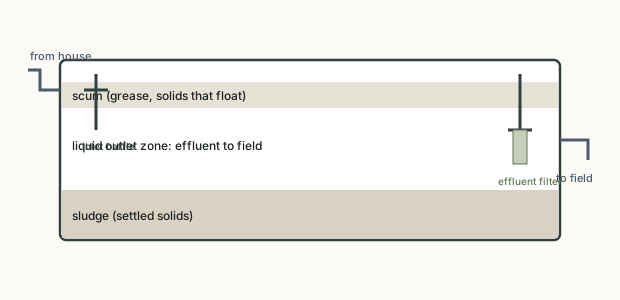
EPA identifies pumping thresholds at sludge within 12 inches of the outlet, scum within 6 inches of the outlet bottom, or combined sludge/scum exceeding 25% of liquid depth. Have the professional measure and interpret the actual tank; do not open a lid to estimate this yourself.
Record service dates, household use, disposal use and the tank’s condition. A large tank, seasonal occupancy or a low measurement at one visit does not automatically authorize a longer interval. Ask what the findings support and whether the equipment or permit adds inspection duties.
Separate normal liquid level from a developing fault
Liquid returns as the house discharges after service. Sludge/scum accumulation is a different measurement from the liquid level. Neither a full-looking tank nor the number of affected fixtures identifies the failed component.
Slow drains, odor, wet ground or recurring symptoms can involve plumbing, an outlet, distribution, controls, loading or the treatment area. Ask the provider to document the cause it established and what remains uncertain. Repeated pump-outs are not a substitute for that assessment.
Specify the complete pump-out and any separate inspection
Ask who locates and exposes covers, which compartments are serviced, how solids and liquid are removed, and what disposal and site-access charges are included. Coordinate safe cover access with the provider.
Filter service follows the installed product’s instructions. A property-transfer inspection has its own scope and limitations; agree its sequence with any pumping so relevant observations are recorded. Keep the pump-out invoice and inspection findings distinct.
Use a published price benchmark with its limits
Angi’s October 14,2026 national guide reports a $432 average and a $297–$584 typical range for septic pumping. These are reported national projects, not Vermont quotes. Access, service scope and additional work can change the attending company’s price.
Request a written price describing the actual tank and work. Disposal, exposing buried covers, filter work, assessment and repairs should be identifiable rather than assumed to be included because the service is called cleaning or pumping.
Read the sludge measurement alongside household loading
The reliable way to dial it in is to have the sludge and scum depth measured at your next pump-out. If the tank was close to the point where solids escape, keep the schedule tight. If the measured reserve was large, ask the provider whether an adjusted schedule is appropriate under the system’s operating conditions.
The calendar interval is a proxy for the thing that matters: how close the tank is to letting solids escape to the field. That point arrives when the combined sludge and scum fill enough of the tank that the clear middle zone can no longer do its job. How fast that happens is a simple function of how much solid material goes in versus how much volume the tank has to hold it.
So the answer to 'how often' is 'often enough that solids never reach the field, and no more often than that.' A calendar interval does not capture the differences between a lightly loaded large tank and a heavily loaded small one. Knowing your tank size and occupancy gets you a good estimate. Measuring gets you the real number.
A larger household, frequent long-term guests, or a home office that keeps the house occupied all day increase daily flow. The outlet baffle and any effluent filter also need assessment; filter service does not remove the solids already stored in the tank.
Things that lengthen it are mostly the reverse: a large tank, few occupants, water-efficient fixtures, and disciplined habits about what goes down the drain. A seasonal camp used only in summer accumulates solids only part of the year.
The best schedule comes from data your pumper already gathers. Ask them to measure the sludge and scum at the pump-out and tell you how full the tank was relative to the point where solids would start to escape. That single observation converts the generic range into a schedule for your specific system.
Compare the work behind the words pumping and cleaning
Pumping vs cleaning a septic tank . Pumping vs cleaning a septic tank: pumping and cleaning a septic tank overlap, but they are not identical, and the distinction is worth understanding so you know what you are paying for. Pumping, strictly, means vacuuming the contents out of the tank.
A bare pump-out can remove the liquid and loose sludge and leave the job at that. Cleaning means fully emptying the tank of all its solids, the packed sludge on the bottom and the scum on top, and often back-flushing or agitating to break up material the vacuum would otherwise leave behind. The label on an estimate does not establish the extent of solids removal; ask what compartments, filter work and observations the quoted visit includes.
The useful test is not the word on the invoice but whether both layers and, on a two-compartment tank, both compartments were removed, and whether the filter and baffles were serviced.
Pumping describes the physical act: a vacuum truck draws the tank's contents out through a hose. On its own, that can be done well or poorly. A hose that only reaches the liquid layer lowers the level without removing the sludge and scum that cause problems.
Cleaning describes the goal: a tank emptied of all its accumulated solids, not just its liquid. A proper cleaning reaches the bottom, breaks up compacted sludge if needed, and removes the floating scum, so the tank is empty instead of merely lower.
The risk is paying for a 'pump' that is really a partial skim. If the truck removes the easy liquid and some loose material but leaves the packed bottom sludge and the scum mat, the tank looks serviced but the solids that would reach the field are still there. A tank refills with liquid as household wastewater enters; the useful follow-up measure is remaining solids and the cause of any symptoms, not liquid level alone.
This is why the cheapest quote is not always the cheapest job. Removing accumulated solids supports maintenance, but the next interval still depends on the measured findings, loading and system requirements.
A skim that leaves half the solids behind sets you up to pay again sooner and risks the field in between. The words on the two invoices can be identical while the work is not.
Ignore the label and confirm the substance. Ask whether both the sludge and the scum were removed, whether both compartments of a two-compartment tank were cleared, and whether the effluent filter was cleaned and the baffles checked. A pumper who does all of that is cleaning the tank regardless of what the invoice says.
Also ask for the sludge measurement and the tank's condition. That report distinguishes real maintenance from a quick lowering of the level, and it gives you the data to set the next interval. When you buy the outcome, an empty, inspected tank, rather than the word, the pumping-versus-cleaning debate resolves itself.
Access, removal and observations during the visit
What happens during a septic pump-out . What happens during a septic pump-out: during a pump-out, a truck with a vacuum tank locates your septic tank, exposes the access lids, and removes everything inside, the floating scum, the settled sludge and the liquid, leaving the tank empty. The technician starts by finding the lids, which is quick if risers bring them to the surface and slower if they have to be dug up.
Once open, a large hose reaches to the bottom of the tank, and the vacuum breaks up and draws out the sludge and scum instead of just skimming the liquid off the top. Ask whether the pumping scope includes baffle observations, filter service and checks for cracks, corrosion or roots. They should tell you how full the tank was, which sets your next interval, and flag anything that needs repair.
The job begins with locating the tank and its access lids. On a system with risers, buried pipes that bring the lids to ground level, this is immediate. Without them, the technician probes for the tank using the permit drawing, a metal detector or a locating tool, and then digs down to the lids, which is where most of the extra time and cost on an older system comes from.
This is exactly why risers are worth installing. Accessible risers can reduce uncovering work, but truck access, weather and the tank’s condition still affect the visit. If your lids are hard to reach, ask about an appropriate riser installation and secure lid arrangement.
A proper pump-out empties the whole tank, not just the easy liquid in the middle. The hose reaches the bottom and the vacuum, sometimes with the sludge broken up by back-flushing, pulls out the settled solids and the floating scum together.
For a two-compartment tank, both compartments are cleared. This is why the full scope matters more than a bare advertised price: the value of a pump-out is in removing the material that would otherwise reach the field , and that only happens if the technician empties both layers and both compartments.
An empty tank is the one time the inside is visible, so a good pumper uses the moment. They check the inlet and outlet baffles for cracks or missing pieces, clean or inspect the effluent filter, and look for structural problems, corroded steel, cracked concrete, roots, that would otherwise go unseen until they cause a failure.
You should come away with information, not just an empty tank: how full it was relative to needing service, the condition of the baffles and filter, and any repairs to plan for. That report is what turns a pump-out from a chore into real maintenance, and it is reasonable to ask for the sludge measurement so you can set the next interval.
Mainly help the technician find the tank and lids the first time, and clear vehicles or obstacles from the access route for the truck. Knowing your tank's location beforehand, or having risers installed, avoids a locating charge and speeds the job.
Why a temporarily improved drain does not prove the diagnosis
Signs your septic tank is full . The clearest signs a septic tank needs attention are slow drains throughout the house, gurgling in the plumbing, sewage odors indoors or over the tank, and wet or unusually lush ground above the tank or drain field. These symptoms require diagnosis even when pumping is current, because plumbing, components and the treatment area can cause similar effects.
The tricky part is that the same signs can mean either a full tank or a failed leachfield, and telling them apart matters because one is a cheap pump-out and the other a costly replacement. Record whether a pump-out changes the symptoms, but do not treat that temporary storage as proof that the tank was the only fault.
Symptoms that return within days, or a permanently soggy area over the field, point at the field. Any sewage backing up indoors, or standing effluent in the yard, means stop adding water and call for service. It is both a system problem and a health hazard.
Slow drains are the first hint. Several fixtures draining sluggishly at once, instead of a single clogged sink, because the problem is downstream of the whole house. Gurgling from toilets or drains as air escapes, and a sewage smell near the tank or in the lowest fixtures, follow the same logic: the system is struggling to move water out.
Outside, watch the ground over the tank and field. Grass that is greener, taller or spongier than the surrounding lawn, standing water with no rain to explain it, or an outright sewage odor in the yard require investigation of the liquid source; lawn appearance alone does not prove surfacing sewage. These outdoor signs tend to point more at the field than the tank, which is an important distinction.
The single most useful test is what happens after a pump-out. If pumping clears symptoms, have the report explain the measured solids, outlet condition and field observations before concluding that an overdue pump-out was the cause.
If symptoms return after pumping, the investigation must include field acceptance, piping, filters, distribution and groundwater; rapid recurrence alone does not identify the failed component. An empty tank cannot fix a field that will not drain.
Timing offers another clue. Trouble that appears only during heavy use, a laundry day, a full house, and eases afterward requires a comparison of the actual loading with the tank and field condition.
A wet spot over the field that never dries, or backups that happen regardless of water use, suggest the field itself. When in doubt, an inspection can measure the tank and check whether effluent is ponding in the field.
First, reduce water use immediately. Hold off on laundry, dishwashers and long showers so you are not adding to a system that cannot keep up. That alone often buys time and keeps a slow drain from becoming a backup into the house.
Does a two-person household really need less frequent pumping?
Yes, because less wastewater and fewer solids enter the tank, so the sludge and scum grow more slowly. A lightly loaded tank can accumulate solids more slowly, but the measurements and operating requirements should determine the next visit.
How does a garbage disposal change the interval?
It adds ground food solids that increase the sludge layer faster than the tank was designed for, so households that use one heavily should ask for a schedule based on measured accumulation and the actual solids load. Using it sparingly, or composting instead, keeps the interval where it would otherwise be.
Can I go longer than five years if the tank looked empty last time?
Have the provider assess the measurements against the system’s requirements before extending the interval. A one-time low reading does not establish that the same schedule will remain appropriate indefinitely. Household use can change.
What if I have no idea when it was last pumped?
Arrange an assessment and establish the solids levels and service history rather than waiting for symptoms. Starting from a known empty tank and a recorded date lets you build a real schedule going forward instead of guessing against an unknown history.
Does water usage affect how often I pump?
High water use pushes more liquid through faster, which can carry solids toward the outlet and stress the field, though the sludge accumulation itself is driven more by solids than water. Water-efficient fixtures help the field. Disciplined solids habits help the pumping interval.
Do I pump on a schedule or wait for symptoms?
On a schedule. Waiting for slow drains or odors means waiting until solids may already be reaching the field, which is exactly the damage pumping is meant to prevent. The whole point of an interval is to act before there is anything to notice.
Should a rental or Airbnb be pumped more often?
Variable, sometimes heavy occupancy and guests unfamiliar with septic limits increase both flow and the risk of the wrong things going down the drain, so a shorter, more conservative interval protects the system between guests.
How do I keep track of the schedule?
Record the pump-out date and the sludge finding somewhere you will find it. A note in the permit file, a calendar reminder for the next due date. A simple log turns a vague memory into a schedule and prevents the years-long gaps that damage fields.
What is the first sign a tank needs pumping?
Several slow drains with gurgling call for diagnosis of the downstream restriction. Because the restriction is downstream of the whole house, it shows up everywhere rather than at one sink. A single slow drain is more likely a local clog than a septic issue.
Why does my yard smell like sewage?
Sewage odor needs investigation of its source; possible wastewater faults include surfacing near the tank or field. It can mean an overfull tank, a failing field, or a broken component.
Is lush green grass over the drain field a bad sign?
It can be. Grass that is noticeably greener, taller or spongier than the rest of the lawn over the field can accompany a wastewater problem but does not prove the liquid source. Have the field assessed rather than diagnose failure from grass color alone.
Can a full tank cause gurgling toilets?
Yes. When the system cannot move water out quickly, air is displaced back through the plumbing, causing gurgling in toilets and drains. It is a sign the system is struggling and, combined with slow drains, points toward a tank that needs pumping or a field problem.
How full is 'full' for a septic tank?
A working tank is always full of liquid to the outlet level. That is normal. 'Full' in the sense that matters means the sludge and scum have grown enough that solids are about to escape to the field. That is measured at a pump-out, not visible from the surface.
Are slow drains ever not a septic problem?
Yes. A single slow fixture often needs investigation at that fixture or branch before assuming a whole-system fault. Septic-related slowness shows up across multiple fixtures at once and often with odor or gurgling, which is how you distinguish a system issue from a plugged trap.
Should I use a drain cleaner if my septic drains are slow?
Avoid harsh chemical drain cleaners on a septic system. They can kill the bacteria the tank relies on and rarely fix a septic-level slowdown anyway. If the slowness is system-wide, have the tank and downstream components evaluated; chemical drain cleaner is not a diagnosis or a repair for a failed treatment area.
When is a sign an emergency?
Sewage backing up into living space, or standing effluent in the yard, is urgent both as a system failure and a health hazard. Stop adding water, keep people and pets away from any backup, and arrange service promptly rather than waiting to see if it clears on its own.
How often to pump a septic tank: service details and questions
Most Vermont septic tanks should be pumped every three to five years, but that range is a default you should adjust to your own tank and household. Two numbers set the true interval: how big the tank is, and how much load the household puts on it. A 1,000-gallon tank serving a family of five fills its sludge and scum layers far faster than a 1,500-gallon tank serving a retired couple, so the same calendar rule under-serves one and wastes money on the other.
Habits matter too. A garbage disposal, a household that does laundry in big weekly batches, or a system that has never had its effluent filter cleaned all shorten the interval
The reliable way to dial it in is to have the sludge and scum depth measured at your next pump-out. If the tank was close to the point where solids escape, keep the schedule tight. If there was plenty of clear space left, you can safely lengthen it
Sludge depth, not the calendar, decides when this tank needs pumping
Adjusting your pumping interval: factors that move it
Small tank, full household
Higher household loading can bring pumping forward; use the measured sludge and scum levels to set the interval
Large tank, few people
Lower household loading can slow solids accumulation; keep inspections and use their measurements rather than extending the interval from household size alone
Garbage disposal in use
Shorten the interval by about a year; disposals add solids the tank was not sized for
Seasonal or part-time use
Extend the interval; solids only accumulate while the house is occupied
Effluent filter never cleaned
Clean it every pump-out; a neglected filter or none at all lets more solids reach the field
Reflects the standard relationship between tank capacity, load and solids accumulation. Your measured sludge level is the authoritative guide
Why one number cannot fit every house
So the answer to 'how often' is 'often enough that solids never reach the field, and no more often than that.' A rigid three-year rule wastes money on a lightly loaded large tank and is dangerously slow for a heavily loaded small one. Knowing your tank size and occupancy gets you a good estimate. Measuring gets you the real number
What shortens or lengthens your interval
Several things push the interval shorter. A garbage disposal adds solids the tank was not sized for
A larger household, frequent long-term guests, or a home office that keeps the house occupied all day increase daily flow. An old tank without an effluent filter lets more solids move toward the outlet, and skipping filter cleanings has the same effect
None of these change the mechanism. They change the rate, which is exactly what the interval is trying to track
Setting your schedule from a measurement
Write the date and the finding down. If the tank was near capacity at a four-year interval, hold at four years or tighten to three
If it was only half-loaded, extend toward five or six and re-check. Two or three cycles of this and you will know your system's real rhythm better than any table can tell you
Is three to five years a hard rule?
No, it is a default for an average household on an average tank. Your real interval depends on tank size and occupancy, and can be shorter than three years for a small tank on a big family, or longer than five for a large tank on a couple. Measuring the sludge settles it
How do I find my tank size?
It is on the septic permit or design drawing in your file, the capacity specified for the actual permitted residential design. If you have no records, the pumper can estimate it from the tank dimensions when they open it, and the regional office may have the permit on record
Lower wastewater and solids loading can slow sludge and scum accumulation. Keep inspections and use the actual layer measurements when setting the next pump-out rather than extending the interval from household size alone. A large tank serving two people can accumulate solids differently from a smaller tank with a larger household, but the calendar and normal water level do not replace those measurements.
It adds ground food solids that increase the sludge layer faster than the tank was designed for, so households that use one heavily should use measured sludge and scum accumulation to set their inspection and pumping interval. Using it sparingly, or composting instead, keeps the interval where it would otherwise be
If a measurement showed plenty of clear space at five years, you can cautiously extend and re-check. The safe method is to lengthen gradually and confirm at the next pump-out instead of assume a one-time low reading holds forever. Household use can change
Treat it as overdue and schedule a pump-out now, with a sludge measurement. Starting from a known empty tank and a recorded date lets you build a real schedule going forward instead of guessing against an unknown history
Is more frequent pumping ever harmful?
Pumping a tank before measured solids or the maintenance plan require it can add expense without addressing another problem. Ask the service provider to record sludge and scum levels and the tank’s condition. Normal bacteria do not need a purchased additive after pumping, but do not treat unnecessary pumping as a harmless solution to every alarm, leak or failed drain field.
Yes. Variable, sometimes heavy occupancy and guests unfamiliar with septic limits increase both flow and the risk of the wrong things going down the drain, so a shorter, more conservative interval protects the system between guests
Does Vermont require pumping on a set schedule?
The state regulates system design and permitting instead of mandating a homeowner pumping calendar, so the interval is your maintenance responsibility. Some towns or lenders may ask for proof of recent pumping at a sale, which is another reason to keep records
Pumping vs cleaning a septic tank: service details and questions
Pumping vs cleaning a septic tank: pumping and cleaning a septic tank overlap, but they are not identical, and the distinction is worth understanding so you know what you are paying for. Pumping, strictly, means vacuuming the contents out of the tank. A bare pump-out can remove the liquid and loose sludge and leave the job at that.
Cleaning means fully emptying the tank of all its solids, the packed sludge on the bottom and the scum on top, and often back-flushing or agitating to break up material the vacuum would otherwise leave behind. In practice, a reputable operator's 'pumping' is a complete cleaning, and a cheap 'pump' can be a partial skim that leaves the problem layers in place
Pumping vs cleaning: what you are really buying
A bare 'pump' (skim)
Fully, broken up if compacted
Reflects common industry usage; confirm the scope of work with your operator
What each word technically means
Good operators use the words interchangeably because their pumping is always a cleaning. The gap appears only with a cut-rate skim
Where the distinction costs you
The risk is paying for a 'pump' that is really a partial skim. If the truck removes the easy liquid and some loose material but leaves the packed bottom sludge and the scum mat, the tank looks serviced but the solids that would reach the field are still there. Months later the tank seems to fill quickly and the interval appears far too short, when the real problem was an incomplete previous visit
This is why the cheapest quote is not always the cheapest job. A complete cleaning that removes everything protects the field and resets the interval
What to confirm, whatever it's called
Are pumping and cleaning the same thing?
They overlap and reputable operators use the terms interchangeably. Strictly, pumping is the act of vacuuming and cleaning is fully emptying the tank of all solids. The practical difference only appears when a cheap 'pump' skims the liquid and leaves the sludge and scum behind
How do I know if my tank was cleaned?
Confirm that both the bottom sludge and the floating scum were removed, both compartments were cleared, and the filter and baffles were serviced. A sludge measurement and a condition report distinguish a real cleaning from a level being merely lowered
Is a cheaper 'pump only' service a bad deal?
It can be, if it leaves the problem layers in place. The tank then appears to fill quickly and you pay again sooner, with the field at risk in between. The lowest quote is only a bargain if the tank is emptied, not skimmed
Does cleaning include the filter and baffles?
A complete cleaning includes checking the baffles and cleaning the effluent filter while the tank is open, since that is the one time they are accessible. If those steps are skipped, the service is less complete than a full cleaning regardless of the term used
What is back-flushing during a pump-out?
It is agitating or spraying to break up compacted sludge so the vacuum can remove it, instead of leaving a hardened layer on the bottom. It is part of a proper cleaning when the sludge has packed down, especially on a tank that is well overdue
Do I ever need a 'deep clean' beyond normal pumping?
A tank that is severely overdue, has heavily compacted sludge, or has never had the scum mat removed may need extra agitation to clean fully. For a tank on a normal schedule, a complete routine cleaning is all that is required
Should both compartments always be cleaned?
Yes, if you have a two-compartment tank. Pumping only the first compartment leaves solids in the second, so confirm both sides were opened and emptied. Many older Vermont tanks are two-compartment, so it is worth asking specifically
Why does my tank seem to fill up so fast?
After pumping, household wastewater brings the tank back to its operating liquid level. That water level alone does not show that sludge and scum have filled it again.
If service seems necessary unusually soon, ask the pumper to measure the layers and check the condition, household load, leaks or inflow, and whether the previous work removed the accumulated solids. Use the measurements to set the next interval.
Does 'cleaning' mean scrubbing the tank walls?
No. It means removing all the accumulated solids and liquid, not sterilizing the interior. A residential septic tank does not need its walls scrubbed, and the bacteria coating them are beneficial. Emptying both layers is what 'clean' means here
Will additives clean the tank instead of pumping?
No additive removes accumulated sludge and scum. Only physical pumping or cleaning does. Products that claim to eliminate the need to pump are contradicted by how solids build up, and relying on them lets the layers grow until they reach the field
Is the price difference worth it for a complete job?
Yes, because the value is in protecting a leachfield that can involve substantial replacement work. Paying more for a complete cleaning that empties everything and inspects the tank is cheaper over the life of the system than repeated partial skims
What should I ask for when I book service?
Ask for a full pump-out that removes both layers and both compartments, cleans the filter, checks the baffles, and reports how full the tank was. Buying that defined outcome sidesteps any ambiguity between the words 'pumping' and 'cleaning'
What happens during a septic pump-out: service details and questions
What happens during a septic pump-out: during a pump-out, a truck with a vacuum tank locates your septic tank, exposes the access lids, and removes everything inside, the floating scum, the settled sludge and the liquid, leaving the tank empty. The technician starts by finding the lids, which is quick if risers bring them to the surface and slower if they have to be dug up. Once open, a large hose reaches to the bottom of the tank, and the vacuum breaks up and draws out the sludge and scum instead of just skimming the liquid off the top.
While the tank is empty, a complete pumper inspects the baffles, cleans the effluent filter, and looks for cracks, corrosion or roots. They should tell you how full the tank was, which sets your next interval, and flag anything that needs repair
The whole tank is emptied, which is also the moment to look at the baffles
A complete pump-out, step by step
Locate and open the lids
Fast with risers; otherwise the tank is probed for and dug down to
The hose reaches the bottom and removes sludge and scum, not just the liquid
A two-compartment tank has both sides pumped
Inspect baffles and filter
Inlet and outlet baffles checked; effluent filter cleaned or inspected
How full the tank was, the condition of components, and any repairs needed
The waste goes to an approved treatment facility, never onto the property
The standard sequence a licensed pumper follows on a residential tank
Finding and opening the tank
This is exactly why risers are worth installing. They turn every future pump-out into a quick, predictable job and mean nobody skips maintenance because the lids are buried under a foot of lawn. If your lids are hard to reach, having risers added is the best small investment you can make in the system
Removing both layers, not just the liquid
Skimming only the liquid leaves the layers that cause problems in place. A tank that looks pumped may not really be
For a two-compartment tank, both compartments are cleared. This is why a complete hauler is worth more than the cheapest quote: the value of a pump-out is in removing the material that would otherwise reach the field , and that only happens if the technician empties both layers and both compartments
The inspection you should get for free
How long does a septic pump-out take?
Under an hour once the access lids are exposed. Locating and digging up buried lids, an overfull tank, or a two-compartment tank that needs both sides cleared can add time. Surface-level risers on the lids keep every future visit consistently quick
Do I need to do anything to prepare?
Does the pumper remove all the liquid too?
Yes. A proper pump-out empties the tank completely, sludge, scum and liquid. The tank then refills with wastewater over the following days as the household uses water, and the bacteria re-establish. Leaving liquid or the bottom sludge behind is a sign of an incomplete job
Will pumping leave my tank 'reset' with no bacteria?
The tank re-establishes its bacterial population quickly as normal use resumes, so an empty tank is not a problem. You do not need to add anything to restart it. Ordinary household wastewater reseeds it within days, and additives are unnecessary
Should the effluent filter be cleaned during the pump-out?
Yes, if your tank has one. Cleaning the effluent filter at each pump-out is standard and cheap, and a clogged filter is a common cause of slow drains. Ask whether your tank has a filter and confirm it was serviced
What should the pumper tell me afterward?
How full the tank was, the condition of the baffles and filter, whether there were cracks, roots or corrosion, and any repairs to plan. The sludge measurement in particular lets you set the right interval for next time. It is worth asking for specifically
Where does the waste go?
The septage is hauled by a licensed hauler to an approved treatment facility, often a municipal wastewater plant that accepts it, not disposed of on your property or anyone else's. Proper disposal is part of why pumping must be done by a licensed operator
Can the pumper tell if my drain field is failing?
They can spot warning signs, effluent standing at the outlet, a tank that refills abnormally fast, backflow from the outlet, and recommend a closer inspection. A pump-out is not a full field evaluation, but it often shows the first evidence that the field is struggling
Do they check for cracks or leaks?
A complete pumper inspects the visible interior while the tank is empty for cracked concrete, corroded steel, failed baffles and root intrusion. Some problems are only visible empty, which is another reason the inspection portion of a pump-out has real value
Is it normal for the ground to be disturbed afterward?
If the lids had to be dug up, expect some disturbed soil and grass over the access points, which settles back. Installing risers eliminates the digging on future visits, so the lawn is left undisturbed at every pump-out after that
Can two-compartment tanks be pumped through one lid?
Both compartments need to be accessed and emptied, so the pump-out opens the lid over each compartment. A hauler who pumps only the first compartment leaves half the job undone, so confirm both sides were cleared if you have a two-compartment tank
How do I choose a good pumper?
Look for a licensed hauler who empties both layers and both compartments, cleans the filter, inspects the tank, and reports what they found, not simply the lowest price for skimming the liquid. The difference shows up years later in whether your field survives
Signs your septic tank is full: service details and questions
The clearest signs a septic tank needs attention are slow drains throughout the house, gurgling in the plumbing, sewage odors indoors or over the tank, and wet or unusually lush ground above the tank or drain field. By the time these appear, the tank is often already overdue, since a healthy interval is meant to keep you ahead of any symptom at all.
The tricky part is that the same signs can mean either a full tank or a failed leachfield, and telling them apart matters because one is a cheap pump-out and the other a costly replacement. A backup right after heavy water use that clears when the tank is pumped points at the tank
The layers keep rising as the tank fills, and the first sign shows up inside the house
Reading the signs: tank problem versus field problem
More likely the tank
More likely the field
Returns within days of pumping
After heavy water use, then eases
Right over the tank lid
Over the drain field, never dries
Near the tank access
Across the field area or in the yard
Symptoms come back quickly
General diagnostic guidance; an on-site inspection confirms the cause
What the everyday warning signs look like
Outside, watch the ground over the tank and field. Grass that is greener, taller or spongier than the surrounding lawn, standing water with no rain to explain it, or an outright sewage odor in the yard all mean liquid is surfacing that should be underground. These outdoor signs tend to point more at the field than the tank, which is an important distinction
Telling a full tank from a failed field
The single most useful test is what happens after a pump-out. If pumping the tank clears the symptoms and they stay gone for weeks or months, the tank was the problem and you were simply overdue
If the tank fills and the symptoms return within days, the leachfield is no longer accepting water at the rate the household produces it. An empty tank cannot fix a field that will not drain
Timing offers another clue. Trouble that appears only during heavy use, a laundry day, a full house, and eases afterward suggests capacity that pumping will restore
What to do the moment you notice
Then get the tank measured and pumped. A pump-out both relieves the immediate problem and produces the diagnostic information you need: how full the tank was, the condition of the baffles and filter, and whether effluent is standing in the field. If a backup has already reached living space, treat the affected area as contaminated and keep people and pets away until it is cleaned
Slow drains across several fixtures at once, often with gurgling. Because the restriction is downstream of the whole house, it shows up everywhere rather than at one sink. A single slow drain is more likely a local clog than a septic issue
Does a full tank always cause a backup?
Not always. Many overdue tanks give warning signs like slow drains and odors before any backup. But a tank left long enough will eventually back up into the lowest fixtures, so treating the early signs seriously is what keeps sewage out of the house
Effluent is surfacing that should be underground, over the tank or field. It can mean an overfull tank, a failing field, or a broken component
It is both an unpleasant sign and a health concern. It warrants prompt service instead of waiting
It can be. Grass that is noticeably greener, taller or spongier than the rest of the lawn over the field often means effluent is reaching the surface and over-fertilizing it. A sign the field is saturated instead of treating water correctly
My drains are slow only on laundry day. What does that mean?
Trouble that appears under heavy water use and eases afterward points at capacity, which pumping often restores. It suggests the system is near its limit instead of fully failed, but it is a clear prompt to have the tank measured before it worsens
If pumping fixed it, am I done?
If the symptoms stay gone, the tank was the issue and you should set a schedule to stay ahead of it. If they return within days, the field is failing and pumping only bought time. That quick return is the key diagnostic that tells you the tank was not the real problem
Can I check the tank level myself?
You can note surface signs. Do not open the tank to look inside
The gases are dangerous and the lids are heavy. Leave measuring the sludge and scum to the pumper, who has the tools to do it safely and can tell you exactly how full it was
Yes. A single slow fixture is a local clog in that drain, not the septic system. Septic-related slowness shows up across multiple fixtures at once and often with odor or gurgling, which is how you distinguish a system issue from a plugged trap
Avoid harsh chemical drain cleaners on a septic system. They can kill the bacteria the tank relies on and rarely fix a septic-level slowdown anyway. If the slowness is system-wide, the answer is measuring and pumping the tank, not pouring chemicals down the drain
How often to pump a septic tank
How often to pump a septic tank depends on its solids measurements, tank volume and actual household loading. EPA describes a three-to-five-year household pumping interval and inspection at least every three years; those planning ranges do not override an earlier measured need or an alternative system’s maintenance requirements. Ask the pumper to record sludge, scum and the outlet condition before the tank is emptied.
Keep the date with the service report. A growing household, a disposal unit or a shift from seasonal to year-round use changes what the next inspection needs to evaluate.
The correct next appointment follows the observed accumulation and operating requirements, rather than a promise that every tank can wait five years. If sewage is backing up or reaching the surface, request a fault assessment now instead of using this routine schedule.
How often to pump a septic tank after a change in use
Tell the service company when occupancy changed and provide the last measured solids levels. A dated receipt that says only “pumped” cannot show the accumulation rate.
Ask for an inspection date that can establish it. A shorter initial review interval may be appropriate where the previous loading is unknown; the provider should explain the basis rather than sell an arbitrary annual pump-out.
A calendar example with a clear limit
For an illustrative household last pumped in October 2023, October 2026 is three years later and October 2028 is five years later. Those dates mark EPA’s planning range, not permission to ignore an alarm until 2028.
Check the intervening inspection record and current solids measurements before choosing the next pumping date. A failed component or overloaded field needs its own repair scope.
Signs your septic tank is full
Signs your septic tank is full of excess solids cannot be confirmed from odors or slow drains alone. A working tank holds liquid up to its outlet; finding water inside does not diagnose failure. Backups, widespread slow drainage, an alarm or wet ground can arise from different components, so report what happened and request an assessment.
Stop avoidable wastewater use if sewage is returning indoors. Keep people and pets away from exposed sewage and leave lids closed for the professional. The service visit should distinguish accumulated solids, blocked piping, outlet trouble, pump faults and a field that cannot accept flow.
Pumping may provide temporary relief, but that relief does not prove the field is sound. Ask the provider to document the observed levels and the reason for the recommended next step.
Signs at a full septic tank need a component diagnosis
A tank refills toward its operating liquid level as wastewater enters after pumping. Solids accumulation is a separate measurement.
The pumper can compare scum and sludge with the outlet and record evidence of obstruction or damaged components. Avoid opening the tank yourself or entering any septic structure.
Describe the pattern before choosing a pump-out
Record whether one fixture or the whole house is affected, whether the problem follows heavy rain, and whether an alarm operated. Note the location of outside wetness without walking through sewage. These observations help the technician choose the investigation; they do not turn a symptom into a remote diagnosis or a guaranteed replacement recommendation.
What happens during a septic pump-out
A septic pump-out should have an agreed scope before the truck arrives: safe access to the correct openings, removal of the tank contents, the checks included in the price and a written service record. Give the company the permit sketch or previous service location and describe buried lids, gates and vehicle access. Ask whether locating and excavation are included or charged separately.
A pumping visit can expose conditions worth recording, such as a damaged baffle or abnormal liquid level, but it is not automatically a complete real-estate inspection. Keep the field’s performance question separate from the work visible through the tank openings.
At the end, obtain the date, tank identification, work completed and any recommended follow-up. Those records help the next technician understand what was observed before everything was closed.
Septic pump-out access, removal and the service record
The professional locates the relevant access points and uses equipment suited to the installation. Confirm that the agreed scope covers the compartments and components present at your property.
Do not assume that a charge described as “pump tank” includes filter cleaning, locating a second opening or replacing a lid. A damaged cover must be reported and made safe.
Before the truck leaves the driveway
Ask what was measured before emptying, what could not be inspected and whether a separate repair visit is needed. Keep the disposal and service documentation provided. If the concern was recurrent backup, ask which finding explains it; a newly emptied tank alone does not establish that the cause has been corrected.
Pumping vs cleaning a septic tank
Pumping vs cleaning a septic tank is a scope question: ask each company what it will remove, inspect and document rather than assuming the words describe two regulated service packages. A low “pumping” price and a higher “cleaning” price cannot be compared until both identify access work, tank compartments, accumulated solids, filter attention and disposal. Request a written itemization.
Neither label proves that a technician will evaluate the disposal field or certify the property for a sale. If a tank has unusual buildup or difficult access, describe the condition and ask how it changes equipment or labor.
The useful comparison is the work performed at your particular installation. Keep repair recommendations distinct from routine servicing so an inspection finding does not disappear inside a vague cleaning charge.
Pumping vs cleaning a septic tank: compare the scope
Put both estimates beside the permit drawing. Ask whether the quoted work includes every compartment and how access openings will be located and uncovered.
If a provider recommends additional agitation or a return visit, request the observed reason and charge. Do not infer that a more elaborate name means the field will recover from failure.
Separate tank servicing from an inspection report
A service invoice can record tank condition and work completed. A broader inspection may need records review, component tests and investigation beyond the tank.
State whether the purpose is scheduled maintenance, a symptom investigation or purchase due diligence before choosing the scope. That distinction is more useful than debating which advertising term is correct.
Winter septic pumping in Vermont
Winter septic pumping in Vermont: yes, a septic tank can be pumped in a Vermont winter, pumpers work year-round, but frozen ground and deep snow make the job harder, slower and sometimes more expensive, so the better strategy is to schedule ahead and avoid needing it mid-winter. The main obstacles are access: snow has to be cleared for the truck, and buried lids under frozen ground are far harder to locate and dig up than in summer. Fitting risers that bring the lids to the surface makes winter pumping almost as easy as any other time.
For a winter pump-out, confirm provider availability, access and the quoted work before relying on a visit. The related winter risk is freezing, not a full tank: a lightly used system, shallow or exposed pipes, or lost snow cover can all freeze. Planning pumping for the accessible months and protecting the system from freezing together keep winter uneventful.
What winter changes about the job
Pumping trucks operate in all seasons, so the tank's contents can be removed in winter without trouble. What winter changes is everything around the tank: the truck needs a cleared path and a place to park near the access, and snow over the lids has to be moved before work can start.
The bigger obstacle is frozen ground over buried lids. In summer a technician can dig down to a lid in minutes.
Through frost that same dig is slow and sometimes needs thawing. This is where a system without risers becomes expensive in winter, because most of the added time and cost is in reaching the lids, not in the pumping itself.
Why risers turn a winter headache into a routine visit
Compatible secured risers can improve winter access. By bringing the access lids to the surface, they eliminate the frozen-ground dig entirely. The technician clears the snow off the lid and opens it, and the job proceeds as it would in July.
If service may be needed in winter, ask whether approved risers would improve access and what their installation would cost. Snow clearance, safe cover condition and the provider’s access requirements still need planning.
Freezing is the other winter problem, and it isn't the tank
A distinct winter risk is the system freezing, which is not the same as the tank being full. Lightly used systems, shallow or poorly insulated pipes, and areas where snow cover was compacted or removed are the ones that freeze, because snow is what insulates a Vermont system through the coldest months.
The defenses are different from pumping: keep a snow cover over the tank and field instead of plowing or driving it bare, use water regularly enough to keep warm effluent moving, and fix any dripping fixtures that send a thin, freeze-prone trickle through the pipes. A frozen system needs thawing, not pumping. Telling the two apart saves an unnecessary call.
Is it more expensive to pump in winter?
It can be, mainly because of the added labor to clear snow and dig buried lids out of frozen ground. The pumping itself is not the costly part. Access is. Scheduling ahead for the accessible months, or installing risers, avoids the winter premium.
Should I pump before winter?
If a pump-out is due in the colder months, doing it in the fall is easier and cheaper than risking an emergency in a storm. Getting ahead of the interval before the ground freezes is the simplest way to avoid a difficult winter dig.
What if my tank needs pumping in January?
It still gets pumped. An overfull tank cannot wait for spring. Expect the access to take longer if the lids are buried and frozen over, and expect an emergency or storm call to cost more than a planned visit would have.
How do risers help in winter?
They bring the access lids to ground level, so the technician clears the snow and opens the lid instead of digging through frost. Risers can reduce excavation for access. They do not guarantee safe winter access or company availability.
Can a septic system freeze in Vermont?
It can, though that is a different problem from needing a pump-out. Vulnerable systems are the lightly used ones, those with shallow pipes, and any where the snow cover was stripped away.
And the fix is thawing and prevention, not pumping. The frozen-system guide covers it in detail.
Why does snow cover matter for a septic system?
Snow is an insulator that helps keep the tank and field from freezing through the coldest weather. Clearing or packing down the snow above the system removes that insulation, so the area over a septic system should be left with its natural snow cover.
My system froze: do I pump it?
No, a frozen system needs thawing, not pumping. Pumping a frozen tank does not address the ice blocking flow.
A professional can thaw the affected component. Telling freezing apart from a full tank avoids paying for the wrong service.
Does a seasonal camp need special winter care?
Yes. A camp left unused all winter has no warm flow to prevent freezing and should be winterized, and if a pump-out is due it is best done before closing up for the season. Ask a local operator about the right steps for an unoccupied system.
Can the truck reach my tank in deep snow?
It needs a cleared path and a place to park near the access, so plan to have the route and the area over the lids cleared before the appointment. In heavy snow, arranging access in advance is what keeps a winter pump-out from turning into a wasted trip.
Is fall the best time to pump in Vermont?
For many households, yes. The ground is still workable, access is easy, and it gets you ahead of a winter due date. Any accessible season works, but scheduling before the frost sets in is the simplest way to keep pumping routine instead of an emergency.
| Record | What it establishes | What it cannot establish |
|---|---|---|
| Last pumping date | Elapsed time | Present solids depth |
| Sludge and scum readings | Observed accumulation | Field performance by themselves |
| Changed occupancy | A reason to reassess loading | One universal shorter interval |
EPA’s planning interval is interpreted alongside the tank’s measured solids and household use.
| Observation | Useful detail | Assessment required |
|---|---|---|
| Indoor backup | Fixtures affected and start time | Locate the restriction |
| Alarm | Sound/light and recent power loss | Identify control or pump fault |
| Outside wetness | Location and weather sequence | Distinguish sewage from other water |
Observed symptoms guide an investigation; liquid in a tank is not itself a failure diagnosis.
| Stage | Owner information | Provider documentation |
|---|---|---|
| Access | Sketch, gates and buried lids | Locating/excavation scope |
| Tank work | Known compartments or filter | Components serviced |
| Closure | Concern that prompted the visit | Findings and follow-up |
Separate the visit logistics from the observations retained in the service report.
| Question | Pumping quote | Cleaning quote |
|---|---|---|
| Openings and locating | Get the written inclusion | Require the same detail |
| Solids and compartments | Specify tank arrangement | Identify additional work |
| Field assessment | Request any separate scope | Do not assume certification |
Compare written inclusions because service labels alone do not specify the work.
| Item | Explanation |
|---|---|
| Pump before winter if due | Schedule a fall pump-out rather than risking an emergency dig through frost and snow. |
| Install risers | A compatible, secure riser can improve access. Snow clearance, cover condition and safe working access still matter. |
| Keep snow cover | Snow insulates the tank and field; do not plow, drive or compact the area bare. |
| Describe winter occupancy | Have the provider assess freeze protection and any closure plan; do not run extra water as a substitute for a design or repair. |
| Fix drips | A slow trickle from a leaky fixture freezes in the pipe more readily than normal flow. |
Reflects standard cold-climate septic practice; conditions vary by site.
Septic tank pumping: access, measurements and pump-out records
How often should a septic tank be pumped?+
EPA’s typical household interval is three to five years, with the schedule set from capacity, use and accumulated solids. Inspection and powered-equipment duties are separate; follow the installed system and permit requirements.
How full is a working septic tank?+
Liquid near the outlet can be normal operation. The service decision needs sludge and scum measurements, condition and operating history rather than a surface guess at liquid level.
Do slow drains mean my tank needs pumping?+
They do not identify the cause. Plumbing restrictions, outlet or distribution faults, controls, loading and treatment-area conditions can overlap. Record the pattern and arrange diagnosis rather than assume a pump-out fixes it.
If pumping stopped a backup, is the cause proved?+
Temporary or lasting relief does not by itself identify the fault. Keep the measured service findings and report recurrence. An empty tank can temporarily change what you observe downstream.
Can I extend the interval if I live alone?+
Discuss actual use and measured solids with the service provider. Occupancy alone cannot establish a safe interval, and equipment service or permit duties can still apply.
What if I do not know the last service date?+
Search the property records and arrange an assessment of the tank and service need. Record the findings and the resulting schedule. Missing history is not a reason to wait for symptoms.
Does a garbage disposal affect pumping?+
Food scraps add solids even when ground. Tell the provider about use and keep suitable scraps out of the drain. Measurements and loading should determine the service decision.
Is pumping the same as a real estate inspection?+
No. Agree the inspection components, records and limitations separately. Coordinate pumping with the inspector rather than assume an emptied tank establishes the condition of the field or whole system.
Should the filter be cleaned at a pump-out?+
Ask for service under the exact filter’s instructions. Model intervals and procedures differ. An alarm or restriction needs investigation before the next scheduled visit.
How much does septic pumping cost in Vermont?+
Obtain the local company’s complete price. For context, Angi’s October 14,2026 national guide reports $432 average and $297–$584 typical, with access and scope affecting the result. It is not a Vermont bid.
Can pumping during high groundwater create a problem?+
Have the provider assess site conditions and tank buoyancy, particularly after flooding. Do not treat extra or repeated pumping as universally harmless or use it to replace a diagnosis.
What should I do for a backup or sewage in the yard?+
Reduce wastewater input, keep people and pets away from contamination and contact service promptly. Avoid wet electrical equipment, questionable covers and open excavations.
Do I need to be home for service?+
Confirm the provider’s access and attendance requirements. Supply the known location, safe route and relevant history; do not assume that every tank is reachable or every visit takes a fixed time.