The septic tank
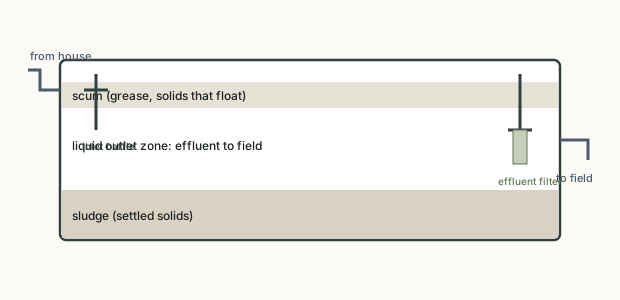
A septic tank is a sealed, watertight box, concrete, sometimes plastic or fiberglass, that holds wastewater still long enough for gravity to separate it into three layers: floating scum, settled sludge, and clear liquid in between. An inlet baffle slows incoming water so it does not stir up the settled solids, and an outlet baffle, often fitted with an effluent filter, holds solids back so only clarified liquid leaves for the distribution box and drain field. Tank capacity follows permitted design flow; residential bedrooms and occupancy help determine that flow, and the current rule adds capacity for a disposal or pump storage.
Access comes through lids over each compartment. Risers that extend those lids to the surface turn every future pump-out or inspection from a dig into a five-minute job.
Everything downstream of the tank depends on these parts working. A cracked baffle or a clogged filter is often the real cause of a problem that looks like a full field.
| Part or record | What to confirm |
|---|---|
| Tank body | Watertight condition, material and liquid capacity |
| Each compartment | Access for inspection and cleaning |
| Inlet and outlet | Devices intact and correctly located |
| Effluent filter | Correct model, condition and service instructions |
| Access covers | Tight fit and protection against entry by children |
Vermont wastewater rules §1-908: compartment access, inlet/outlet devices, filter, structural integrity and pumping to prevent solids discharge.
Why the tank is built the way it is
The tank's entire job is to hold water still. Motion is the enemy of settling, so a tank is sized to give incoming wastewater enough retention time, as required by the approved design, for solids to separate before more water pushes through. The required liquid capacity, loading, internal devices and operating condition all affect tank performance; size alone does not establish a particular fault.
Concrete is the traditional Vermont material since it is heavy enough to resist floating in wet ground and has decades of proven service life. Plastic and fiberglass tanks are lighter to install and increasingly common on tight sites.
Either way, the tank must be watertight. A cracked or leaking tank lets groundwater in or effluent out, both of which are code violations and both of which shorten its life.
The parts that do the actual work
The inlet baffle or tee directs incoming wastewater down below the surface layer so it does not disturb the scum that has already formed. The outlet baffle does the same job in reverse, keeping the tank's contents from moving toward the field until they have settled, and an effluent filter fitted at the outlet is a fine mesh screen that catches solids the baffle alone would miss.
A two-compartment tank adds a second settling stage: wastewater clears in the first chamber, then clears further in the second before reaching the outlet, which protects the field even better than a single chamber. From the tank, clarified effluent flows to a distribution box, which splits it evenly among the leachfield's trenches or beds.
Sizing, access and what to do with a tank you cannot find
Vermont’s Table 9-1 uses design flow: the base is 1,000 gallons through 560 gallons per day, then twice the flow below 6,500 gallons per day. Required increases and approved exceptions also apply. If you do not know your tank's size, the permit on file with the town or the regional office states it.
Finding a tank with no records takes probing the yard along the likely path from the house, or hiring a locator. Record the tank location and any compatible riser work for future service. Plan safe access so the required inspections and service can be performed; access alone does not predict field life.
Check permitted tank capacity before changing bedrooms
If you are buying a home or planning an addition that changes bedroom count, checking the tank's size against the new total matters, because inadequate settling volume can let solids move toward the field. The size is stated on the original wastewater permit, the most reliable source if you do not know it.
Household size fluctuates, guests, children growing up and leaving, renters, while bedroom count is fixed and represents the home's designed peak occupancy. Vermont's wastewater rules use bedroom count as a stable, verifiable number that does not change with who happens to be living there in a given year, so the state ties tank size to it.
A garbage disposal adds solids load beyond what a minimum-sized tank anticipates, and some designers size up specifically to accommodate one. A change of use or added bedrooms needs review of the permit and design flow; discuss unusual fixture discharges with the designer before connecting them.
If you are adding a bedroom to an existing home, that change can trigger a requirement to upgrade the septic system to match the new bedroom count under Vermont's rules. This is one of the more common reasons an older, smaller tank needs replacement even though it was functioning fine before the addition.
The most reliable source is the wastewater permit filed with the town or the state's regional office when the system was installed, which states the tank size and the bedroom count it was designed for. If records are missing, a pump-out gives a technician the chance to measure the tank directly.
If you are buying a house, comparing the permitted tank size against the actual bedroom count, including any additions made after the original permit, is a worthwhile check, since an undersized tank for the current bedroom count is exactly the kind of hidden issue a septic inspection is meant to catch.
Bedroom count is fixed and represents a home's designed peak occupancy, while the number of people living there changes over time. Vermont's wastewater rules use it as a stable number that protects future owners with a larger household than the current one.
A review is needed before assuming the existing design covers it. Adding a bedroom can trigger a requirement to upgrade the septic system to match the new bedroom count under Vermont's rules, which sometimes means a larger tank or, in some cases, a larger leachfield as well.
It can. A garbage disposal adds solids load beyond what a minimum-sized tank anticipates, so some designers size up to accommodate one even at the same bedroom count. Ask your septic designer if you plan to install one.
What size septic tank you need: service details and questions
Vermont septic-tank sizing starts with the permitted design flow and Table 9-1, not a universal bedroom-to-tank-size staircase. The table gives 1,000 gallons for design flow of 560 gallons per day or less, subject to the exceptions in §1-908(a). Greater flow below 6,500 gallons per day uses twice the design flow.
Pumps, dose and emergency storage, garbage disposals and an upstream pump station can require added capacity. Have the designer identify those requirements before comparing a concrete or plastic tank by its advertised volume.
If you are buying a home or planning an addition that changes bedroom count, checking the tank's size against the new total matters, because an undersized tank churns constantly and shortens the field's working life. The size is stated on the original wastewater permit, the most reliable source if you do not know it
Tank size is the time solids get to settle. Bedroom count sets that volume
Vermont minimum septic tank size by bedrooms
Sized individually by the designer
Reflects standard bedroom-based minimums under Vermont's wastewater system rules; specific site conditions or added fixtures can require a larger tank
Why bedrooms, not people, set the size
This means a couple in a 4-bedroom house is sized the same as a family of five in that same house, even though their day-to-day water use differs substantially. The system is designed for the home's potential peak load, not its current occupancy, which protects a future owner with a larger household
When you need more than the minimum
A garbage disposal adds solids load beyond what a minimum-sized tank anticipates, and some designers size up specifically to accommodate one. A hot tub, an in-home business with added plumbing fixtures, or any addition that adds bedrooms or significant fixture count can push a design above the state's baseline minimum
Checking the size of an existing tank
What size septic tank do I need for a 3-bedroom house?
For a three-bedroom home, have the designer calculate the design flow and apply Table 9-1 and §1-908(a). The table’s base minimum is 1,000 gallons at design flows of 560 gallons per day or less. A disposal, pump arrangement or other applicable exception can require more capacity, so bedroom count alone is not the complete tank specification.
Why is septic tank size based on bedrooms instead of people?
Do I need a bigger septic tank if I add a bedroom?
Often yes. Adding a bedroom can trigger a requirement to upgrade the septic system to match the new bedroom count under Vermont's rules, which sometimes means a larger tank or, in some cases, a larger leachfield as well
Does a garbage disposal require a bigger septic tank?
How do I find out what size my existing septic tank is?
Check the original wastewater permit on file with your town or the state's regional office, which states the tank size. If records are missing, a technician can measure the tank directly at your next pump-out
What happens if my septic tank is too small for my house?
An undersized tank churns constantly because wastewater does not have enough retention time to settle correctly, pushing more solids toward the field than the system was designed to handle, which shortens the field's working life
Is a 1,000-gallon tank enough for most Vermont homes?
A 1,000-gallon tank is the base Table 9-1 minimum for design flows of 560 gallons per day or less, rather than a guarantee of suitability for every home. Have the designer confirm actual flow, dosing and emergency storage, disposal use and other applicable exceptions before choosing the tank.
Can I install a smaller tank than the state minimum to save money?
No. The minimum tank size for a given bedroom count is a requirement under Vermont's wastewater permit process, not a suggestion, and a permit will not be issued for an undersized tank
Does a home business affect septic tank sizing?
It can, if it adds significant water use or plumbing fixtures beyond a typical residence. A designer accounts for that added load when sizing the tank and system as part of the permitting process
How does tank size relate to leachfield size?
They are sized together based on the same bedroom-count design flow. A larger tank paired with an undersized field, or vice versa, would not meet Vermont's design requirements. Both are calculated from the same household load
Is it worth installing a bigger tank than the minimum?
It can be. A tank larger than required gives more settling time and a longer pumping interval with no functional downside beyond installation cost, which some homeowners choose for that convenience alone
Do seasonal camps need the same size tank as year-round homes?
Sizing is still based on bedroom count regardless of seasonal use, since the design has to accommodate the home's peak potential occupancy whenever it is in use, not just its typical usage pattern
Septic effluent filters: service details and questions
Septic effluent filters: an effluent filter is a fine mesh cartridge fitted into the outlet baffle of a septic tank, positioned to catch small solids that would otherwise ride the clarified liquid out toward the leachfield. It is a cheap, simple device with an outsized effect: by trapping the last of the suspended solids that survive settling, it keeps them from ever reaching the soil that treats the water, which is exactly the material that clogs a field over time.
Filters should be cleaned about once a year, or at every pump-out at minimum, by rinsing the cartridge off. A job a homeowner can often do themselves once shown, or one a pumper does routinely
The filter sits on the outlet tee and catches what the tank did not settle out
Effluent filter cleaning schedule
About once a year
Garbage disposal in regular use
Large household or frequent guests
General guidance; a heavily loaded household should check more often
Settling inside the tank removes most solids. Not all of them
A filter should be checked and rinsed about once a year for an average household, though heavy use or a garbage disposal can clog it faster. At minimum, clean it at every pump-out, since the tank is already open and the filter is easy to access
Cleaning is as simple as lifting the cartridge out and rinsing the accumulated solids off with a hose back into the tank, then reinserting it. A task many homeowners handle themselves after being shown once, though a pumper will do it as a matter of course during service
If you know your tank has a filter and it has not been cleaned in a year or more, that is worth checking before assuming the worst. If your tank predates filters and has never had one, adding one during the next pump-out closes that gap for good
What does a septic effluent filter do?
It is a fine mesh screen at the tank's outlet that catches solids the settling process missed, keeping them out of the leachfield. It protects the soil that treats the water from the exact material, suspended solids, that clogs it permanently over time
How often should I clean my septic filter?
About once a year for a typical household, more often with a garbage disposal or heavy use, and at minimum every time the tank is pumped. A clean filter keeps the tank draining freely and protects the field from clogging solids
Often yes. Many filters lift out easily and can be rinsed with a hose back into the tank, then reinserted. If you are unsure how to access it safely or the tank is buried without risers, having a professional show you once or handle it is the simpler option
The filter cartridge itself is inexpensive, a modest parts cost, with retrofit labor adding more if it is installed as a separate visit instead of during a scheduled pump-out. It is one of the cheapest protective upgrades available for a septic system
Not directly, but a fully clogged filter that backs sewage up into the house is both unpleasant and unsanitary. Routine cleaning before it reaches that point keeps the situation from ever becoming a health concern
Newer installations commonly include one as standard practice, though state rules focus more on overall system design than mandating this specific component on older tanks. Adding one to an existing tank remains a voluntary but strongly worthwhile upgrade
Some advanced filter or pump systems include a high-water alarm that signals restricted flow, though a basic gravity-fed effluent filter does not. Sticking to a yearly cleaning schedule is the more common and reliable approach for most homes
How to find your septic tank: service details and questions
Finding a septic tank with no records starts with the wastewater permit filed with your town or the state's regional office, which may include a site sketch showing the tank's approximate location relative to the house. Without a usable record, trace the building sewer, the pipe leaving the house's foundation, visible in a basement or crawlspace, and follow its likely straight-line path outward, since most residential runs are short and direct. A metal probe pushed into the soil along that path can locate the tank's lid by feel, and a professional locator uses a metal detector for older tanks with metal lids, or a sewer camera with a radio transmitter fed through a cleanout to pinpoint the tank precisely
Once found, install risers on the access lids, bringing them to the surface permanently so this search never has to happen again. A pump-out is also an opportunity to have the location marked for future reference
The sewer line leaves the house and runs to the tank, so start from the foundation
Finding a septic tank with no records
Check the wastewater permit
The town clerk or regional office may have the original design sketch on file
Find where the drain exits the foundation and follow its likely straight path
Probe along that path
A metal rod finds the firmer soil over the tank lid by feel
Call a professional locator
A metal detector or camera-and-transmitter finds it precisely for a modest fee
Install risers once found
Bring the lids to the surface so you never have to search again
The standard sequence used when locating an unmarked residential septic tank in Vermont
Search for a design or as-built sketch in the property’s permit record, either with the town clerk, the regional wastewater office, or sometimes both. This sketch shows measurements from a fixed point on the house to the tank and field, which is by far the fastest way to find a tank if the record exists
Once located, the single most valuable thing you can do is install risers so the lids sit at the surface going forward. This converts a one-time search into a permanent, easy access point. Ask the pumper or locator to record the exact position relative to a fixed landmark, in case anything is ever disturbed above it
How do I find my septic tank without records?
Start by tracing the building sewer pipe from where it exits your house's foundation, then probe the ground along its likely path with a metal rod. If that fails, a professional locator with a metal detector or sewer camera can find it precisely
Does the town have a record of my septic tank location?
A permit or installation record may contain one. Check with the town clerk or the state's regional wastewater office, which may hold the original permit and design sketch showing the tank's location
Yes, using a blunt metal rod pushed into the soil, avoiding forceful jabbing that could damage buried pipes or the tank lid itself. If you are unsure, a professional locator avoids any risk of accidental damage
What should I do once the tank is found?
Install risers on the access lids so they sit at the surface permanently, and record the exact location relative to a fixed landmark. Both steps mean you never have to repeat this search again
Concrete vs plastic septic tanks: service details and questions
Concrete vs plastic septic tanks: concrete, plastic and fiberglass are all approved septic tank materials in Vermont, and all three perform well when correctly installed and maintained. The choice comes down to site access, budget and installer preference instead of one material being categorically better.
Concrete is the traditional choice: heavy enough to resist floating even in wet ground, with a long, proven track record, but its weight requires heavier equipment to set and can be a problem on sites with difficult access. Plastic (polyethylene) and fiberglass tanks are far lighter, making them easier to place on tight or remote sites, and they resist the corrosion that can affect certain concrete tank components, but they must be backfilled or anchored against flotation in high water table conditions
For most Vermont homeowners choosing a replacement tank, the deciding factors are what your excavator can access, what the design specifies, and cost. Not a meaningful difference in expected lifespan when either is installed correctly
The material changes the shell. The layers and baffles inside work the same way
Concrete vs plastic/fiberglass septic tanks
Light: needs anchoring in wet soil
Crane or heavy excavator
Often lighter equipment or by hand
Minimal, but some steel fittings can rust
None: resists corrosion entirely
Easy site access, no flotation concern
Tight access or difficult sites
Comparable when correctly anchored
General comparison of properties relevant to Vermont site conditions; your septic designer's site-specific recommendation should govern
Concrete: the traditional choice
Concrete and approved plastic or fiberglass tanks have different handling, installation and groundwater requirements. Concrete’s weight can help resist uplift, but weight alone is not proof against flotation on a particular site.
Ask the designer and installer to check the selected tank’s instructions, groundwater and restraint or bedding requirements. Condition, watertightness and structural suitability determine whether an existing tank remains usable; do not treat its material as a guaranteed service life.
The tradeoff is that weight also makes installation harder. A precast concrete tank needs a crane or heavy excavator to set, and delivery trucks need reasonable access to the site. A real constraint on a steep, wooded or narrow driveway lot common in parts of Vermont
Plastic and fiberglass: lighter, easier access
Polyethylene and fiberglass tanks weigh a fraction of an equivalent concrete tank, so they can often be moved into place by hand or with lighter equipment, opening up sites that would be difficult or costly for a concrete delivery. They also do not corrode, which removes one long-term concern some older concrete and metal fittings can have
Their lightness is also their main installation risk: an empty plastic tank in wet or high-water-table soil can float upward before it is backfilled and filled with water, so installers use specific anchoring and backfill procedures to prevent it. Done correctly, this is a solved problem. It needs to be done correctly
For most homeowners, the deciding factor is practical: can heavy equipment reach the tank location , and what does your septic designer specify or recommend for the site's soil and water table conditions. Some sites with high groundwater or tight access strongly favor plastic. Others with easy access and no flotation risk see no meaningful difference
Cost varies by supplier and site, and is not consistently lower for one material over the other once installation is included. A lighter tank can save on equipment costs but the tank itself is sometimes priced comparably to concrete. Ask your installer which material they recommend for your specific site and why, instead of choosing based on the material alone
Is concrete or plastic better for a septic tank?
Neither is categorically better. Both perform well when correctly installed and maintained. Concrete resists floating and has a long track record
Plastic is lighter and easier to place on difficult sites. The right choice depends on your site's access and soil conditions
Do plastic septic tanks float in wet soil?
An empty plastic tank can float upward in high water table or wet conditions before it is correctly backfilled and anchored, so installers use specific procedures to secure it. Once correctly installed and in service, flotation is not an ongoing concern
How long do plastic septic tanks last?
Comparable to concrete when correctly installed. Polyethylene and fiberglass tanks do not corrode and have decades of proven service life. Longevity depends more on correct installation and normal maintenance than on the tank material itself
Can a plastic tank be installed on a steep or remote Vermont lot?
Often more easily than concrete, since its lighter weight means it can sometimes be moved into place without the heavy crane or delivery access a concrete tank requires, making it a common choice on difficult sites
Septic risers and lids
Septic risers extend a buried tank’s access openings to ground level, using plastic or concrete structures and secured lids that sit near the lawn surface instead of beneath soil. Without risers, every pump-out, inspection or filter cleaning starts with locating and digging up the original lids. Work that adds time, cost and the temptation to skip maintenance since it is inconvenient.
Installing risers on an existing tank is a modest one-time job, done at a pump-out while the tank is already open, and it costs a few hundred dollars per lid depending on depth and access. DIY riser kits exist and are within reach for a handy homeowner, though getting the seal right and the riser flush with grade takes care. Whatever the source, a securely locked, child- and pet-safe lid at the surface is what gets a tank serviced on schedule instead of neglected.
Why risers change how a tank gets maintained
Buried lids can complicate service access. A pumper who has to dig up a lid charges for the extra labor, and a homeowner facing that cost or hassle is more likely to push the visit back a season, then another. Risers remove that friction entirely by putting the access at the surface where anyone can see and reach it.
The effect compounds over the tank's life. A tank that is easy to open gets pumped on schedule, its filter gets cleaned, and small problems get caught early.
A tank that is hard to open gets neglected until something forces the issue, a backup or a field showing signs of failure. At which point the fix costs far more than the riser would have.
What installation involves and costs
Installing risers means excavating down to the existing lid, fitting a riser section (or stack of sections for a deep tank) over the opening, sealing the joint, and capping it with a secure lid at grade. This is done while the tank is already open for a pump-out, which saves a separate excavation and its cost.
Pricing varies with depth and how many lids the tank has, but a per-lid range of a few hundred dollars is typical in Vermont, with deeper tanks or awkward access running higher. A two-compartment tank has two lids to riser, which nearly doubles the job.
DIY kits, sealing and safety
Riser kits with adapter rings sized to common tank lid openings are sold for homeowner installation, and a comfortable DIYer can do the job with basic digging and a level. The parts that matter most are a correctly sized adapter ring so the riser seals to the tank, and setting the riser flush with the surrounding grade so it does not become a tripping hazard or catch a mower.
Whoever installs it, the lid itself needs to lock or bolt down securely. Keep people and animals away from a loose or damaged cover.
Have its fit, locking arrangement and seal assessed before allowing access to the area. A cracked or ill-fitting riser lid defeats the purpose, since it lets rain in and can let gases out unsafely.
What is a septic riser?
It is a pipe section, plastic or precast concrete, that extends a buried tank's access lid up to ground level so it sits flush with the lawn. It turns a buried opening that has to be dug up into a surface access point that a pumper or inspector opens directly.
Do all septic tanks need risers?
Current Vermont design rules require at least one manhole access to grade, with access to the filter if only one is provided. Review an older tank against its permit and the proposed work before deciding what retrofit is needed.
Are septic riser lids safe around kids and pets?
Only if they lock or bolt down. An unsecured lid at the surface is a genuine hazard, so a proper riser installation always includes a lid that fastens securely, not just one that sits loosely in place.
Will a riser let rainwater into my septic tank?
Not if it is sealed correctly at the tank and fitted with a proper gasketed lid. A poorly sealed riser is one of the few ways surface water gets into a tank, so the seal matters as much as the riser itself.
How deep can septic risers go?
Use the stacking limits for the exact riser system. Polylok’s stacking guide advises against exceeding 60 inches, or 5 feet. That limit cannot be assumed for a different manufacturer.
What material are septic risers made of?
Most are heavy-duty plastic (HDPE or PVC-based), chosen for being lightweight, corrosion-resistant and easy to cut to length. Precast concrete risers are also used, especially to match an existing concrete tank.
Can risers be added to an old tank?
Yes. Retrofitting risers onto an existing tank is one of the most common upgrade jobs a septic contractor does, performed at a pump-out. It works on both concrete and plastic tanks as long as the original lid opening is intact.
Do risers affect septic tank inspections?
They make inspections faster and more complete. The inspector can open the lid directly instead of locating and digging, so more of the visit is spent examining the tank instead of finding it.
Is it OK to cover a septic riser lid with mulch or a planter?
Light, removable cover is fine. The lid must stay easy to uncover and open. Nothing permanent, heavy, or requiring excavation to move.
The whole point of a riser is quick access. Anything that defeats that should be avoided.
How long do septic risers last?
Quality plastic risers commonly last several decades outdoors, and concrete risers last as long as the tank itself. UV-stabilized plastic and a correctly seated, locked lid are what determine whether a riser holds up over time.
Septic effluent filters
Septic effluent filters: an effluent filter is a fine mesh cartridge fitted into the outlet baffle of a septic tank, positioned to catch small solids that would otherwise ride the clarified liquid out toward the leachfield. It is a cheap, simple device with an outsized effect: by trapping the last of the suspended solids that survive settling, it keeps them from ever reaching the soil that treats the water, which is exactly the material that clogs a field over time. Use the filter model’s service instructions.
Polylok’s PL-122/PL-525/PL-625 instructions call for cleaning with tank pumping or at least every three years and specify service by a septic pumper or installer. A neglected filter clogs and can cause the same symptoms as a full tank: slow drains and gurgling, because water backs up behind the blocked screen. Not every older Vermont tank has one, but retrofitting a filter into an existing outlet baffle is inexpensive and among the highest-value upgrades available.
What the filter stops
Settling inside the tank removes most solids. Fine suspended material can remain.
Some fine material stays suspended in the clarified zone and would travel with the outflowing liquid straight to the distribution box and field. The effluent filter's mesh catches that last fraction before it leaves the tank.
Because the soil in a leachfield treats water by letting it percolate through pore spaces, any solids that reach it start clogging those spaces permanently. A filter is inexpensive insurance against exactly that outcome, and it is one of the few upgrades that measurably extends a field's working life without touching the field itself.
Cleaning schedule and how it's done
Identify the model and follow its manual and the system’s service plan. A high-water alarm or developing backup needs investigation before the next scheduled visit.
For Polylok’s PL-122/PL-525/PL-625 family, the instructions require no plumbing use while the cartridge is removed, gloves during cleaning, correct cartridge alignment and replacement of the cover. The service provider follows the instructions for the installed model.
When a clogged filter mimics a full tank
A badly clogged filter restricts the tank's outflow almost the same way a full tank does, producing slow drains and gurgling that look identical from inside the house. This is a common misdiagnosis. A homeowner assumes the tank needs pumping when the real fix is simply cleaning the filter.
If you know your tank has a filter and it has not been cleaned in a year or more, that is worth checking before assuming the worst. Ask the provider whether a compatible filter or outlet modification is appropriate and authorized; installation does not remove future service duties.
Can I clean my septic effluent filter myself?
Check the installed model’s instructions. Polylok’s PL-122/PL-525/PL-625 manual specifies a septic pumper or installer for service. Never enter the tank; keep the opening secured and follow the manufacturer’s procedure.
What happens if I never clean my septic filter?
A neglected filter eventually clogs and restricts flow out of the tank, causing slow drains and gurgling that mimic a full tank. Left long enough, it can back water up into the house. The same symptoms you would see from an overdue pump-out.
How do I know if my septic tank has an effluent filter?
Check your tank's permit or design record, or ask at your next pump-out. The pumper can tell you by looking at the outlet baffle when the tank is open. Not every older tank has one, especially systems installed before filters were common.
Can I add an effluent filter to an old septic tank?
Yes, retrofitting a filter into an existing outlet baffle is a common, inexpensive upgrade, done during a pump-out while the tank is already open. It is one of the best-value improvements you can make to an older system.
Does a clogged filter mean my tank needs pumping?
Not necessarily. A clogged filter alone can cause slow drains and gurgling without the tank being full. Cleaning the filter first is a quick, cheap check before assuming the tank itself is overdue for a pump-out.
How much does an effluent filter cost?
The filter cartridge itself is inexpensive, a modest parts cost, with retrofit labor adding more if it is installed as a separate visit instead of during a scheduled pump-out. Compare the specified product, installation and service scope in the actual proposal.
Is a dirty effluent filter a health hazard?
The cartridge and rinsings have contact with wastewater. Follow the service procedure and use the required protection.
A blocked filter can also cause a sewage backup. Polylok’s instructions specify gloves when cleaning.
What size are septic effluent filters?
They come sized to fit standard outlet baffle openings, 4-inch, and in different mesh finenesses. The tank's design or a pumper determines the correct size for a retrofit. Using the wrong size risks a poor fit or reduced flow.
Do all Vermont septic systems require an effluent filter?
Section 1-908(b)(7) requires an outlet filter in a tank designed under the current rules, retaining solids larger than 1/8 inch and meeting the stated testing requirement. For an existing tank, the designer reviews its permit and any proposed retrofit.
Can a filter alarm tell me when it needs cleaning?
Some advanced filter or pump systems include a high-water alarm that signals restricted flow, though a basic gravity-fed effluent filter does not. Use the installed filter’s instructions and service history rather than a universal yearly interval.
Septic tank baffles and tees
Baffles, sometimes built as simple pipe tees rather than solid partitions, are the fittings at a septic tank's inlet and outlet that direct wastewater below the surface layers instead of letting it splash straight across the tank. On the inlet side it stops incoming water from stirring settled sludge and floating scum. On the outlet side it draws only from the clarified middle zone, so solids stay in the tank instead of washing to the field.
Older tanks, especially those built before the 1980s, often used cast iron or steel tees that corrode over decades of exposure to tank gases, eventually rusting through or breaking off entirely. A failed baffle lets solids bypass the settling the tank was designed to provide, which is a leading cause of a leachfield clogging years before it should. Because baffles sit below the liquid surface, a failure is invisible from outside and is only found during a pump-out or inspection, which is one reason both matter.
How baffles are built and what a tee is
A baffle can be a solid partition fixed to the tank wall, or simply a pipe fitting shaped like an upside-down T, a 'tee', with the vertical leg extending down into the liquid and below the scum layer. Either design accomplishes the same thing: it forces flow to enter or exit below the surface layers instead of skimming across the top.
Modern tanks are built with the baffle formed as part of the concrete or molded into the tank, which does not corrode. Older tanks, and any tank retrofitted decades ago, are more likely to have a separate cast iron or PVC tee fitted into the inlet or outlet pipe, and it is these separate fittings that are most prone to failure.
Why baffles fail and what it looks like
Inspect the installed inlet and outlet devices for corrosion, breakage and displacement. Material and age alone do not establish whether a tee has failed. PVC baffles resist corrosion but can be knocked loose or broken by rough handling during a pump-out, or by root intrusion in an old tank with deteriorated joints.
A failed inlet baffle lets incoming water disturb the settled layers, pushing more solids toward the outlet. A failed outlet baffle is worse. It lets scum and even sludge escape directly to the field, which is a fast track to a costly field failure that a healthy baffle would have prevented for years.
Diagnosis and repair
Because baffles are underwater, a pump-out or dedicated inspection is the only reliable way to check them. A technician looks and sometimes probes for the tee once the tank is empty. A missing outlet baffle combined with solids visible near the outlet pipe is one of the clearer signs an inspector looks for at sale or during routine service.
Repair means fitting a new plastic baffle or tee into the existing pipe opening, which is a relatively modest job compared to any work on the tank itself. A failed baffle can quietly damage a field for months or years before it is caught, so having baffles checked at every pump-out is one of the better routine habits a septic owner can keep.
Ask for the inlet and outlet findings separately
Section 1-908 gives different jobs and dimensions to the inlet and outlet. The inspection report should identify the damaged part, its attachment and the condition of the tank around it. A replacement fitting must suit the approved tank; a loose tee should not be treated as proof that the whole tank or field must be replaced.
What's the difference between a baffle and a tee?
A tee is one common way to build a baffle. Ask the service provider to identify the inlet and outlet components in the inspection record. A missing or damaged fitting needs a repair decision that matches the tank and permitted arrangement.
A baffle can also be a solid molded or poured partition. Both terms describe the same function of directing flow below the surface layers.
How do I know if my septic baffle has failed?
Baffles are underwater and cannot be seen without opening the tank, so a pump-out or dedicated inspection is the way to find out. Signs a technician looks for include a missing or crumbled tee, or solids near the outlet that suggest they are bypassing the settling zone.
What happens if the outlet baffle fails?
Scum and even sludge can bypass the settling process and flow directly toward the leachfield, which clogs the soil far faster than normal operation. A failed outlet baffle is one of the more serious hidden problems a septic tank can develop.
Can a broken baffle be repaired without replacing the tank?
Yes, in almost all cases. A new plastic baffle or tee is fitted into the existing inlet or outlet opening.
Replacing the whole tank because of a failed baffle is rarely necessary. The fix is a relatively contained repair.
Are plastic baffles better than cast iron?
Yes, for longevity. PVC and other plastic baffles resist the corrosion that eventually destroys cast iron or steel tees. Most baffle repairs and modern tank installations use plastic for exactly this reason.
Will a pump-out catch a failing baffle?
A complete pump-out should include a visual check of both baffles while the tank is empty, which is the most practical time to spot damage. This is one reason a careful pumper, not just the cheapest quote, matters for long-term system health.
Can tree roots damage a septic baffle?
Roots seeking moisture can enter through deteriorated joints in an old tank and dislodge or crack a baffle, particularly in tanks with aging seams. Keeping trees and large shrubs well back from the tank reduces this risk.
Does a failed baffle cause the same symptoms as a full tank?
Not the same early symptoms, but the long-term effect is similar. Solids reaching the field. A failed baffle often shows up first as evidence during a pump-out instead of as a household symptom, so routine checks matter.
How much does baffle repair cost?
It is a modest repair relative to most septic work, priced as a service call plus a low-cost part, since the fitting itself is inexpensive. It is far cheaper than the field damage a failed baffle can eventually cause if left unrepaired.
Should I ask about baffle condition when buying a house with a septic system?
Yes. A septic inspection at sale should include checking both baffles while the tank is open, since a failed baffle is exactly the kind of hidden defect a buyer would otherwise inherit without knowing.
The septic distribution box
A distribution box, commonly called a d-box, is a small concrete or plastic box between the septic tank and the leachfield that receives clarified effluent and splits it into equal shares among the pipes leading to the field's separate trenches or beds. Its job matters a great deal: a leachfield only performs as designed if every section receives about the same water, and a d-box is what makes that even split happen instead of leaving it to gravity and pipe layout alone. Over time a d-box can settle out of level, so one outlet sits lower and takes a disproportionate share of the flow, or sludge can accumulate inside and partially block an outlet.
Either problem overloads part of the field while the rest goes underused, shortening the overworked section's life even though the field as a whole looks fine. Checking and leveling the d-box is routine, low-cost maintenance that is easy to overlook.
Why even distribution matters so much
A leachfield's soil can only accept water at a certain rate before it saturates, and that rate is calculated per square foot of trench during design. If one trench receives twice its intended share because of an uneven d-box, that section saturates and can fail years before the rest of the field, even though the overall design had plenty of capacity.
Because failure is gradual and localized, an uneven d-box often goes unnoticed until part of the field shows wet ground or odor while the rest looks fine. By then the overloaded section has taken damage that a leveled d-box, caught earlier, would have prevented.
What goes wrong inside a d-box
The two common problems are settling and sludge buildup. A d-box can shift or settle unevenly in the soil over years, tilting so gravity favors one outlet over the others regardless of how well the field trenches were designed. Separately, if solids have made it past the tank's baffles and filter, they can accumulate inside the d-box and partially block one or more outlets.
Some d-boxes are fitted with speed levelers or baffles at each outlet specifically to correct for minor unevenness, which is a useful upgrade on an older box that has drifted out of level and cannot easily be reset by hand.
Checking and fixing a d-box
Checking a d-box means opening its lid, confirming it is level, and looking for sludge or blockage at any outlet. A job done during a septic inspection or when a field is showing uneven signs of stress. If the box is out of level, resetting it, or shimming and leveling it in place, restores even flow without touching the field itself.
If sludge has built up inside, it can be pumped or cleaned out much like the tank. A d-box in good condition is inexpensive to maintain relative to what it protects, since an overloaded field section is one of the more common, quietly progressing causes of premature field failure.
The Vermont requirements for a gravity trench distribution box
For multiple in-ground trenches without pressure distribution, §1-917(c)(8) requires a distribution box with adjustable flow equalization at each outlet, at-grade access and freeze protection. During operation, the devices need periodic adjustment and settled solids need removal. These are maintenance tasks, not an automatic self-leveling function.
Where is the distribution box located?
It sits between the septic tank and the leachfield, a few feet downstream of the tank's outlet, buried a foot or so underground with an access lid at the surface or slightly below it.
Can a distribution box get clogged?
Yes. Sludge or solids that make it past the tank's baffles and filter can accumulate inside the box and partially block one or more outlets, which has the same uneven-flow effect as an out-of-level box.
How do I know if my d-box needs attention?
Uneven wet spots or odor over part of the leachfield while the rest looks normal is a common sign, though the most reliable check is opening the box and inspecting it directly, which is done during a septic inspection.
Is a distribution box the same as a septic tank?
No. The tank is where solids settle out of wastewater. The distribution box is downstream and simply splits the already-clarified effluent among the field's pipes. They serve entirely different functions in the system.
What are speed levelers on a d-box?
They are adjustable outlet devices used to balance flow. Vermont’s current gravity-trench rule requires periodic adjustment; they do not eliminate inspection or maintenance.
Does every septic system have a distribution box?
Most systems with more than one leachfield trench or bed use one. A very small or single-trench system may not need one since there is nothing to distribute between. Most Vermont residential systems with a standard field do have one.
Should the d-box be checked at every inspection?
Yes, it is a standard, low-cost item on a complete septic inspection, and catching an unlevel or clogged box early prevents the kind of localized field overload that shortens a field's life unnecessarily.
Can I check my own distribution box?
You can open the lid and look. Assessing level and flow accurately, and any needed correction, is best left to a professional who does this routinely and can also check the field's condition at the same time.
Does a bad d-box mean my whole field has failed?
Not necessarily. An uneven d-box often damages one section of the field while the rest remains healthy, which is different from a full field failure. Catching it early can mean fixing the box rather than replacing the field.
Concrete vs plastic septic tanks
Concrete vs plastic septic tanks is a product and installation decision: Vermont’s rules set structural standards, accepted approvals and groundwater anchoring requirements for concrete, plastic and fiberglass tanks. Material alone does not establish that a proposed tank is suitable for the parcel. Start with the permitted capacity and specified product, then compare delivery access, lifting, bedding, connections, backfill and flotation protection.
A heavy concrete tank still needs a groundwater assessment. A lighter product still needs its manufacturer’s installation method and any required anchoring. Ask the designer and installer to identify those requirements for the actual model in the written scope.
Compare the complete installed price and warranty instead of assuming that one material is always cheaper, lasts longer or tolerates every site. For an existing damaged tank, the confirmed defect and the product’s approved repair method determine whether repair is suitable. Choosing a preferred material does not answer that condition question.
Delivery access and model requirements
Have the installer check the route from the road to the tank position, including truck access, lifting equipment and working room. Compare the actual product’s handling instructions with those conditions. A lighter material alone does not establish that a tank can be placed by hand.
Check flotation for every material
Groundwater creates uplift on a buried tank. Section 1-908 requires anchoring when seasonal groundwater makes it necessary, including for concrete tanks. Ask the designer to identify the groundwater assumption and the product’s anchoring and backfill requirements.
Compare approved products and installed scope
The rule requires structural soundness and resistance to extensive corrosion or decay. Reinforced precast tanks must meet the stated ASTM standards and minimum three-inch wall requirement. Plastic and fiberglass products need approval by an organization named in the rule.
Request the specified product, delivery, excavation, bedding, connections, anchoring and restoration in the proposal. Keep any structural repair recommendation separate from a material preference; condition and the manufacturer’s permitted repair method determine whether repair is suitable.
Why do some sites require a concrete septic tank?
A high water table or unstable soil can make an anchored plastic tank riskier, so a designer may specify concrete for its weight and resistance to flotation on those sites. Site conditions, not a blanket preference, drive that recommendation.
Is a plastic septic tank cheaper than concrete?
Not always. While a plastic tank is lighter and can reduce installation equipment costs, especially on hard-to-access sites, the tank itself is sometimes priced comparably to concrete. Total cost depends on the specific site and supplier.
Can I replace a concrete tank with a plastic one?
Yes, as long as the replacement meets the design requirements and site conditions are suitable. This is a common choice when a failing concrete tank sits on a site where lighter equipment access is preferred.
Does Vermont allow both concrete and plastic septic tanks?
Yes, both are approved materials under Vermont's wastewater system rules, along with fiberglass, as long as the specific tank product meets the required standards and the design calls for it.
Are fiberglass septic tanks different from plastic?
They are a related but distinct material. Fiberglass tanks are also lightweight and corrosion-resistant, similar to polyethylene plastic tanks, and share the same flotation consideration on wet sites, though the two are made and reinforced differently.
Which tank material is easier to repair?
Both can be repaired, though the methods differ. Concrete repairs often use patching compounds for cracks, while plastic and fiberglass use specialized adhesives or patches suited to those materials. Neither is dramatically easier or harder in practice.
Does tank material affect pumping or maintenance?
No. Pumping, filter cleaning and baffle checks are done the same way regardless of whether the tank is concrete, plastic or fiberglass. The material affects installation and site fit, not the ongoing maintenance routine.
What does my septic designer consider when choosing tank material?
Site access for delivery and setting equipment, soil type and water table depth (flotation risk), and sometimes cost and installer preference. The design should specify the material and any anchoring requirements for the specific site.
What size septic tank you need
What size septic tank you need in Vermont starts with the permitted design flow, rather than a universal bedroom-to-tank chart. Table 9-1 sets a 1,000-gallon liquid capacity for design flows of 560 gallons per day or less; above 560 and below 6,500 gallons per day, the base capacity is twice the design flow. Bedrooms help establish residential design flow, but they are not a separate tank-size ladder.
A garbage disposal requires at least 50 percent more capacity than the table, and a pump inside the tank needs additional dose and emergency storage. For example, a three-bedroom home calculated at 420 gallons per day has a 1,000-gallon base tank requirement, or at least 1,500 gallons with a disposal. The designer must also account for the actual proposed occupancy, any other use and the permitted configuration before selecting the tank.
Calculate the flow before selecting a tank
Section 1-803 allows the residential design methods specified by the rules. Under the occupancy method, the first three bedrooms each count at least two people and later bedrooms at least one, at 70 gallons per person per day.
A single-family home has a two-bedroom calculation floor. The alternative table method and greater proposed occupancy can change the flow.
Use the flow written on the design and permit. Do not infer that a tank is undersized merely because an old generic chart assigns a larger size to the bedroom count. Tank volume, treatment area and use must be reviewed together.
Worked tank-capacity examples
At 420 gallons per day, Table 9-1 gives a 1,000-gallon base tank. At 630 gallons per day, twice the flow is 1,260 gallons; the selected tank must provide at least the required liquid capacity unless a rule exception is approved. Liquid capacity is measured below the bottom of the outlet, not to the top of the tank.
With a garbage disposal, the 1,000-gallon table capacity becomes at least 1,500 gallons. A pump in the tank needs additional volume for dosing and emergency storage, so a catalog capacity alone does not settle the design.
Check an existing tank against its approved use
Find the permit drawing and tank record. Ask the inspector to identify the tank’s liquid capacity and compare the installed system with the permitted flow, current bedroom count and other uses. An addition or conversion needs its own permit review; an apparently large tank does not establish that the field can accept more flow.
If records are missing, a technician can identify or measure the tank. Keep that record with the permit search results and have the designer resolve any mismatch before committing to an addition or a purchase.
Is a 1,000-gallon tank enough for a three-bedroom home?
It is the Table 9-1 base capacity at a 420-gallon-per-day design flow. A disposal, internal pump, different design flow or other rule condition can require more. The approved design controls.
Does a four-bedroom house always need 1,250 gallons?
No. Vermont’s Table 9-1 is based on design flow, not that generic bedroom ladder. Calculate the permitted flow first, then apply the table and required increases.
Can the state approve a smaller tank?
Section 1-908 includes a Secretary-approved exception when the designer demonstrates at least two days of retention. It is an approval route, not permission for an owner to choose a smaller tank unilaterally.
Does a bigger tank permit another bedroom?
Not by itself. The treatment area, water supply and permitted design flow also need to serve the proposed use. Have the designer review the whole system.
What capacity does a tank label describe?
Confirm the usable liquid capacity below the outlet and the manufacturer’s dimensions. Total shell volume and usable liquid volume need not be the same.
Where can I find the existing tank size?
Start with the wastewater permit, design drawing and tank records. If those are unavailable, ask the service provider to identify or measure the tank rather than estimating it from surface lids.
Is the pumping truck’s load a tank-size measurement?
Use a tank identification, dimensional measurement or approved drawing for capacity. A service invoice records the work performed and material removed.
Ask the technician which observation establishes the liquid volume below the outlet. Keep that evidence with the tank specification so the designer can compare it with the required capacity.
How do I compare two proposed tank models?
Put the required liquid capacity, disposal allowance and any pump storage beside each product’s documented usable capacity. Then compare the approved inlet, outlet, access, installation and structural requirements. Two catalog labels with the same nominal gallon number do not resolve the whole design or establish that the existing field can accept a changed use.
How to find your septic tank
To find your septic tank without records, start with the wastewater permit held by the town or state regional office. It may include a drawing of the installed system. Without a usable record, trace the building sewer, the pipe leaving the house's foundation, visible in a basement or crawlspace, and follow its likely straight-line path outward, since most residential runs are short and direct.
A metal probe pushed into the soil along that path can locate the tank's lid by feel, and a professional locator uses a metal detector for older tanks with metal lids, or a sewer camera with a radio transmitter fed through a cleanout to pinpoint the tank precisely. After location, have suitable access improvements assessed and keep the installation record for future visits. A pump-out is also an opportunity to have the location marked for future reference.
Start with the paper trail
Search the state permit record, town files and the seller’s documents for a design or as-built sketch. An older system may have no usable drawing, so a missing search result does not establish where the tank is. This sketch shows measurements from a fixed point on the house to the tank and field, which is by far the fastest way to find a tank if the record exists.
If you are buying a house, requesting this record during due diligence saves real time and money later. It is worth asking the seller or checking with the town before assuming you will need to search the yard from scratch.
Tracing the pipe when there's no record
Without a usable sketch, start inside: find where the main drain line exits the house's foundation, in a basement or crawlspace, and note its direction. Septic tanks are located a modest, code-minimum distance from the foundation along a direct path, so the starting direction narrows the search considerably.
From there, probing the ground with a long metal rod along the likely path can locate the top of the tank by feel. It is noticeably firmer than surrounding soil. This works but takes patience and is easiest when the ground is not frozen or saturated.
Professional locating and what to do once you find it
If probing does not turn up the tank, a professional locator has better tools: a metal detector works well for tanks with metal lids or fittings, and a sewer camera fed through a cleanout with a built-in radio transmitter can be traced from the surface with a receiver, locating even a plastic tank precisely. This service costs a modest flat fee and is far faster than continued guessing.
After location, ask how secure covers and any compatible risers should be installed for this tank and site. This converts a one-time search into a permanent, easy access point. Ask the pumper or locator to record the exact position relative to a fixed landmark, in case anything is ever disturbed above it.
How far is a septic tank from the house?
Within a code-minimum setback distance and along a direct path from where the building sewer exits the foundation, though exact distance varies by site. This makes tracing the pipe's direction the most useful starting point.
Can a metal detector find a plastic septic tank?
Not directly, since plastic has no metal to detect, though it can still find metal lids, fittings or rebar sometimes present. For a fully plastic tank, a sewer camera with a radio transmitter fed through a cleanout is the more reliable professional method.
How much does it cost to have a septic tank located professionally?
It is a modest flat fee for the locating visit alone, separate from any pumping or repair work, and is often folded into the cost of a scheduled pump-out if locating is needed at the same visit.
What if I can't find a cleanout to trace the pipe?
Some homes lack an accessible cleanout, in which case probing along the likely path from the foundation, or hiring a locator with ground-penetrating equipment, becomes the primary method instead of a camera trace.
Should I mark my septic tank location once I find it?
Yes. A discreet, permanent marker or a note in your home records with measurements from a fixed point saves the next search entirely. Risers on the access lids accomplish this even more permanently by making the tank visible at the surface.
Is it safe to probe for a septic tank myself?
Do not probe blindly around unmarked utilities or walk on a suspected tank cover. Start with the records and utility-location process; a septic locator can trace the system and select a method suitable for the tank and buried services.
Can I use a metal detector I already own?
A basic consumer metal detector can sometimes find shallow metal lids or fittings, but professional-grade locating tools are more reliable for buried or plastic tanks, especially on a site where the first search attempt fails.
Why does my septic tank location matter if I'm not having problems?
Knowing the location before there is a problem means you can schedule routine pumping easily and avoid an emergency locating charge during a backup, when speed matters and options are more limited.
Does frozen ground make it harder to find a septic tank?
Yes. Probing is far harder through frozen soil, and even professional locating can take longer in winter. If you suspect you will need to locate your tank, doing it in an unfrozen season is easier and often cheaper.
| Item | Explanation |
|---|---|
| Size the adapter ring to the tank | A poor-fitting ring will not seal correctly against the original lid opening. |
| Stack for depth | Select compatible riser sections and connections for the measured tank opening and required access elevation. |
| Specify elevation and surface-water protection | Follow the approved detail and product instructions; coordinate drainage, safe access and mower or traffic exposure. |
| Use a locking or bolted lid | An unsecured lid at the surface is a real safety hazard for children and pets. |
| Do it at a pump-out | Coordinate access, installation and any due service; an open lid is not a safe work area for the owner. |
Reflects standard practice for retrofitting risers onto an existing Vermont septic tank.
| Service item | Manufacturer example or decision |
|---|---|
| PL-122/PL-525/PL-625 cleaning interval | Clean with tank pumping or at least every three years. |
| During cartridge removal | Polylok says not to use the plumbing; service must prevent solids bypass. |
| Reassembly | Align and fully seat the cartridge, then replace the cover. |
| Alarm or backup before scheduled service | Contact the service provider to investigate; do not wait for the calendar. |
Polylok PL-122/PL-525/PL-625 installation and maintenance instructions; other models can specify different intervals and procedures.
| Component | Rule detail to check with the designer |
|---|---|
| Tank inlet elevation | At least 3 inches above liquid level |
| Inlet tee or baffle | At least 6 inches below liquid level; not deeper than the outlet device allows |
| Outlet device | Generally 40% of liquid depth below the surface; 35% in a horizontal cylindrical tank |
| Outlet filter | Retains solids larger than 1/8 inch; certification or accepted testing required |
Vermont wastewater rules §1-908(b)(4)–(7); the approved tank and system design determine the installation.
| Item | Explanation |
|---|---|
| Is the box level | An unlevel box sends more flow to whichever outlet sits lowest. |
| Sludge or debris inside | Accumulated solids can partially block one or more outlets. |
| Even flow at each outlet | Record visible outlet conditions and limitations; an observation at the box does not prove equal treatment across the complete field. |
| Speed levelers or baffles present | Adjustable devices that need periodic checking and adjustment. |
| Lid intact and accessible | A d-box that cannot be opened cannot be checked or maintained. |
Standard items examined during a septic system evaluation.
| Decision | Concrete | Plastic or fiberglass |
|---|---|---|
| Product standard | Reinforced precast tank meeting the stated ASTM requirements | Product approved by one of the organizations named in the rule |
| Delivery and lifting | Confirm truck access, equipment and lifting plan | Use the model’s handling and installation instructions |
| Groundwater | Designer checks flotation and anchoring | Designer checks flotation and anchoring |
| Repair decision | Assess structural damage; use an approved repair or replacement | Use the manufacturer’s approved repair or replacement method |
Vermont wastewater rules §1-908(b): structural standards, accepted products and anchoring where seasonal groundwater requires it.
| Design condition | Base or adjusted liquid capacity |
|---|---|
| Design flow up to 560 gallons/day | 1,000 gallons base |
| Design flow above 560 and below 6,500 gallons/day | Twice the design flow |
| 420 gallons/day, no required increase | 1,000 gallons base |
| 630 gallons/day, no required increase | 1,260 gallons base |
| 1,000-gallon table requirement plus a disposal | At least 1,500 gallons |
| Pump within the septic tank | Additional dose and emergency storage required |
Vermont wastewater rules §1-908(a), Table 9-1; occupancy-method examples use §1-803. Base capacity excludes required increases for disposal or pump storage.
| Item | Explanation |
|---|---|
| Search permit and construction records | Use state records, the town and available service reports to locate the approved system. |
| Identify accessible house records | A drawing or known sewer exit can help a professional plan the search; do not assume a straight pipe route. |
| Keep unknown covers secured | Do not stand on a questionable lid, open it or enter a tank. |
| Use a qualified locator | The provider selects appropriate locating tools and establishes safe access; confirm scope and price. |
| Plan future access | Have compatible secured risers and record updates specified after location and condition are established. |
EPA care guidance and the existing system’s approved design and service instructions; these checks do not establish a diagnosis by themselves.
The septic tank: capacity, structure and outlets
What is a septic tank made of?+
Most Vermont tanks are precast concrete, chosen for its weight and long service life. Plastic and fiberglass tanks are lighter and increasingly used where site access is tight. All three must be watertight and structurally sound, and the material itself matters less than proper installation and maintenance.
How many compartments does a septic tank have?+
Many Vermont tanks have two compartments, which gives wastewater two settling stages before it reaches the outlet and better protects the leachfield than a single chamber. Older or smaller systems may have one compartment. Both types are pumped the same way, just with attention to each chamber.
What is an effluent filter and do I need one?+
It is a fine mesh screen fitted at the tank's outlet that catches solids the baffle alone misses, protecting the leachfield from the material most likely to clog it. Not every older tank has one, but adding one is inexpensive and one of the best upgrades available for an existing system.
Can a septic tank be too big?+
Not functionally. A larger tank than required simply gives more settling time and a longer pumping interval, with no downside beyond installation cost. Have the complete system’s authorized design flow and capacity checked against proposed use, alongside actual condition.
What is a distribution box?+
It is a small box downstream of the tank that receives clarified effluent and splits it evenly among the pipes leading to the leachfield's trenches or beds. A d-box that has settled unevenly or clogged sends too much water to one part of the field, which can shorten its life.
How do I find my septic tank if I don't know where it is?+
Start with the wastewater permit on file with the town or the state's regional office, which includes a site sketch. Without records, a technician can probe the likely path from the house's main drain, and a locating tool finds metal lids or access risers underground.
What are risers and why would I want them?+
Risers are pipes that extend a buried tank's access lids up to ground level, so a pumper or inspector opens the lid instead of digging for it. They cost little relative to what they save in labor over the tank's life, and they make routine maintenance far more likely to happen.
Is a concrete or plastic tank better for Vermont?+
Both perform well when correctly installed. Concrete is the traditional choice for its weight and durability, while plastic and fiberglass are lighter and easier to place on difficult or remote sites.
Neither is clearly superior. Installation quality and maintenance matter more than the material.
Does the tank ever need to be replaced, not just pumped?+
Yes, if it develops structural cracks, a failed baffle that cannot be repaired, or has settled and lost its watertight seal. Replacement is far less common than field replacement, since the tank itself sees less wear than the field does. Age and damage eventually catch up with any tank.