Types of septic systems
Septic system types in Vermont include conventional in-ground fields, at-grade and mound systems, sand filters and approved innovative-alternative treatment or distribution products. The usable soil depth, seasonal groundwater, rock, slope and design flow determine which designs can fit the property. A conventional gravity layout can move tank effluent through a distribution box to trenches.
Pressure distribution uses a pump and specified dosing arrangement. A mound adds designed fill above natural grade but still needs suitable receiving soil beneath it. Distinguish a product that distributes effluent from equipment that treats it before disposal.
Neither a chamber nor an “advanced” label automatically removes separation or land-area requirements. Ask the licensed designer to identify the proposed system, the rule or product approval supporting it and the ongoing service obligations. Compare construction, power, inspections and replacement parts as a complete commitment rather than assuming every alternative has the same cost or maintenance.
| System type | Chosen when | Needs power? | What it adds to maintenance |
|---|---|---|---|
| Conventional gravity | Adequate depth of suitable native soil above bedrock and groundwater | Only if the complete design includes no pump or powered equipment | Pump the tank; protect the field |
| Pressure distribution | The approved design specifies pressure distribution | Yes | Pump, control panel, alarm; orifices need periodic checking |
| Mound / raised | The evaluated site and approved design call for a raised treatment area | Yes | Pumping/control maintenance and protection of the raised treatment area |
| Bottomless sand filter | Extra treatment needed before effluent reaches native soil | Yes, if a pump lifts the effluent | Pump and panel; filter media performance monitored |
| Aerobic treatment unit | An approved treatment product is selected for the site and required performance | As required by the specified equipment | Product-specific operation, service and permit duties |
System categories as recognized in the Vermont Wastewater System and Potable Water Supply Rules designer scope sections (§1-703 to §1-705). The relative cost and maintenance comparison describes general practice; obtain a written quote for the proposed design.
Conventional gravity systems
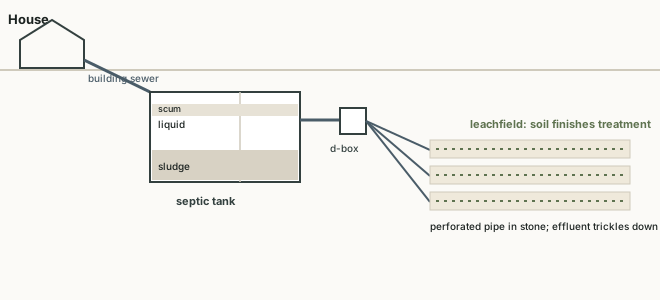
This is the system most Vermont homes have and the one every designer would prefer to build. Wastewater flows by gravity from the house to the tank, out to a distribution box, and along trenches of perforated pipe bedded in stone or formed by plastic chambers. There is no pump, no panel, no alarm and nothing to lose in a power cut.
What it needs is depth. There has to be enough naturally occurring soil between the bottom of the trench and the limiting layer, bedrock, or the level the seasonal high water table reaches, for treatment to happen before effluent arrives at groundwater. On the clay plain and on thin mountain soils, that depth often is not there, and that single fact is what pushes a site toward a raised system.
Mound and raised systems
A mound builds the leachfield above natural grade. Suitable sand is placed on the prepared surface, the distribution piping sits within it, and the whole thing is covered and grassed. The effect is to manufacture the soil depth the site does not naturally have, and effluent is treated within the mound before it reaches the original ground.
Use the dosing and distribution arrangement specified by the approved mound design. Effluent has to be lifted to a field that sits above the tank. They are visible, a grassed rectangle standing proud of the lawn, and they cost substantially more than a conventional field because the sand is imported and placed to specification.
Mounds are also the reason many Vermont lots are buildable at all. The trade is worth making.
Pressure distribution, sand filters and aerobic units
Pressure distribution is about evenness instead of treatment. Instead of relying on a level distribution box, a pump delivers timed or demand doses through small-diameter pipe with drilled orifices, so the entire field is loaded at once. On sites where gravity would overload the first few feet of each trench, this materially extends field life, and it is standard on mounds.
An aerobic unit introduces oxygen and treatment happens in the tank rather than relying entirely on the ground.
These appear where a site is tight, close to surface water, short on area, or with soil that cannot be asked to do the whole job. Aerobic units are the most capable option and the most demanding to own, with moving parts running continuously.
How the site evaluation determines the design
The soil and site evaluation determines which system types the designer can propose. A licensed designer digs test pits, reads the soil profile, records the depth to bedrock and to seasonal groundwater indicators, measures how quickly the soil accepts water, and maps the separation distances to wells, surface water and property lines. The design that satisfies all of those limits on that particular lot is the system you get.
This is also why quotes that name a system type before anyone has opened the ground should be treated cautiously. Two neighboring lots in the same Vermont town can require different treatment designs. Each proposed field needs its own soil profile and site evaluation before the appropriate design can be selected.
Types of septic systems: matching treatment to the site
What are the main types of septic systems?+
In Vermont: conventional gravity trenches, pressure-distributed fields, mound or raised systems, bottomless sand filters, and aerobic treatment units. The first is the default where soil allows. The rest exist to solve a specific site limitation.
What are the different leach field types?+
Leachfields differ mainly in how effluent is held and spread: stone-and-pipe trenches, plastic chamber systems that create a void without stone, and beds. On raised systems the field sits inside imported sand instead of in native soil.
What are drain field types used in Vermont?+
Trench fields in native soil are the common form. Where depth is short, the same distribution arrangement is built into a mound above grade. Chamber systems are widely used in place of stone since they are lighter to handle and need less excavation.
What is an aerobic septic system?+
A tank that actively introduces oxygen. Aerobic bacteria break down waste far more completely than in a conventional anaerobic tank. The effluent leaving it is substantially cleaner, which is what allows it to be used where a standard system would not be permitted.
What do septic system types cost relative to each other?+
Dollar figures depend on the contractor and the lot, so a written quote is the only number worth trusting. Compare the complete feasible designs, including material, equipment, access, operating and service duties. A category label alone cannot establish a fixed price ranking.
Is a mound system worse than a conventional one?+
Not worse. Different, and chosen because the site required it. A mound treats effluent in engineered sand instead of native soil and performs well. Its costs are higher construction, a visible raised area, and a pump to maintain.
Can I choose which type of system I get?+
Only within the range the site supports. The system type falls out of the soil profile, depth to bedrock and groundwater, available area and separation distances found during the site evaluation. Where more than one design would work, cost and site disruption are legitimate grounds to prefer one.
What is a chamber system?+
A leachfield built from open-bottomed plastic arches instead of pipe surrounded by stone. The arch creates the storage void directly, so no stone to haul, a shallower excavation and, on many sites, a smaller footprint for the same capacity.
What is pressure distribution and when is it required?+
A pump delivers effluent in measured doses through small orifices so the whole field is loaded evenly instead of the first section of each trench taking most of the flow. It is required on mounds and is used wherever even loading materially affects how long the field will last.
What is a bottomless sand filter?+
A layer of specified sand placed over native soil with distribution piping above it and no liner beneath, so effluent is treated as it passes through the sand and then continues into the ground. It is used where extra treatment is needed but a full aerobic unit is not warranted.
How do I find out what type I have?+
The permit file at the regional office holds the design drawing, which names the system type. Physically, a raised grassed rectangle indicates a mound, a control panel or septic breaker indicates a pump, and a plain lawn with two tank lids and no electrical indicates conventional gravity.