Septic vs sewer
Septic vs. sewer comes down to who owns the treatment equipment and pays when it needs replacing. On sewer, wastewater leaves the property in a municipal main and the town treats it. You pay a recurring charge and the town owns the infrastructure past your connection.
On septic, treatment happens in your own ground, you own every part of it, and there is no recurring bill. But you carry the maintenance and eventually the replacement cost of the leachfield. Neither is inherently better to live with.
A sound system on suitable soil is undemanding. A failing one is expensive and inconvenient. What matters for a Vermont buyer is not which category a property falls into but the condition, capacity and permit history of the specific system it has, and whether a municipal main is even available to the road it sits on.
| Question | Private septic | Municipal sewer |
|---|---|---|
| Treatment | Onsite treatment as specified by the permitted design | Public collection and treatment under the utility’s arrangement |
| Recurring ownership costs | Pumping, inspections, repairs and any power or service contract | Utility charges plus the owner’s private components |
| Major work | Tank, pipe, equipment or field repair/replacement as condition requires | Connection and allocation charges, lateral repairs or other required work |
| Responsibilities | Confirm owner, service and permit obligations | Confirm the utility’s actual ownership/connection boundary |
| Records | Permit, design, construction certification and service reports | Connection/allocation records and private-lateral history |
| Planned expansion | Assess design flow, condition and authorized capacity | Confirm allocation, connection conditions and applicable approvals |
EPA septic operation/care and Burlington utility connection information; actual utility terms and property records govern.
The cost structure is different, not simply higher or lower
Sewer costs are predictable and recurring: a quarterly or monthly charge that continues for as long as you own the property, plus a connection fee if you are joining the system for the first time. The town maintains public mains, but a private lateral can still require an expensive repair. Confirm the boundary of responsibility and any connection, allocation or assessment charges with the utility.
Private-system costs include inspection, pumping and any power, service contract or component repairs. Condition determines whether replacement is needed; there is no guaranteed one-replacement ownership schedule.
Over a long ownership the totals can land in similar territory. The difference people feel is exposure to one large bill whose timing they do not control.
Responsibility and what that means in practice
On sewer, the local ordinance defines your responsibility; it can include the entire lateral out to the public main. A blockage in the main is the town's problem. On septic, everything from the fixture to the leachfield is yours, and so is compliance: the permit, the design, the installation certification and any conditions attached to them.
This is why the questions that matter on a septic property are documentary as well as physical. Is there a permit? Does the permitted design match what is in the ground?
Was the installation certified? A property with a sound system and no paperwork can still be a difficult transaction, and that is a septic-specific risk with no sewer equivalent.
Can you convert from septic to sewer?
Only if a municipal main is available to serve the property, which is a fact about the town's service area instead of a choice. Where a main runs past the property and the town has allocation available, connection is possible and involves an allocation approval, a connection fee, the physical service line and abandonment of the old tank to the required standard.
Where no main exists, the question does not arise, and in much of Vermont it does not. A proposed sewer extension needs utility approval and an agreement on construction, ownership and costs. For most rural and lakeshore property in the state, the real decision is which kind of on-site system the ground will support.
What this means when buying in Vermont
Because more than half of Vermont homes are on private systems, ruling out septic properties would rule out most of the market outside the city cores. The productive approach is to treat the system as a major building component with a known life, like a roof, and to establish three things before closing: its type and age, its condition under inspection, and whether its permit history matches what is installed.
A system with a documented design, a recent pumping record and a clean inspection is a known quantity. An undocumented system of unknown age on a constrained lot is a genuine risk, because the replacement design might be substantially more expensive than the one being replaced, and on a tight lot, occasionally difficult to site at all.
Do you need septic, or can the parcel connect to sewer?
Start with the town’s wastewater or public works office. Ask whether a main serves the parcel, whether capacity and a connection are available, and whether the local ordinance requires a connection. A sewer line elsewhere on the road does not establish service for the lot.
Without an available sewer connection, a building that produces wastewater needs an on-site system that can be permitted for its use. On raw land, have the soil and system location evaluated before committing to a house location. Adding bedrooms or changing use can require the existing permit to be reviewed.
Establish the wastewater route before planning a building
Do I need a septic system: you need a septic system whenever a building produces wastewater and there is no municipal sewer to connect to, which describes most property in Vermont outside the city cores. The deciding fact is simple: is there a public sewer main in the road that your property can legally and practically tie into? A city or village location does not by itself establish a legal connection.
Ask the utility whether the particular parcel can connect; properties outside a public service area need an approved onsite or other permitted wastewater arrangement. A vacant lot you intend to build on needs a designed, permitted system before it can be occupied, and the soil has to be tested first to prove a system will even work there.
A septic system is simply what a property uses when it cannot connect to a municipal sewer. So the first thing to establish is whether sewer service reaches your parcel. The town's public works or wastewater department can tell you whether there is a main in your road and whether your lot is within the service area.
On a lot that has never had a system, you cannot assume one will fit. A licensed designer evaluates the proposed onsite arrangement and that design depends on what the soil test pits reveal. Depth to ledge, the seasonal high water table, and how fast the soil drains.
A lot that looks buildable can turn out to need an expensive engineered or mound system, or in hard cases may not support a conventional system at all. A land-purchase contingency can require the appropriate licensed site evaluation and confirmation that the intended use can obtain its wastewater and water-supply approvals.
The sequence is planned: soil test, then design, then a Wastewater System and Potable Water Supply permit , then construction. Skipping ahead, building or placing a dwelling before the system is permitted, creates exactly the kind of unpermitted problem that surfaces at a future sale.
Even where a system already exists, some changes require permit review. Compare the proposed bedrooms, dwelling units and use against the wastewater permit before assuming that the existing design covers the addition.
Change of use matters too. Turning a single-family home into a duplex or a short-term rental, or adding a commercial use, changes the flow the system must handle. The safe move before any of these is to confirm what your permit allows and whether the change needs a new one, instead of discovering the limit after the work is done.
Check the design-flow method, not today’s head count
The state sizes a residential system from its design flow. Under the occupancy method in Section 1-803(d)(1), the rules use 70 gallons per day per person at the maximum occupancy proposed, subject to minimum occupancy assumptions.
Each of the first three bedrooms counts as at least two people, and each bedroom after the third counts as at least one. Section 1-803(c) applies a two-bedroom minimum to a single-family residence on a lot with no other buildings or structures and no campground, even if that residence contains only one bedroom.
Using that method and minimum occupancy assumptions, the floor for a one- or two-bedroom residence within that scope is 280 gallons a day; a three-bedroom residence is 420, and a five-bedroom residence is 560. A proposal with greater maximum occupancy needs the larger calculation.
Section 1-803(d)(2) also provides the Table 8-1 method. Have the wastewater designer identify the applicable method rather than treating this illustration as the only calculation permitted by the rules.
A finished basement with a new bedroom or a camp proposed for year-round use therefore needs comparison with the property’s existing wastewater authorization. The design flow can change even if the present family does not.
Ask for the permitted use, the proposed maximum occupancy and the design method in the same written review. A current low water bill cannot by itself establish spare permitted capacity in the tank or treatment area.
Can I connect to sewer instead of installing septic?
Only if a public sewer main is available to your property and the town allows the connection. Where sewer exists it is often the simpler long-term option, and some towns require connecting to it. Where no authorized sewer connection is available, the property needs a permitted onsite or other approved wastewater arrangement.
Do I need a septic system to build on vacant land?
A proposed wastewater-producing use needs an approved arrangement unless an applicable exemption covers it. And you cannot assume a system will fit: Vermont requires a soil evaluation and a designed system, and the soil test determines what is possible. Some lots need expensive engineered systems, and a few cannot support a conventional system at all.
Does adding a bedroom require a new septic system?
It can. Systems are sized by design flow, which is based on bedroom count, so adding a bedroom may require the existing system to be re-evaluated and possibly enlarged or replaced, and it may need a permit. Confirm with the regional office before you build.
Does converting a camp to a year-round home need a new system?
Often it needs the system reviewed. A leachfield sized for summer weekend use handles a very different load once a household lives there full time, so year-round conversion is a common trigger for an upgraded or replaced system.
What happens if a property has no permitted system?
An unpermitted or non-compliant system becomes a problem at sale, at a change of use, or when it fails, and resolving it can be expensive and slow. If you suspect a property has no permit on file, treat it as due diligence to confirm before buying or building.
Who decides whether I need a system and what kind?
A licensed designer evaluates the soil and prepares the design, and the state's regional office issues the Wastewater System and Potable Water Supply permit. The relevant utility confirms whether sewer service and allocation are available for the parcel.
If sewer is coming to my area, should I wait?
That is a local timing and cost question. A failing system cannot wait for a sewer project that may be years out, but a healthy one might. Confirm the town's actual timeline and any mandatory-connection rule before deciding, instead of relying on rumour that sewer is 'coming soon'.
Do I need a septic system?: service details and questions
Do I need a septic system: you need a septic system whenever a building produces wastewater and there is no municipal sewer to connect to, which describes most property in Vermont outside the city cores. The deciding fact is simple: is there a public sewer main in the road that your property can legally and practically tie into? In Burlington, South Burlington, Winooski and the villages, yes, and you connect to it.
In the surrounding towns and the countryside, no, and the property must treat and dispose of its own wastewater on site with a septic system. A vacant lot you intend to build on needs a designed, permitted system before it can be occupied, and the soil has to be tested first to prove a system will even work there
Adding a bedroom, a rental unit or a second dwelling can also trigger a new or enlarged system, because the state sizes systems by design flow, and more bedrooms means more flow
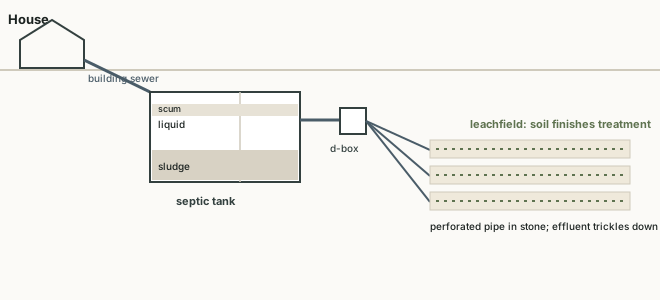
With no sewer main on your road, these three parts are your sewer
Does this property need a septic system? Work down the list
Is municipal sewer available in your road
If yes, you connect to it; some towns require it. If no, the property needs its own system
Is this raw land you intend to build on
It needs a soil test, a designed system and a permit before it can be occupied. Make an offer contingent on a passing soil test
Are you adding bedrooms or living space
Design flow is driven by bedroom count. Added bedrooms can require the existing system to be evaluated or enlarged
Are you converting a seasonal camp to year-round
A system sized for summer use is a different design problem full time; expect it to be reviewed
Are you changing the use
A duplex, rental, ADU or commercial use changes the flow and can trigger a new permit
Reflects how the sewer-vs-septic decision and the design-flow triggers work under Vermont practice. Confirm specifics with your town and regional office
The one question that settles it: sewer or not
A realtor's listing or a title search will also say. If sewer is available, connecting to it is the simpler and cheaper long-term path, and some towns require it where it exists
If there is no sewer, the normal case in rural and lakeshore Vermont, then the property needs its own system, and the questions shift from 'do I need one' to what kind of system the soil will support and how it gets permitted
How Vermont sizes a system: by bedroom, at 70 gallons per person
The state sizes a residential system from its design flow. The rules use 70 gallons per day per person at the maximum occupancy the home could have, and they set a floor: each of the first three bedrooms counts as two people, and each bedroom after the third counts as one. A single-family home is calculated on a minimum of two bedrooms even if it only has one, so the floor for a one- or two-bedroom home is the same 280 gallons a day; a three-bedroom home floors at 420, and a five-bedroom home at 560
A finished basement with a new bedroom, or a camp converted to year-round occupancy, can require permit review when the use or design flow changes, even without an increase in household size. The table shows the floor by bedroom count. A designer can propose the alternative flow in Table 8-1 of the rules, and a home with more people than the floor is designed for the larger number
Building on raw land: soil comes before house
On a lot that has never had a system, you cannot assume one will fit. Vermont requires the site to be evaluated and a system designed by a licensed designer , and that design depends on what the soil test pits reveal. Depth to ledge, the seasonal high water table, and how fast the soil drains
When a change to an existing property triggers a system
Even where a system already exists, some changes require the state to look again. Because systems are sized by design flow, which is driven by the number of bedrooms, adding a bedroom, finishing a basement into living space, or adding an accessory dwelling can require the existing system to be evaluated and sometimes enlarged or replaced
Converting a seasonal camp to year-round use is the classic example. A system sized for summer weekends is a different problem once a family lives there full time
Minimum residential design flow by bedroom count
Design flow, gallons per day
1 (floored at 2)
Vermont Wastewater System and Potable Water Supply Rules, section 1-803(c)-(d): 70 gallons per day per person, 2 persons per bedroom for the first 3 bedrooms and 1 person per bedroom after that; a single-family residence is floored at a minimum of 2 bedrooms even with only 1
Vermont Wastewater System and Potable Water Supply Rules (November 6, 2023 edition, with 2024 corrections)
How do I know if my property is on sewer or septic?
Ask the town public works or wastewater department whether there is a sewer main in your road and whether your lot is in the service area, or check for tank lids and a leachfield in the yard. In Vermont's cities the answer is sewer. In the surrounding towns it is a private septic system
Only if a public sewer main is available to your property and the town allows the connection. Where sewer exists it is often the simpler long-term option, and some towns require connecting to it. Where there is no main, most of rural Vermont, a septic system is the only option
Yes, unless municipal sewer reaches the lot. And you cannot assume a system will fit: Vermont requires a soil evaluation and a designed system, and the soil test determines what is possible. Some lots need expensive engineered systems, and a few cannot support a conventional system at all
Does a small camp used only a few weeks a year need a permit at all?
Vermont defines a primitive camp using occupancy limits of no more than three consecutive weeks and 60 days in a calendar year, together with limits on plumbing and wastewater arrangements. The construction exemption in §1-304(3) also restricts other development on the lot. Adding plumbing or changing use can change eligibility; give the regional office the actual occupancy, fixtures, other structures and existing permit before assuming the exemption applies.
Do I need a septic system for a cabin or tiny home?
Any dwelling that produces wastewater and cannot connect to sewer needs an approved means of treating it. Small structures may qualify for smaller or alternative systems, but they still require the state's design and permitting. There is no size below which the rules simply do not apply to occupied dwellings
A licensed designer evaluates the soil and prepares the design, and the state's regional office issues the Wastewater System and Potable Water Supply permit. The town confirms whether sewer is available
This site can route you to a designer. It cannot make the determination for your parcel
Is a septic system required for a garage or outbuilding?
Only if it produces wastewater. A bathroom, a kitchen or a floor drain to sanitary
A plain unheated garage with no plumbing does not need one. Adding plumbing to an outbuilding, though, can bring it under the same rules as a dwelling
How much does it cost to put a system on land that never had one?
It ranges widely because the soil decides the system type. A conventional in-ground field is far cheaper than an engineered mound
Soil evaluation establishes site limitations before a designer can select a system. Vermont’s current rule uses soil characterization and loading-rate criteria; a historical timed perc test alone cannot establish the current design or project price.
Septic vs sewer: connections, responsibility and recurring charges
What is the difference between septic and sewer?+
Septic treats wastewater on your own property in a tank and leachfield that you own and maintain. Sewer carries it away in a municipal main to a town treatment plant, for a recurring charge. The core difference is who owns the treatment and who pays to replace it.
What is the difference between a septic tank and sewer?+
A septic tank is a component you own that separates solids from wastewater before it reaches your leachfield. A sewer is a public pipe network that takes wastewater off the property entirely.
The tank is part of a treatment system. The sewer is a means of transport.
Is sewer better than septic?+
Sewer removes a maintenance and replacement liability, which many owners value. Septic has no recurring charge and, on suitable soil with reasonable care, is unremarkable to live with. The answer is that the condition of the specific system matters far more than the category.
Can I convert my septic system to sewer?+
Only where a municipal main is available to the property and the town has allocation to grant. That is a question for the town's water and sewer department.
Where no main exists, conversion is not something a homeowner can arrange. Extending a main is a municipal capital project.
Is a septic property harder to sell in Vermont?+
Not in itself. Most of the state's housing stock outside the city cores is on septic, so buyers and lenders are used to it. What causes difficulty is a system with no permit record, visible failure, or capacity that does not match the number of bedrooms being marketed.
Does being on septic limit how much I can build?+
Yes, and this surprises people. System capacity is tied to design flow, which is derived from bedroom count.
Adding bedrooms means demonstrating the system can serve them, which may mean a new design and permit. Occasionally the limiting factor on whether an addition is feasible.
Which is cheaper over twenty years?+
It depends heavily on local sewer rates and on whether a leachfield replacement falls inside that window. Sewer spreads a steady cost over the whole period.
Septic concentrates most of its cost into pumping plus one large event. Comparing them requires the actual local rate, not a general rule.
If a sewer main comes down my road, do I have to connect?+
That depends on the town's ordinance. Some municipalities require connection within a set distance of a main, sometimes on a timescale or when a system fails. It is worth asking the town directly instead of assuming, since it affects whether investing in a septic replacement makes sense.
What happens to the old tank if I connect to sewer?+
It has to be taken out of service correctly rather than simply abandoned. Pumped out and either removed or filled so it cannot collapse or hold water. The town or the state sets the required method, and it should be documented for the property file.
Is septic worse for the environment than sewer?+
A correctly designed, sited and maintained septic system treats wastewater effectively through soil. Failing systems, and systems too close to wells or surface water, are the environmental problem, which is what separation distances and permitting exist to prevent.
How do I find out whether sewer is available at my address?+
Ask the town's water and sewer department, or the municipal office in smaller towns. They can tell you whether a main serves your road, whether allocation is available, and what connection would involve. This is worth confirming before commissioning a septic replacement design.