No water from the tap
No water from the tap can come from loss of power, a control fault, a leak, a blocked or frozen line, a pump problem or insufficient water in the well. One symptom does not establish which part failed. Check whether every fixture is affected and whether an outage or recent plumbing work preceded the loss.
Read an accessible pressure gauge without opening electrical covers. If the pump is running without delivering water, switch off its dedicated circuit and call a well service professional. Running dry can damage equipment.
Do not repeatedly reset a breaker or handle wet electrical equipment. A jet pump can lose prime, but that diagnosis does not apply to every submersible installation.
The gauge reading, alarm state, recent sputtering and the well’s recovery history distinguish pressure loss from exhausted supply. Arrange a safe temporary drinking-water supply while the fault and any contamination risk are assessed.
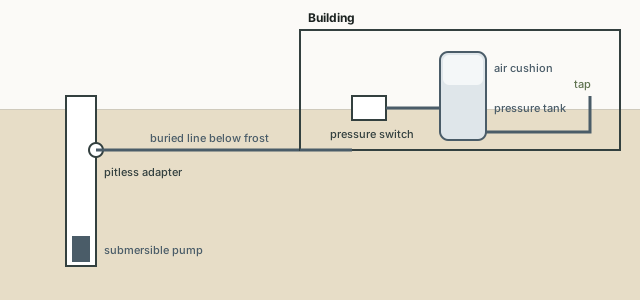
Power loss and visible circuit status
Compare several taps. A single affected fixture points toward its valve, aerator or branch rather than proving a well-wide failure. Note whether both hot and cold water are affected.
An area power outage can interrupt the pump supply. Do not remove covers, touch pressure-switch contacts or keep resetting a tripping breaker. Tell the technician what you observed.
| Observation | What it helps distinguish |
|---|---|
| One fixture or the whole house | Local restriction versus supply fault |
| Gauge reading and power status | Delivery, control and electrical checks |
| Sputtering and recovery history | Water-level assessment |
| Flooding or opened system | Water-quality follow-up |
Goulds pump troubleshooting and Vermont Health private-water guidance.
Running without delivery needs prompt service
Goulds Water Technology’s troubleshooting manual lists several causes of poor or absent delivery, including water level, suction leaks, prime on jet systems, obstructions and pump condition. A noise alone does not isolate the fault.
Turn off a pump that runs without water delivery. Frozen piping needs a safe thawing assessment; never use a flame. A flooded electrical area requires professional assistance before equipment is handled.
Restore supply and check safety separately
A restored pressure reading does not establish drinking-water quality. If the well flooded or a repair opened the system, discuss disinfection and testing before drinking the water.
Recovery measurements help separate temporary drawdown from a pump or control fault. Establish the cause before deciding to drill deeper.
Separate an electrical loss from a delivery problem
No water from the tap . A sudden, total loss of water from every tap has several possible causes: a tripped breaker for the pump circuit, a failed pressure switch that isn't telling the pump to run, a pump that has lost prime or failed, or insufficient water at the intake.
Observe whether the pump circuit shows a trip indication without opening covers or touching wiring; a tripped breaker calls for identifying the fault rather than repeated resets. Report any running sound already apparent from a safe location, together with an accessible gauge reading; neither observation proves the condition of the motor or controls.
A sound or the absence of one does not identify the failed component, particularly for equipment down inside a well. Give the technician the location and operating observations so electrical, control, delivery and source checks can be interpreted together.
Loss of supply can also involve the operating water level. Report preceding sputtering or air in the water, but their absence does not exclude a supply problem.
The labeled pump circuit identifies the supply; electrical covers stay closed during an external visual check. A loss of circuit supply can resemble an equipment failure at the taps, but the indication alone cannot explain why the circuit stopped supplying power.
A breaker that has tripped repeatedly needs fault diagnosis. It suggests an actual electrical fault in the pump, wiring, or pressure switch, and calls for a professional rather than repeated resets.
Describe whether the loss affects all fixtures and whether a safely visible gauge or equipment indicator changed. A submerged motor may not be audible from the tank. The technician must establish the electrical supply and operation.
The checks must suit the installed equipment. Silence elsewhere cannot distinguish switch, wiring or pump faults.
If you can hear the pump running but no water reaches the faucet, possible causes include lost prime on a jet-pump arrangement, a piping or check-valve problem, insufficient water at the intake or a blockage between the pump and the house.
A well with low yield relative to demand can lose delivery as the water level falls. Possible preceding observations include sputtering faucets, air in the water, or a noticeable drop in pressure before total loss.
A documented low-yield well can stop supplying fixtures when household demand exceeds recovery. Have the operating water level and recovery evaluated alongside the delivery equipment. If inadequate source production is confirmed, compare reduced draw, suitable storage or changes to the supply with the designer or well contractor; sputtering alone cannot justify deeper drilling or establish which option will help.
For an abrupt outage, report the breaker indication and accessible gauge before any attempted repair. Hearing a sound near the tank does not establish the condition of the motor down the well. Supply power, control response and actual water delivery are separate diagnostic findings.
No water from the tap: service details and questions
A sudden, total loss of water from every tap points to a handful of possible causes: a tripped breaker for the pump circuit, a failed pressure switch that isn't telling the pump to run, a pump that has lost prime or failed, or a well with insufficient water at its intake. These are not an established order of likelihood. A tripped breaker produces the same symptom at the taps as a failed pump, but observing it does not establish the cause of the trip or rule out an equipment fault.
A sudden loss at every tap can involve circuit power, controls, pump operation, pipework or the water available at the intake. There is no established likelihood order from that symptom alone. An already audible sound is another observation, not proof that the motor is operating correctly.
Give the provider the equipment labels and well record so the diagnostic checks address this installation. A visible breaker indication may help the investigation, but it cannot rule out a fault in seconds or establish that restarting the circuit is safe.
Hearing it cycle with no water reaching the house calls for checks of the piping as well as the source and equipment; total silence does not identify whether the switch, wiring, or the pump itself failed. Report sputtering or air in the water before total loss, while recognizing that a source problem can occur without those warning signs.
Compare the outage with prior household demand and any documented source-recovery information. Air or sputtering may accompany inadequate available water, but a supply problem need not give advance warning. Have measured water level and recovery distinguished from electrical, pump and piping findings before selecting storage, equipment changes or work on the source.
Work backwards from the tap: tank, switch, line, pump
No water: troubleshooting in order
1. Check the breaker
Record an accessible trip indication and outage history; the provider must identify its cause
2. Listen for the pump
Report an already apparent sound and its location without treating silence or humming as a motor test
3. Check for warning signs beforehand
Sputtering or air in the water suggests low well yield
4. Rule out a lost prime or check valve issue
Identify the actual pump type; priming checks apply to a compatible jet arrangement
5. Call a professional
Electrical testing and fault diagnosis need a qualified person
Standard troubleshooting sequence for sudden total water loss on a Vermont private well system
A tripped breaker requires fault diagnosis
The pump circuit can lose power when a breaker trips, but the trip alone does not establish a failed pump or a harmless one-off event. Observe the breaker indication without opening covers or touching wiring, and tell the well company what happened. Re-energizing suspect equipment before the cause is established can repeat the fault; a reset is not a complete diagnosis.
A breaker that has tripped repeatedly needs fault diagnosis. It can indicate an electrical problem in the pump, wiring or pressure switch. Repeated resets can re-energize a fault; safe return to service depends on identifying its cause.
Listen for the pump, then narrow it down
If you can hear the pump running but no water reaches the faucet, possible causes include a lost prime on a matching jet-pump arrangement, a stuck check valve, or a blockage somewhere between the pump and the house. The sound alone cannot rank these above a fault in the pump itself.
If a sound accompanies loss of delivery, identify where it is heard and whether a gauge changes. A jet arrangement may need priming or valve investigation, while piping, source level and the pump itself remain relevant. Hearing the sound does not establish that the fault is downstream or that the pump is healthy.
When it might be the well itself
A well with naturally low yield relative to household demand may lose delivery during significant drought conditions or sustained use. Possible observations include sputtering faucets, air in the water, or a noticeable drop in pressure before total loss. Those signs are useful to report but are not guaranteed and do not establish a dry well.
Air at faucets, falling pressure or loss of delivery can accompany low available water, but those observations do not establish a dry well or guarantee advance warning. Have source level and recovery evaluated alongside the pump, piping and electrical findings. Drought and household demand are relevant history to report, not substitutes for identifying the cause at this supply
Why did my water suddenly stop working with no warning?
Check the breaker indication first if it is safely visible. If that indication does not explain the outage, report any already apparent sound near the pressure tank without opening covers or approaching an unsafe wellhead. Listening for the pump is an observation, not proof that the breaker is fine or that the motor is healthy.
An abrupt loss needs the same evidence as a gradual one: timing, affected fixtures, the existing pressure indication and known interruptions. Give those observations to the well service provider. A breaker position or a quiet tank area cannot rule out a submerged equipment fault, and neither supplies a reason to keep attempting resets.
A lost prime, a stuck check valve, or a blockage between the pump and the house can be relevant to an installation with the matching pump arrangement. Do not treat hearing a sound as proof that the problem is downstream of the pump instead of the pump itself having failed.
A running sound does not exclude a pump defect. Pump operating state, delivered flow, source level and connected piping are separate parts of the diagnosis.
Priming is relevant to a matching jet-pump configuration; it is not a universal explanation for a submersible installation. Ask the findings to identify which condition prevented water reaching the house.
Without power, the pump can't run. Once the tank's usable stored reserve is exhausted, no water reaches the house until power is restored and the equipment is operating again. Restoration of electricity alone does not prove delivery is normal.
At that point the system should be checked for expected flow, control operation and pressure. A continuing fault means normal delivery has not been established. The pressure tank may provide some water during the interruption, so loss of electricity and immediate loss at the taps need not occur together.
Stored water can remain available briefly after electricity stops because tank pressure and motor power are different conditions. Record whether taps continued to deliver and when that changed. Once power returns, a continuing loss still needs assessment; restoration of the circuit alone does not prove that the pump, controls and source have returned to normal.
Sputtering, air and a pressure change are useful observations to report, but a lack of those signs cannot rule out a source or equipment problem. Have the actual level, recovery and delivery findings assessed instead of identifying the cause from timing alone
Is a tripped breaker a serious problem for a well pump?
If the breaker trips again immediately after resetting, that's a different and more serious sign than a delivery complaint without a trip indication. It suggests an actual electrical fault in the pump, wiring, or pressure switch, and calls for a professional rather than repeated resets.
A single trip is not proof that the condition is minor. Goulds' instructions require qualified electrical work and isolation before service, and list an open breaker or blown fuse as one motor-not-running cause, not a complete diagnosis.
A single trip does not prove that the fault is minor. Electrical covers and wiring are outside an external visual inspection. Repeated trips call for fault diagnosis, and a reset alone does not establish that the pump circuit is safe or that the underlying problem is resolved.
How urgent is a total loss of water pressure?
Flooding, damaged electrical equipment and suspected contamination create hazards beyond loss of household water. A pressure loss alone does not establish a safe waiting period or identify the defect; report when the water stopped and any change in the equipment without opening damaged electrical controls.
Intermittent return of water can involve a failing but not fully dead component, a marginal pressure switch or a pump problem, and is worth having checked before it fails completely. Those possibilities do not exclude source recovery or piping conditions, so report the sequence instead of selecting a replacement from timing alone.
When delivery returns intermittently, keep a sequence of the losses and returns alongside household use and known power changes. Recovery of source level, controls or equipment behavior may need investigation. The pattern is useful evidence, but it does not by itself identify a dying switch or pump or predict the next failure.
A sudden, total loss of water from every tap points to a handful of possible causes: a tripped breaker for the pump circuit, a failed pressure switch that isn't telling the pump to run, a pump that has lost prime or failed, or a well that has run dry. The symptom does not establish their order of likelihood. Observe the electrical panel only from a safe, accessible position: a tripped breaker produces exactly the same symptom as a failed pump, but that indication cannot rule out an electrical fault or justify repeated resets.
If those warning signs preceded the total loss, or if the property has a documented history of low yield, compare the source-level and recovery measurements with the pump and electrical findings. A confirmed source shortage changes the fix from an electrical or pump repair to a conversation about well yield, storage, or in rare cases redrilling deeper if the responsible designer finds that suitable.
The observations alone do not establish that diagnosis or rank deeper drilling above other remedies. The available supply and proposed household demand determine whether additional storage can address a shortage.
The well pump circuit may have a dedicated breaker. A loss of circuit supply can produce a symptom indistinguishable from a failed pump at the taps. Checking and resetting it does not rule out the cause immediately; a reset is not a fault diagnosis, even if delivery temporarily resumes.
A breaker that trips repeatedly right after resetting suggests an actual electrical fault and needs professional diagnosis instead of continued resetting. A single trip also needs its cause assessed; temporary delivery after a reset does not prove the installation is sound.
With the breaker confirmed fine by the qualified person making the electrical assessment, the technician can open a faucet and listen near the pressure tank or well cap for the pump attempting to run. Silence suggests the pressure switch isn't triggering it, a wiring problem exists, or the pump itself has failed; those are possibilities to test, not conclusions from listening. All of which need a professional to diagnose safely.
Goulds' jet-pump troubleshooting also lists a tripped motor thermal protector, impeller binding and incorrect wiring or voltage among motor-not-running causes. The actual checks must match the installed model.
If you can hear the pump running but no water reaches the faucet, check the actual configuration before interpreting it. A lost prime, a stuck check valve, or a blockage somewhere between the pump and the house are possible explanations for suitable arrangements. A lost prime is not a universal result of certain types of power interruption on every pump configuration, and the sound cannot establish that the pump is healthy.
A well with naturally low yield relative to household demand can have insufficient water available during significant drought conditions or high use. Possible signs are sputtering faucets, air in the water, or a noticeable drop in pressure before total loss. These are not guaranteed warning signs: an outage without them still needs investigation of both the source and delivery equipment.
Hearing it cycle with no water reaching the house points toward the piping as one investigation path, while total silence points toward the switch, wiring, or the pump itself as possibilities to test. Neither observation excludes the source, a cable fault or other connected components.
The distinction matters for equipment down inside a well, where the observer may hear a different component from the motor. Pump sound cannot substitute for electrical, delivery and source checks.
Questions on No water from the tap
What does it mean if I can hear the pump running but no water comes out?
Running without delivery needs checks of water level, the pump and piping as well as the controls. A jet pump can lose prime; a blockage, check valve or leaking pipe can also affect delivery, but sound alone does not exclude pump failure.
Can a power outage cause no water from the tap?
Yes. An electric pump needs its specified supply; stored tank pressure can remain after a power interruption. The pressure tank may supply a limited reserve; after restoration, observe whether the system returns to normal and report any continuing fault.
How do I know if my well has run dry?
Possible signs include sputtering faucets, air in the water, or a noticeable pressure drop. Their absence does not exclude insufficient water at the intake; a provider needs the operating level and recovery findings.
Can cold weather cause a sudden loss of water from a well?
Yes, if exposed or shallow pipes freeze between the pump and the house, blocking flow even though the pump itself works fine. This is a different problem from pump or well failure.
Should I call a well contractor or an electrician for no water?
A well contractor is the right first call. They can diagnose the pressure switch, pump and electrical connections specific to the well system, rather than general household wiring.
Can low water pressure everywhere in the house mean the same thing as no water at all?
It can be an earlier stage of the same underlying causes, a struggling pump, a weak switch, or declining well yield, worth investigating before it progresses to a total loss.
Does a dry well mean I need a new well?
Not necessarily. Options can include adding storage capacity, adjusting the pump setup, or in some cases deepening the existing well, all of which a well contractor can evaluate before assuming a full new well is needed.
Can I reset my own pressure switch?
Resetting a pressure switch is best left to a professional. It involves electrical components at the well system, and misdiagnosis can leave the underlying problem unresolved or create a new issue.
Why does my water come back on its own sometimes?
Intermittent return can involve controls, pump protection, piping or recovery of the well’s water level. Demand before the outage and the sequence of pressure changes distinguish supply recovery from a recurring equipment fault.
No water from the tap: loss of supply and safe first observations
Can an outage stop a private well?
An electrically powered pump cannot run without power. Stored pressure may provide only limited water before it falls.
Should I repeatedly reset a well-pump breaker?
No. A repeated trip needs fault diagnosis. Do not handle wet equipment or open electrical covers.
Does a running pump prove the well is dry?
No. Leaks, obstructions, pump faults and water level can produce overlapping symptoms. Give the technician the outage timing, gauge readings and well record so the tests cover both supply and equipment.
Can every well pump lose prime?
No. Priming applies to jet-pump arrangements and is not a universal explanation for a submersible pump. Identify the pump and follow its manufacturer’s instructions. Do not open energized equipment to test a guess.
Is restored pressure proof the water is safe?
No. Restored pressure establishes water delivery, not laboratory quality. Vermont Health’s return-to-drinking-water guidance includes disinfection and testing after flooding, contamination or opened equipment.
Which well records help a no-water service call?
Bring the well report, pump model, gauge readings, outage timing and previous recovery or repair information.
Why can well water return without a repair?
Changes in power, household demand, affected fixtures and measured pressure can account for an interruption that ends without a repair. Recurring interruptions differ from a single outage. That sequence can guide tests for drawdown, controls, leakage or intermittent equipment faults.
It does not establish a diagnosis. Do not run the pump without water to repeat the fault.
Should I order a pump before the service visit?
Establish the fault first. A replacement selected from a symptom can leave a leaking line, failed control or limited source unresolved. A repair or replacement diagnosis depends on the test findings, not merely the return of flow.
The proposed pump must match the well and required delivery conditions. Motor size alone cannot answer those questions or create additional groundwater.
Can I inspect the pressure switch contacts myself?
Keep electrical covers closed and avoid wet equipment. The safe observations for the service call are the existing gauge, alarms, fixture behavior and known outage history.
Contact testing and energized control diagnosis belong to a qualified professional following the equipment instructions. Repeated breaker trips need assessment, rather than repeated resets to see whether the pump will eventually run.