Well pump short-cycling and noise
Well pump short-cycling means rapid repeated starts instead of the expected run-and-rest behavior of a conventional installation. A waterlogged tank, a control fault, a leak or a restriction between the pump and tank can need investigation; the pattern alone does not establish which component should be replaced. Humming without delivery and grinding during flow are separate observations, not component diagnoses.
A bang when a fast-closing fixture valve shuts may be a pressure transient; location matters because the pulse can affect connected pipes, valves and pumps. Noise at the motor, tank or a closing fixture identifies different parts of that event.
Gauge pressure during the event and the installed control instructions define the operating conditions. Recharge, control repair, pipe changes and pump replacement address different measured faults; return-to-service checks concern the resulting pressure and delivery.
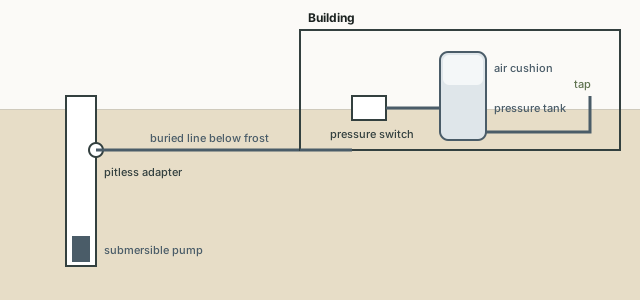
What's causing the short-cycling
Tank drawdown is one possible factor; controls, leakage, available water and the pump arrangement also need assessment. Once the tank's air cushion is gone, it can no longer buffer pressure, so the pump has to run almost continuously in short bursts to keep up with even modest household demand.
A failing pressure switch can be involved, since the switch's job is to tell the pump when to start and stop based on tank pressure. A switch with worn contacts or an inaccurate setpoint can trigger the pump too frequently even with a healthy tank.
The pressure switch starts and stops a conventional pump at its operating settings. Have those switching events compared with the actual gauge response. Goulds’ jet-pump instructions also identify piping restrictions as a source of switch chatter, so a rapid clicking sound alone does not establish worn contacts or a failed tank.
| Observation | Assessment to request |
|---|---|
| Rapid on/off cycling | Tank drawdown, leakage, controls and the actual pump arrangement |
| Humming with poor delivery | Qualified electrical, motor, control and available-water checks |
| Grinding or rattling | Record the location and operating conditions; equipment assessment required |
| Knock when a valve closes | Assess the plumbing transient and controls; sound alone cannot locate the fault |
Standard diagnostic guidance for common well pump and pressure system noises.
What the usual fixes cost, and the cold-weather angle
Price the diagnosed cause, not the noise. A failed bladder, worn switch and leaking pipe are different repairs. Ask for the findings that support the selected work and a proposal separating the vessel, controls, piping and labor.
Compare included access and testing as well as equipment. A recharge also requires service time and confirmation that the tank permits it; it is not automatically free or an adequate repair. Record whether the cycling stops after the repair before treating the complaint as resolved.
In Vermont, look at the space around the tank before the pump. A tank or switch in an unheated bulkhead or garage can see freezing temperatures on the coldest nights, and a frozen line or switch can mimic a failing pump. After an outage, report any slow starting or humming instead of assuming that a breaker reset will establish the cause.
Describe whether the tank, switch and supply line are in a heated room, an exposed bulkhead or an unheated garage. The actual location matters when delivery stops in cold weather.
Goulds’ installation instructions call for a pump-and-tank location protected from freezing. Have a suspected frozen section distinguished from an electrical or pump fault before ordering replacement equipment.
Reading the specific noise
Stop repeated attempts to run a pump that hums without delivering water. Report the sound, control behavior and loss of supply so the provider can assess the electrical and pumping equipment safely. Often a seized impeller, a capacitor issue, or an electrical problem, all of which need a professional's diagnosis since continuing to run a straining motor can burn it out.
Record when the sound starts, whether water is flowing and whether pressure changes with it. Let the provider inspect the equipment before deciding between repair and replacement.
Trace valve-related bangs through the connected system
Grundfos describes sudden valve closure and filling empty pipework as water-hammer risks. The resulting pressure pulse can affect valves, pipes and pumps; it is not confined to one fixture.
Ask the provider to trace the event and explain whether a valve change, pressure-control measure or correctly selected shock absorber suits the actual installation. Record which action produces the bang.
Well pump short-cycling and noise: service details and questions
Short-cycling, a well pump turning on and off rapidly instead of running for a stretch and resting, can be caused by a waterlogged pressure tank that has lost its air cushion, though a failing pressure switch or a system leak can produce the same symptom. Unusual noise is a separate but related clue: a humming sound with no water movement can accompany a motor or electrical issue.
A grinding or rattling noise while running can indicate worn bearings or debris in the pump. Water hammer, a banging sound when a valve closes, can be caused by the sudden stop of moving water; its effects are not limited to plumbing fixtures.
Record rapid cycling and noise as separate observations. A conventional system repeatedly starting with little useful drawdown needs assessment of the tank, controls and delivery path. Humming without water, grinding during operation and a bang after valve closure do not establish the same fault.
Note which control or fixture event accompanies each sound. Record any visible pressure change. The remedy should follow those findings: recharge, a manufacturer-permitted tank repair, switch or piping work and pump replacement have different scopes.
Addressing a recurring abnormal pattern matters, but the observation does not prove the tank is responsible, rank the repair costs or predict how much pump life remains. Ask how the company will verify delivery after the selected work.
Compare the run pattern with the installed control arrangement before treating every frequent start as proof of a tank failure
Well system noises and what they mean
Waterlogged pressure tank or failing switch
Humming, no water movement
Seized motor, capacitor or electrical issue
Grinding or rattling while running
Worn bearings or debris in the pump
Banging or knocking when a valve closes
Water-hammer assessment includes the connected pipes, valves and possible effects on the pump
A waterlogged pressure tank is one possible cause, alongside control faults, leakage and supply problems. Once the tank's air cushion is gone, it can no longer buffer pressure, so the pump has to run almost continuously in short bursts to keep up with even modest household demand
Short cycling is the pump starting and stopping too often. Tank reserve, controls, leakage and water delivery need checking together.
If the tank's air charge is low, the provider must establish whether the separator is intact and which recharge procedure the manufacturer permits. Service time and the diagnosed repair determine the charge; adding air does not repair a ruptured bladder.
A humming noise with no water moving can mean the pump motor is trying to start but can't. A seized impeller, a capacitor issue, or an electrical problem are possibilities requiring professional diagnosis. Continuing to operate faulty equipment is not a way to identify which condition applies.
When humming accompanies no delivery, report which component appears to make the sound and any visible control indication. The supply power, starting equipment and condition of the pump need their appropriate checks before the sound can be interpreted. Do not identify a seized motor or capacitor from the sound alone; ask the service findings to explain the diagnosed fault and proposed remedy.
Grinding, rattling, or a rough running sound while water is flowing can involve wear inside the pump, worn bearings or, in some cases, debris or sediment that has entered the pump. Those possibilities need inspection before determining whether the pump is nearing the end of its service life.
For grinding or rattling during flow, describe whether the sound comes from the wellhead, tank or house piping and whether it changes with demand. Have wear and debris evaluated alongside other causes. The observation can guide an inspection, but it cannot establish a failed bearing or determine remaining service life without examining the equipment.
Water hammer, a sharp banging or knocking sound, often when a faucet or valve closes suddenly, is caused by the abrupt stop of moving water creating a pressure wave in the pipes. A suitable shock absorber or control measure may help; the assessment must include possible effects on the pump instead of treating it as an exclusively fixture-level problem.
A sharp knock associated with sudden valve action may be a pressure-wave event. Grundfos describes effects extending through pipes, valves and pumps, so the assessment should follow the connected arrangement. Ask what the proposed pressure-control or shock-absorbing measure is intended to change and how its location and suitability will be established.
Published well-pump pressure-switch troubleshooting guide
; Pump diagnosis and quantity comparison
Why does my well pump turn on and off so often?
Short cycling can involve lost usable tank reserve, controls or a leak. Goulds’ jet-pump manual also describes switch chatter from restrictions between the pump and tank; the installer needs to identify the arrangement and actual finding
Why does my well pump make a grinding noise?
Grinding while running points to worn bearings or debris inside the pump as possibilities to investigate. The applicable manufacturer's instructions determine which checks suit the actual model. Locate the sound before assigning it to the submerged unit.
Ask whether inspection requires retrieval and how that work affects the repair-versus-replacement comparison. The noise alone cannot establish a low-cost fix or an exhausted pump.
What is water hammer and is it related to my well pump?
Water hammer is a banging noise from a sudden pressure wave when a valve closes quickly. In a confirmed fixture-valve case, it is fixed at the fixture level instead of at the well when the selected arrestor or valve measure addresses that initiating event. This is not a conclusion from sound alone.
Distinguishing this from pump-related noise matters because the repair depends on the initiating event and connected components. A plumber may address that fixture; pump and pressure tank noises need assessment at the source of the system too.
Where assessment identifies a fast-closing fixture valve as the cause, the event may be addressed with water hammer arrestors installed near the affected fixtures. A plumber can diagnose and install the right fix for where the banging occurs. Watts describes its LF05 as single-fixture protection for a dishwasher, washing machine or fast-closing positive-shutoff valve, installed as close to the shock source as possible.
That factory-charged sealed device is not an instruction to add air to unidentified piping. Grundfos's broader guidance still applies when the event involves pump starts, filling empty pipework or other parts of the delivery system.
A failing pressure switch is another possible cause, since the switch's job is to tell the pump when to start and stop based on tank pressure. A switch with worn contacts or an inaccurate setpoint can trigger the pump too frequently even with a healthy tank. Compare the control findings with usable tank reserve instead of assigning an order of likelihood from the cycling symptom alone.
Unusual noise is a separate but related clue: a humming sound with no water movement suggests the pump is trying to run but something is preventing it. A seized motor or an electrical issue are possibilities to investigate, not diagnoses established by the sound. A grinding or rattling noise while running can indicate worn bearings or debris in the pump, which also need examination before selecting a repair.
Because short-cycling accelerates wear on the pump, addressing the underlying cause matters for the equipment. Frequent starting and stopping is harder on a pump than infrequent, longer runs; Amtrol and Xylem describe the benefit of adequate tank drawdown and fewer starts. The pressure tank is one possible cause, not an established diagnosis or automatically the cheaper repair.
The provider must compare the actual operating pattern with the equipment's limits. That finding determines the recommendation; a description of cycling cannot establish an immediately safe condition or predict remaining life.
In Vermont, look at the space around the tank before the pump. A tank or switch in an unheated bulkhead or garage can see freezing temperatures on the coldest nights, and a frozen line or switch mimics a failing pump. For an installation where, after an outage, the pump restarts under load, a slow-starting or humming pump needs its supply and starting equipment checked.
Record any accessible tripped-breaker indication before calling a driller, without opening covers or repeatedly resetting it. An indication does not establish the fault. Goulds requires freeze protection and warns that a tripped thermal protector can restart the motor unexpectedly.
For a confirmed quick-closing fixture-valve problem, distinguishing this from pump-related noise matters because the fix is entirely different. A plumber addresses water hammer at the fixture level when that is the diagnosed initiating event. Pump and pressure tank noises need a well contractor's attention at the source of the system.
Grundfos explains why the investigation still includes the connected pipework: the pressure pulse can affect pipes, valves and pumps. The service boundary follows the measured event, not simply where the bang is loudest.
If the bladder has failed, obtain a tank-replacement scope that includes the vessel, connections, removal and pressure checks. A worn pressure switch needs its own diagnosis and compatible control selection. Ask the proposal to distinguish the replacement vessel, a worn pressure switch and any other included work.
Include the visit and labor in the comparison instead of comparing parts alone. A pump replacement is a different scope; neither a symptom description nor the sound establishes that it is the last resort or most expensive option here.
The cost depends on the cause. Recharging or replacing a pressure tank and work on a failing pressure switch are different jobs.
Either may be less expensive than pump replacement in a particular proposal, but that comparison needs the included scope and actual prices. Establish the fault before ordering the part; an inexpensive description does not identify the needed component or its complete installed price.
Well pump short-cycling and noise: cycling observations and fault isolation
Is short-cycling dangerous for my well pump?
Repeated starting is a fault to investigate, but a description of cycling cannot establish that operation is safe or predict remaining life. Give the provider the run pattern and any heat, loss of delivery or control indications so the operating decision follows the actual equipment and findings.
What does it mean if my well pump hums but no water comes out?
This suggests the motor is trying to start but can't, often due to a seized impeller, a capacitor issue, or an electrical problem. Have a professional check it rather than letting it run.
Can a bad pressure switch cause short-cycling?
Yes. Have the pressure readings and switch operation checked before assuming the tank has failed. Electrical diagnosis belongs to the service provider.
Should I turn off my well pump if it's making strange noises?
For a humming, non-running motor, it's reasonable to shut off power and call a professional instead of let it strain. For milder cycling noise, scheduling service promptly is sufficient.
How much does it cost to fix a short-cycling well pump?
First establish whether the proposal covers air-charge service, a vessel, controls, leakage or the pump itself. Ask for the work and exclusions to be itemized.
Identify each part and task in the estimate. A tank or pump quote cannot price a different switch repair at this property.
Can debris in my well cause pump noise?
Yes. Sediment or debris entering the pump can cause grinding or rough running, and depending on severity may require pump inspection or, in some cases, addressing the well's water quality or screen.
Is it normal for a well pump to make some noise?
A brief run sound during normal cycling is expected. Humming with no water flow, grinding, or frequent rapid cycling are not normal and warrant checking rather than assuming it's just the pump being noisy.
How do I fix water hammer in my house?
Have the valve event and connected pipework assessed. Grundfos identifies shock absorbers and controlled valve or pressure changes among possible approaches, but the remedy depends on the arrangement. Ask which event the proposed device addresses and where it will be installed; a bang does not by itself establish a fixture-only fault.
Can short-cycling shorten my pump's expected lifespan?
Yes. The added wear from frequent starting and stopping can meaningfully shorten a pump's life compared to one that cycles at its designed rate, so addressing the underlying tank or switch issue matters.